


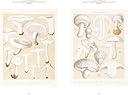


Mushroom Botanical Art (Japanese Edition) Paperback – November 15, 2013
Buy anything from 5,000+ international stores. One checkout price. No surprise fees. Join 2M+ shoppers on Desertcart.
Desertcart purchases this item on your behalf and handles shipping, customs, and support to Vanuatu.
Description
Full description not available
Reviews
S**H
beautiful art
:)
R**K
Just Lovely.....
A gorgeous book full of lovingly-reproduced images of fungi from classic texts.....a great gift for any mycophile !
K**D
Best eye candy book ?
Amazing drawings, this book is a true gem. If you like botanical sketches or organic shapes drawing, need inspiration etc.
B**D
beautifully rendered in black and white
Mushroom Botanical ArtLanguage: JapaneseBotanical art in the pre-photography age expressed the morphology of a plant, or, in the case of fungi, mushrooms. The practice of creating meticulous visual depictions was important: it succeeded in communicating information about a species where non-taxonomic language failed. Think about it. Different communities might have different common names for a mushroom, and that confusion could cause problems. But a picture says a thousand words. Sometimes those pictures, whose fundamental purpose was accuracy, crossed into the realm of the profound, and that is what makes botanical drawing botanical art. This was made so clear to me when I received a copy of Mushroom Botanical Art. The book is a compilation of works collected in the Natural History Museum and Institute, in Chiba, Japan, and the Natural Museum of Nature and Science in Tokyo. The editor Rei Sekita, has published numerous mushroom-oriented volumes and papers for the Japanese market. The supervising editor, Toshimitso Fukiharu is the senior principal researcher at the National History Museum and Institute in Chiba where many of the works in the book are housed. He has published several books on fungi in Japanese. Everything about Mushroom Botanical Art reflects the Japanese aesthetic: fastidious, detailed, and stylized. The soft cover is awash with tiny embossed gold mushrooms, with A. muscaria, beautifully rendered in black and white, in the center. The quality of the images is terrific: The paper is fine and heavy, and, because each image was individually photographed from the original, the detail and especially the color are nuanced. The book is composed of three parts. Part One, European Mushroom Art, is composed of 9 collections. First is a posthumously published collection of drawings by the French mycologist Jean-Jacques Paulet (1750-1826) titled Iconographe Des Champignons De Paulet, (France, 1855). These are beautifully colored, formal drawings that often show multiple species from one genus together. Nova Plantarum Genera by the Italian botanist (and discoverer of spores) Pier Antonio Michelli (1697-1737) was also published posthumously, in 1792. The collection of black and white etchings is wonderfully quirky, depicting mushroom growth and spore dispersal phenomena. Fungorum Agri Arminensis Historia by Giovanni Antonio Battarra in 1755 is also a collection of fine black and white etchings. The drawings in I Meceti Dell’Agro Bresciano Descritti Ed Illustrati Con Figure Tratte Dal Vero by Carlo Antonio Venturi (Italy, 1863) have an almost anime quality to them while still strongly descriptive. Mycologist (and botanist and entomologist and inventor of among other things, the washing machine) Jacob Christian Schaffer’s The Fungi that Grow in Bavaria and the Palatine Around Ratisbon (published during his life in Germany, 1761-1767) is marvelous for its compositions. Jean-Louis Lucand’s Atlas Des Champignons De L’Arrondissement de Montlucon, published in 1869-1871 reveals truly spectacular watercolor craft. Careful drawings from Italian mycologist Carlo Vittadini’s Descrizione Dei Funghi Mangerecci Piu Comuni Dell’Italian E De Velenosi Che Possono Co’ Medesimi Confondersi, published in 1835 are included, as are the drawings of Ernest Roze from his Atlas des Champignon Comestribles Et Veneneux De La France Et Des Pays Circonvoisins, who until recently was immortalized by the genus name, Rozites. While all are lovely, a handful of the drawings in Pierre Bulliard’s Champignon De La France (1780-1809) are especially whimsical and charming. Part two consists of the work of two naturalists, the Frenchman Jean-Henri Fabre (1823-1915) and the Japanese Kumagusu Minakata (1867-1941). The Fabre works are humorous pieces of finely crafted art that endow the mushrooms with a kind kooky personality. And the Minakata works, gleaned from the collection of the Natural Museum of Nature and Science in Tokyo, are quite extraordinary, with beautiful illustrations surrounded by spidery notes in English. They remind me of Mushroom Book composed by John Cage and Lois Long, whose fine drawings of various mushrooms are festooned with Cage’s scribbles. If these images were not enough, the third section is a mini 30-page volume bound into the book. Its size, a mere 3 by 5 inches (compared to the overall volume, which is 5 by 7 inches) is meant to illustrate to the reader the difference in scale used by the Europeans verses the Japanese, as is the different paper stock. This little volume, composed of works by three artists between 1835 and 1850, Honso Zu Fu, Fukusoko, and Baien Zu Fu, is a treasure. The works are beautifully rendered and in some ways very modern. I saw the Ellsworth Kelly plant drawings at the Metropolitan Museum last year and I have to say these end of the Samurai-era mushroom drawings explore similar reductions of form and color to achieve surprisingly sensitive images. I don’t read Japanese. The publishers were kind enough to introduce me to one of their colleagues here in New York who stepped me through the five essays—in Japanese—interspersed throughout the book. These essays delve into the history of botanical drawing, mushrooms in literature, in art, and in history, as well as an essay on Kumagusu Mikakata. Mushroom botanical art constitutes a significant subcategory in the fetishistic world of mycophilia. I’ve got quite a few that I pour over when my inspiration lags. This is one such book. Full disclosure: PIE International is publishing my book Mycophilia in Japanese eventually. That’s how I knew about this book. And I am very glad I do.-Eugenia Bone(This review originally published in FUNGI, 2013, vol 6 no.5.)
ケ**ン
ハードカバーだったら、さらにうれしい
とっても素敵な本です!神秘的なキノコの美しいボタニカルアートが満載で、見ているだけでわくわくします。アート的な作品だけでなく、ファーブルや博物学的な図譜も載っているので、かなり分厚い本になっています。網羅されている本もいいのですが、個人的にはアート性の高い作品だけを絞って、ページ数を減らし、ハードカバーの方がよかったかな、と思います。ステキな本なので、プレゼントしたいのですが、ちょっと本格的すぎるので、人に贈りづらいです。
き**こ
お洒落
漠然ときのこが好きって人でも、見入ってしまう、素敵なきのこが沢山。心踊ります☻
M**S
nice art
Beautiful art but not in English still worth buying.
L**A
Five Stars
This book is beautiful
Common Questions
Trustpilot