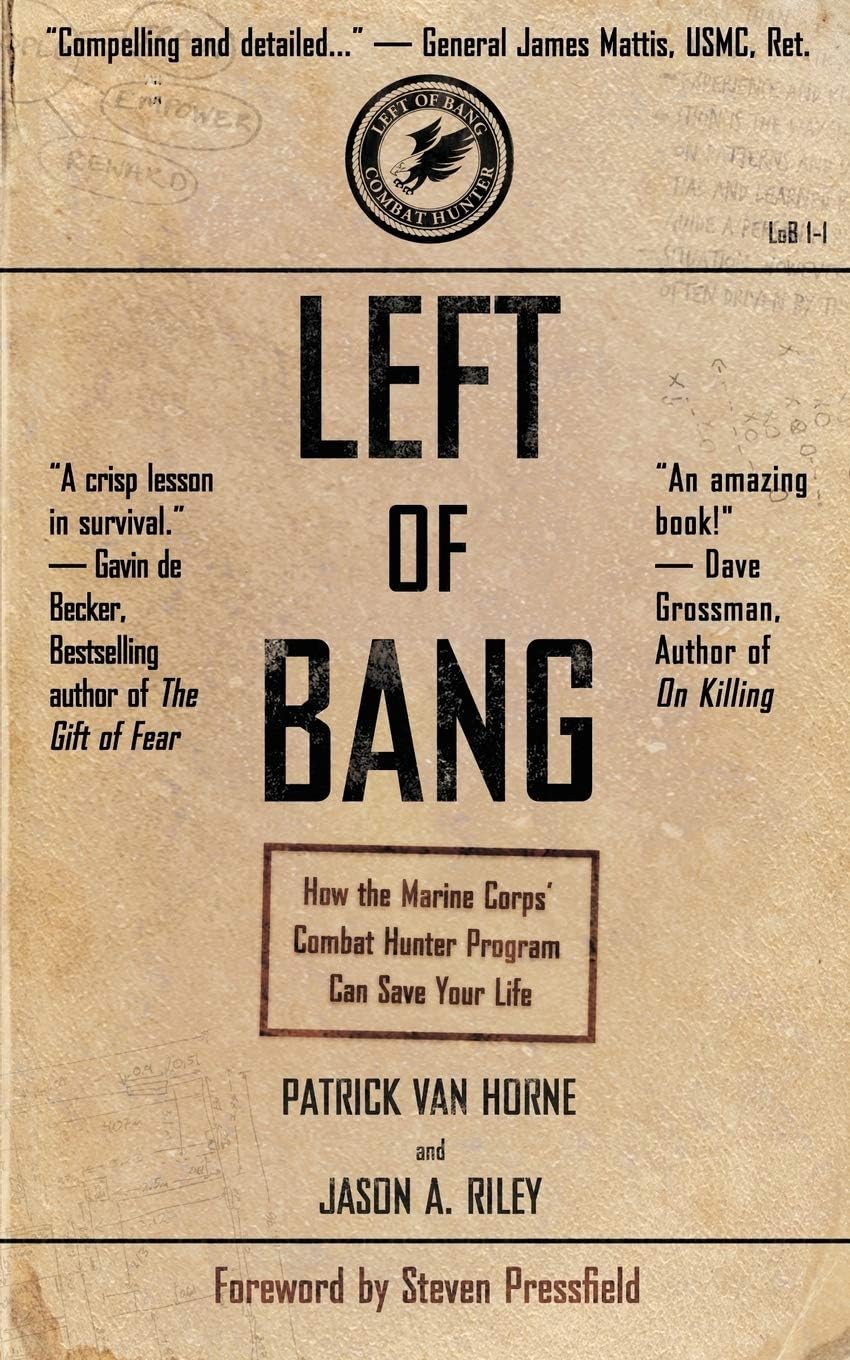
Left of Bang: How the Marine Corps' Combat Hunter Program Can Save Your Life
Product ID: 7146526
Desertcart purchases this item on your behalf and handles shipping, customs, and support to Vanuatu.
"At a time when we must adapt to the changing character of conflict, this is a serious book on a serious issue that can give us the edge we need.” —General James Mattis, USMC, Ret. " Left of Bang offers a crisp lesson in survival in which Van Horne and Riley affirm a compelling truth: It's better to detect sinister intentions early than respond to violent actions late. Left of Bang helps readers avoid the bang." —Gavin de Becker, bestselling author of The Gift of Fear "Rare is the book that is immediately practical and interesting. Left of Bang accomplishes this from start to finish. There is something here for everyone in the people business and we are all in the people business." —Joe Navarro, bestselling author of What Every BODY is Saying. " Left of Bang is a highly important and innovative book that offers a substantial contribution to answering the challenge of Fourth Generation war (4GW)." —William S. Lind, author of Maneuver Warfare Handbook "Like Sun Tzu's The Art of War , Left of Bang isn't just for the military. It's a must read for anyone who has ever had a gut feeling that something's not quite right...be it walking down the street, sitting in a corporate boardroom, or even entering an empty home." -- Steven Pressfield, bestselling author of The Lion's Gate , The Warrior Ethos and Gates of Fire “An amazing book! Applying the lessons learned during the longest war in American history, and building on seminal works like The Gift of Fear and On Combat , this book provides a framework of knowledge that will bring military, law enforcement, and individual citizens to new levels of survival mindset and performance in life-and-death situations. Left of Bang is an instant classic.” --Lt. Colonel Dave Grossman, U.S. Army Ret., author of On Combat and On Killing -- You walk into a restaurant and get an immediate sense that you should leave. -- You are about to step onto an elevator with a stranger and something stops you. -- You interview a potential new employee who has the resume to do the job, but something tells you not to offer a position. These scenarios all represent LEFT OF BANG , the moments before something bad happens. But how many times have you talked yourself out of leaving the restaurant, getting off the elevator, or getting over your silly “gut” feeling about someone? Is there a way to not just listen to your inner protector more, but to actually increase your sensitivity to threats before they happen? Legendary Marine General James Mattis asked the same question and issued a directive to operationalize the Marine Corps’ Combat Hunter program. A comprehensive and no-nonsense approach to heightening each and every one of our gifts of fear, LEFT OF BANG is the result. Review: Life is to the left of bang. Death is to the right. The more good people are to the left, the better this crazy world will be. - I have been more alert to my surroundings than most folks, I think, since that weekend in North Carolina when a wife-beating fellow Marine got it in his head that I’d run off with his wife. No blood was spilled, but it made a lasting impression on me. Cooper’s color codes of awareness have given the average person a model, or paradigm, of how to quantify our alertness (though we have probably misused the code to a great extent.) However, when I was asked, “What are you alert to? Or what are you aware of?” I just sort of blinked and stared like a cow at a new gate. It occurred to me that this is not a small matter. It’s one thing to look around, but quite another to really see things around you. “Left of Bang” originated in the Combat Hunter doctrine used by the US Marines since about 2006, after General Mattis requested, “…a program to instill a hunter-like mindset in Marines, train Marines for increased situational awareness, proactively seek threats, and have a bias for action. Mattis wanted Marines to be the predators, not the prey.” The title comes from a traditional time line, in which time zero - the beginning of the frame – is on the left. A critical event – BANG! – is in the middle, and everything that happens after bang is to the right. Much of the training and doctrine delivered to American forces started at bang, but the problem with that is it means starting with dead or injured Americans. Mattis wanted to take control of any situation by getting into the game to the “left of bang” - To be the predator who says when “bang” happens, not the prey who says, “What the hell just happened?” The authors present the subject in a very straightforward way, with mostly simple, declarative sentences. They have avoided the jargon- and acronym-swamped idiom that makes much of modern military writing virtually indecipherable to anyone on the outside. They start with a certain number of points, then break those down into subpoints. Then they reach back and grab a few more points and break them down, and then – and this is the good part – they tie all those points together. Then they start again with new points, but they always tie the new stuff to the old. Everything in “Left of Bang” is tied to everything else. Part A not only stands on its own, it supports and amplifies Part B, which also supports and amplifies Part A. On and on it goes, and what would otherwise be a staggering mash of details and abstracts becomes an amazingly unified and coherent whole. It’s good, straightforward English– not flowery or overblown, but rather like a bayonet thrust in prime – to the point. “Left of Bang” makes some points that will be considered heresy, if not downright apostasy by some. One of the first of these, and one that comes up time and again, is that there will not always be a perfect solution, no matter how much time we take to analyze and cogitate. Time, in fact, is the one thing Marines and cops on the beat are guaranteed to not have enough of. Ever. This makes doing all we can do to the left of bang not only important, but as precious as life, itself. There are solutions that are good, and hopefully good enough. Perfect is a luxury at best, and probably a myth. Another sacred cow that is sure to send some folks into apoplexy is profiling. The Combat Hunter is the Combat profiler, using knowledge of human nature, as well as the idiosyncrasies of culture, to spot anomalies in a population. “Anomalies” is a fancy word for “People who may want to kill you.” Whether you’re in a market in The ‘Stan or an alley in Chicago, you don’t have time to get to know that guy over there. You don’t have time to meet his family or his kids, or read his master’s thesis. In fact, if you aren’t right on the ball, you may not even have time to get your sights on him and drop him before he does it to you. “Profiling” is not a dirty word. We do it all the time – even those who weep and howl most about it. (If you would like to test this, find a bunch of liberal academics and walk in front of them wearing a Trump hat. See how long it takes the hypocrites to profile you.) Van Horne and Riley start with six “domains:” kinesics, biometric cues, proxemics, geographics, iconography, and atmospherics. They explain how these six categories, or domains, each contain many parameters that will give the combat profiler an amazingly accurate picture of who’s who in a crowd or a social group, such as a village or neighborhood. Within kinesics, for example, there are “clusters” that tell whether a person is dominant or submissive, comfortable or uncomfortable, interested or uninterested, ready to freeze, flee, or fight, or is displaying threat indicators. Van Horne and Riley discuss at some length the differences between Marines, cops, and security guards or other civilians. For example, a Marine has three levels of response: contact and question the person, capture the person, or kill (or prepare to kill) the person. A mall cop or someone keeping an eye on the parking lot at church won’t have these same decisions. They will have some variation of “Run, hide, fight,” which is absolutely valid for those circumstances. I don’t want to go into any depth, at all, because there are a few people who will think, “I’ve read the review, so I don’t need to read the book.” That would be a grievous mistake. The authors point out in the last chapter that it takes an average of 10 years of concentrated effort to become a really top-notch combat profiler. They give some suggestions on how to accelerate that curve a bit, but there’s no substitute for time and experience. Rather than try to list all the chapter headings and subheadings, which wouldn’t make any sense, anyway, I will simply relate an experience that I had a few days ago, when I was about half-way through the book. I was putting gas in my truck at a convenience store, and as is my custom, was watching the people at the pumps and around the store. Two people caught my eye: a male vagrant/panhandler, and a female who I took to be a panhandler. They were standing around the door of the store, and because I had just read the chapter on biometric cues, I spotted a couple of anomalies immediately – before I even realized it, actually. The man was pretty ratty-looking, but he was focused on his panhandling. He’d talk to people going in or coming out, but after a person rebuffed him or gave him something, he immediately shifted to someone else. A man gave him a candy bar or something, and he hustled over to his bags, sat down in the shade, and started eating. The woman, on the other hand, was pretty tough-looking, but not as scrawny and ratty as the man. In fact, she wasn’t missing many meals. She was putting on a clinic in combat profiling. I could never have asked for a better example. She wasn’t talking to people, so she wasn’t panhandling. She would stare at people as they parked and entered the store, but ignored them when they came out. She actually moved away from contact a few times, which is covered in the section on proxemics. She was fidgeting and fussing with her face – more biometrics – but not in the obsessive, frantic way of a crack addict. She had a little pamphlet or paper of some kind which she made a half-hearted effort to pretend to read, but when a new person arrived at the store, she forgot about the paper altogether. Her upper body was tense, she kept her feet about shoulder width apart, and rather than turning just her head or torso to look in a different direction, she’d turn her feet, so they were always pointed where she was looking – more biometrics; she was tense and ready to flee or to fight. She was very alert in 360 degrees, a giveaway that she was either a “good guy” or a “bad guy,” but either way, she warranted watching. All of this was described in the book, right down to the smallest detail. Any one thing would have scarcely been noteworthy, but taken altogether, that gal was like a neon sign saying, “WATCH ME!” If I were a cop – or a Marine in Kandahar – I’d have far more than the three indicators necessary to trigger a response. I’d either be moving to contact and question her, or cuing my mates to cut off her retreat so we could capture her. About that time a woman pulled up in an SUV and parked in front of the store. The “Demonstrator” – no other word for her – stared at her as she had everyone else. Then I noticed the woman had left her windows down. She hadn’t been in the store five seconds when the “target” quickly, but almost calmly reached in and snagged her purse. I whistled loudly and she just about jumped out of her socks! Considering how alert she’d been, I don’t know how she’d managed to miss seeing me watching her. Maybe it’s because I was in the shadows by the pumps and was leaning on the bed of my truck so only my head would have been visible. I thought she was going to bolt, but when I motioned her to put the purse back, she did, and then left at a brisk walk. (If I’d read the section on “Natural Lines of Drift,” and “Anchor Points,” I would have known to watch her all the way to her base of operation.) I was amazed at how those two people illustrated so perfectly so many points from the book. If I hadn’t been a convert to the Combat Hunter before, this incident would have made me one. Before reading it, I would have noticed the man and the woman, but beyond that, I’d have had no idea what I was looking at. I’d have been hopelessly right of bang, and that’s bad place to be. I’ve read a lot of “new age,” “miracle” BS in my career in corporate America, and am quite cynical about new answers to questions no one has asked. “Left of Bang” is no such thing. It’s the real deal - The genuine article - Mental live ammunition. The experienced combat profiler will have noticed that as I watched the “Demonstrator,” I, myself, did something right out of the book; I got so focused on my target that I lost track of the 15 or 20 other people at the station, even though some of them were within a few yards of me! When I read that part a few hours after getting home, all I could do was sit there and think, “Yup. Yer still a dope.” As if my actual experience weren’t enough, the book and the doctrine on which it is based was approved and recommended by a friend who is a retired Marine Warrant Officer. He was a Battalion Gunner with the 7th Marines when the Combat Hunter program was inaugurated, and his opinion bears enormous weight. For anyone who lives on Terra in the 21st Century, and lives in proximity to other people, I cannot recommend “Left of Bang” highly enough. Life is on the left side of bang. Death is to the right. The more good people are to the left, the better this crazy world will be. Semper Fidelis. Review: Though written for Marines, this is one of the most valuable tools a concealed carrier can possess - Most self-defense training focuses entirely on what happens during a fight. We spend hours at the range practicing draw strokes, managing recoil, and clearing malfunctions. But if you are forced to draw your firearm, it means you are already in a reactionary gap. You are playing catch-up against an adversary who chose the time, place, and method of attack. In their book Left of Bang: How the Marine Corps’ Combat Hunter Program Can Save Your Life, authors Patrick Van Horne and Jason A. Riley argue that the best way to win a fight is to recognize it's happening before the first punch is thrown or shot is fired. Though written for Marines, this tactical framework is one of the most valuable tools a concealed carrier can possess. Here is how to apply the principles of Left of Bang to your daily civilian carry routine. 1. The Timeline: Understanding "Left of Bang" To understand the book's core premise, picture a timeline running from left to right. In the middle of that timeline is "The Bang." The Bang is the negative event: the ambush, the carjacking, the armed robbery. Right of Bang is everything that happens after. It is reactive, chaotic, and dangerous. If you are drawing your gun Right of Bang, you are already in deep trouble. Left of Bang is the window of time before the event occurs. This is where the indicators are present. Your goal as a concealed carrier is to live entirely "Left of Bang," giving yourself the time and space to make a proactive decision—usually, to leave. The takeaway: The "Bang" is your absolute deadline. If you aren't actively searching for pre-assault indicators before it happens, you've already yielded the tactical advantage. 2. The Operational Framework: The Combat Hunter Pillars The Combat Hunter program relies on breaking human behavior and environments down into structured data points. Instead of relying on a vague "gut feeling," the book teaches you to look for specific cues across several pillars: Establish a Baseline You cannot identify an anomaly if you don't know what "normal" looks like. Every environment has a baseline. The baseline of a quiet suburban coffee shop is vastly different from a chaotic downtown subway station. Before you can spot a threat, you have to look around and define the collective agreement of how people behave in that specific space. Kinesics (Human Movement) People who are hiding weapons, planning an attack, or experiencing intense adrenaline "leak" their intentions through body language. Watch for shifting weight, hyper-vigilance (scanning for cameras or police), hands hovering near the waistline, or "unconscious grooming" (touching or adjusting a concealed weapon). Proxemics (Spatial Awareness) Distance equals reaction time. Predators rely on closing the distance between themselves and their prey before launching an attack. Pay attention to how people occupy space. Is someone moving toward you at an angle that cuts off your exit? Are they ignoring social boundaries to get closer to you? Geographics (Environmental Cues) Predators leverage the physical environment to their advantage. They look for "anchor points" (places to blend in while observing targets) and transitional spaces (dark alleys, parking garages, stairwells) where you are vulnerable. Conversely, you should constantly map the geography for cover, concealment, and escape routes. Iconography (Clothing and Symbols) People broadcast who they are through what they wear, their tattoos, and their gear. While a specific style of clothing isn't definitive proof of a threat, it provides valuable data. For example, someone wearing a heavy coat on a hot summer day isn't just a fashion anomaly—they are likely concealing something bulky. 3. The OODA Loop on Steroids You might already be familiar with Colonel John Boyd’s OODA Loop (Observe, Orient, Decide, Act). It’s the mental cycle we go through during a tactical situation. When you master the pillars of Left of Bang, you drastically accelerate this process. Because you are actively reading the baseline and scanning for kinesic or geographic anomalies, you Orient to a threat seconds before anyone else. This compresses your decision-making time, allowing you to Act (evacuate, seek cover, or prepare to defend yourself) while the threat is still trying to figure out how to approach you. Put it Into Practice: 3 Daily Drills Reading theory is fine, but situational awareness is a perishable muscle. Use these three low-signature drills to build your "Combat Hunter" mindset without looking paranoid to the outside world. Exercise 1: The 30-Second Baseline Whenever you step into a new environment—a gym, a restaurant, a gas station—pause for 30 seconds. Look at the people and the atmosphere. What is the collective mood? Who belongs here, and what are they doing? Define the "norm" immediately. Exercise 2: Hunt for the Anomaly Once you have the baseline, actively look for the one thing or person that doesn't fit. It doesn’t have to be a threat. It could be someone wearing business casual in a beachside diner, or someone who is visibly angrier than the environment dictates. Identify them and ask yourself why they stand out. This trains your brain to separate signal from noise. Exercise 3: Mindful Pathfinding When walking through crowds or busy areas, practice maintaining your "proxemic buffer." If you spot someone whose body language or positioning makes you uneasy, subtly alter your path. Can you maintain a 10-foot boundary? Do you know where the nearest exit or solid cover is at this exact second? Final Thoughts A firearm is a tool of last resort. It is what you use when all your other systems have failed. By shifting your mindset from surviving the bang to preventing the bang, you elevate yourself from a standard gun-owner to a truly prepared citizen. Pick up a copy of Left of Bang—it might just be the most important piece of self-defense gear you ever invest in.
| Best Sellers Rank | #12,902 in Books ( See Top 100 in Books ) #5 in Safety & First Aid (Books) #15 in Military Strategy History (Books) #511 in Personal Transformation Self-Help |
| Customer Reviews | 4.6 out of 5 stars 4,106 Reviews |
W**S
Life is to the left of bang. Death is to the right. The more good people are to the left, the better this crazy world will be.
I have been more alert to my surroundings than most folks, I think, since that weekend in North Carolina when a wife-beating fellow Marine got it in his head that I’d run off with his wife. No blood was spilled, but it made a lasting impression on me. Cooper’s color codes of awareness have given the average person a model, or paradigm, of how to quantify our alertness (though we have probably misused the code to a great extent.) However, when I was asked, “What are you alert to? Or what are you aware of?” I just sort of blinked and stared like a cow at a new gate. It occurred to me that this is not a small matter. It’s one thing to look around, but quite another to really see things around you. “Left of Bang” originated in the Combat Hunter doctrine used by the US Marines since about 2006, after General Mattis requested, “…a program to instill a hunter-like mindset in Marines, train Marines for increased situational awareness, proactively seek threats, and have a bias for action. Mattis wanted Marines to be the predators, not the prey.” The title comes from a traditional time line, in which time zero - the beginning of the frame – is on the left. A critical event – BANG! – is in the middle, and everything that happens after bang is to the right. Much of the training and doctrine delivered to American forces started at bang, but the problem with that is it means starting with dead or injured Americans. Mattis wanted to take control of any situation by getting into the game to the “left of bang” - To be the predator who says when “bang” happens, not the prey who says, “What the hell just happened?” The authors present the subject in a very straightforward way, with mostly simple, declarative sentences. They have avoided the jargon- and acronym-swamped idiom that makes much of modern military writing virtually indecipherable to anyone on the outside. They start with a certain number of points, then break those down into subpoints. Then they reach back and grab a few more points and break them down, and then – and this is the good part – they tie all those points together. Then they start again with new points, but they always tie the new stuff to the old. Everything in “Left of Bang” is tied to everything else. Part A not only stands on its own, it supports and amplifies Part B, which also supports and amplifies Part A. On and on it goes, and what would otherwise be a staggering mash of details and abstracts becomes an amazingly unified and coherent whole. It’s good, straightforward English– not flowery or overblown, but rather like a bayonet thrust in prime – to the point. “Left of Bang” makes some points that will be considered heresy, if not downright apostasy by some. One of the first of these, and one that comes up time and again, is that there will not always be a perfect solution, no matter how much time we take to analyze and cogitate. Time, in fact, is the one thing Marines and cops on the beat are guaranteed to not have enough of. Ever. This makes doing all we can do to the left of bang not only important, but as precious as life, itself. There are solutions that are good, and hopefully good enough. Perfect is a luxury at best, and probably a myth. Another sacred cow that is sure to send some folks into apoplexy is profiling. The Combat Hunter is the Combat profiler, using knowledge of human nature, as well as the idiosyncrasies of culture, to spot anomalies in a population. “Anomalies” is a fancy word for “People who may want to kill you.” Whether you’re in a market in The ‘Stan or an alley in Chicago, you don’t have time to get to know that guy over there. You don’t have time to meet his family or his kids, or read his master’s thesis. In fact, if you aren’t right on the ball, you may not even have time to get your sights on him and drop him before he does it to you. “Profiling” is not a dirty word. We do it all the time – even those who weep and howl most about it. (If you would like to test this, find a bunch of liberal academics and walk in front of them wearing a Trump hat. See how long it takes the hypocrites to profile you.) Van Horne and Riley start with six “domains:” kinesics, biometric cues, proxemics, geographics, iconography, and atmospherics. They explain how these six categories, or domains, each contain many parameters that will give the combat profiler an amazingly accurate picture of who’s who in a crowd or a social group, such as a village or neighborhood. Within kinesics, for example, there are “clusters” that tell whether a person is dominant or submissive, comfortable or uncomfortable, interested or uninterested, ready to freeze, flee, or fight, or is displaying threat indicators. Van Horne and Riley discuss at some length the differences between Marines, cops, and security guards or other civilians. For example, a Marine has three levels of response: contact and question the person, capture the person, or kill (or prepare to kill) the person. A mall cop or someone keeping an eye on the parking lot at church won’t have these same decisions. They will have some variation of “Run, hide, fight,” which is absolutely valid for those circumstances. I don’t want to go into any depth, at all, because there are a few people who will think, “I’ve read the review, so I don’t need to read the book.” That would be a grievous mistake. The authors point out in the last chapter that it takes an average of 10 years of concentrated effort to become a really top-notch combat profiler. They give some suggestions on how to accelerate that curve a bit, but there’s no substitute for time and experience. Rather than try to list all the chapter headings and subheadings, which wouldn’t make any sense, anyway, I will simply relate an experience that I had a few days ago, when I was about half-way through the book. I was putting gas in my truck at a convenience store, and as is my custom, was watching the people at the pumps and around the store. Two people caught my eye: a male vagrant/panhandler, and a female who I took to be a panhandler. They were standing around the door of the store, and because I had just read the chapter on biometric cues, I spotted a couple of anomalies immediately – before I even realized it, actually. The man was pretty ratty-looking, but he was focused on his panhandling. He’d talk to people going in or coming out, but after a person rebuffed him or gave him something, he immediately shifted to someone else. A man gave him a candy bar or something, and he hustled over to his bags, sat down in the shade, and started eating. The woman, on the other hand, was pretty tough-looking, but not as scrawny and ratty as the man. In fact, she wasn’t missing many meals. She was putting on a clinic in combat profiling. I could never have asked for a better example. She wasn’t talking to people, so she wasn’t panhandling. She would stare at people as they parked and entered the store, but ignored them when they came out. She actually moved away from contact a few times, which is covered in the section on proxemics. She was fidgeting and fussing with her face – more biometrics – but not in the obsessive, frantic way of a crack addict. She had a little pamphlet or paper of some kind which she made a half-hearted effort to pretend to read, but when a new person arrived at the store, she forgot about the paper altogether. Her upper body was tense, she kept her feet about shoulder width apart, and rather than turning just her head or torso to look in a different direction, she’d turn her feet, so they were always pointed where she was looking – more biometrics; she was tense and ready to flee or to fight. She was very alert in 360 degrees, a giveaway that she was either a “good guy” or a “bad guy,” but either way, she warranted watching. All of this was described in the book, right down to the smallest detail. Any one thing would have scarcely been noteworthy, but taken altogether, that gal was like a neon sign saying, “WATCH ME!” If I were a cop – or a Marine in Kandahar – I’d have far more than the three indicators necessary to trigger a response. I’d either be moving to contact and question her, or cuing my mates to cut off her retreat so we could capture her. About that time a woman pulled up in an SUV and parked in front of the store. The “Demonstrator” – no other word for her – stared at her as she had everyone else. Then I noticed the woman had left her windows down. She hadn’t been in the store five seconds when the “target” quickly, but almost calmly reached in and snagged her purse. I whistled loudly and she just about jumped out of her socks! Considering how alert she’d been, I don’t know how she’d managed to miss seeing me watching her. Maybe it’s because I was in the shadows by the pumps and was leaning on the bed of my truck so only my head would have been visible. I thought she was going to bolt, but when I motioned her to put the purse back, she did, and then left at a brisk walk. (If I’d read the section on “Natural Lines of Drift,” and “Anchor Points,” I would have known to watch her all the way to her base of operation.) I was amazed at how those two people illustrated so perfectly so many points from the book. If I hadn’t been a convert to the Combat Hunter before, this incident would have made me one. Before reading it, I would have noticed the man and the woman, but beyond that, I’d have had no idea what I was looking at. I’d have been hopelessly right of bang, and that’s bad place to be. I’ve read a lot of “new age,” “miracle” BS in my career in corporate America, and am quite cynical about new answers to questions no one has asked. “Left of Bang” is no such thing. It’s the real deal - The genuine article - Mental live ammunition. The experienced combat profiler will have noticed that as I watched the “Demonstrator,” I, myself, did something right out of the book; I got so focused on my target that I lost track of the 15 or 20 other people at the station, even though some of them were within a few yards of me! When I read that part a few hours after getting home, all I could do was sit there and think, “Yup. Yer still a dope.” As if my actual experience weren’t enough, the book and the doctrine on which it is based was approved and recommended by a friend who is a retired Marine Warrant Officer. He was a Battalion Gunner with the 7th Marines when the Combat Hunter program was inaugurated, and his opinion bears enormous weight. For anyone who lives on Terra in the 21st Century, and lives in proximity to other people, I cannot recommend “Left of Bang” highly enough. Life is on the left side of bang. Death is to the right. The more good people are to the left, the better this crazy world will be. Semper Fidelis.
R**T
Though written for Marines, this is one of the most valuable tools a concealed carrier can possess
Most self-defense training focuses entirely on what happens during a fight. We spend hours at the range practicing draw strokes, managing recoil, and clearing malfunctions. But if you are forced to draw your firearm, it means you are already in a reactionary gap. You are playing catch-up against an adversary who chose the time, place, and method of attack. In their book Left of Bang: How the Marine Corps’ Combat Hunter Program Can Save Your Life, authors Patrick Van Horne and Jason A. Riley argue that the best way to win a fight is to recognize it's happening before the first punch is thrown or shot is fired. Though written for Marines, this tactical framework is one of the most valuable tools a concealed carrier can possess. Here is how to apply the principles of Left of Bang to your daily civilian carry routine. 1. The Timeline: Understanding "Left of Bang" To understand the book's core premise, picture a timeline running from left to right. In the middle of that timeline is "The Bang." The Bang is the negative event: the ambush, the carjacking, the armed robbery. Right of Bang is everything that happens after. It is reactive, chaotic, and dangerous. If you are drawing your gun Right of Bang, you are already in deep trouble. Left of Bang is the window of time before the event occurs. This is where the indicators are present. Your goal as a concealed carrier is to live entirely "Left of Bang," giving yourself the time and space to make a proactive decision—usually, to leave. The takeaway: The "Bang" is your absolute deadline. If you aren't actively searching for pre-assault indicators before it happens, you've already yielded the tactical advantage. 2. The Operational Framework: The Combat Hunter Pillars The Combat Hunter program relies on breaking human behavior and environments down into structured data points. Instead of relying on a vague "gut feeling," the book teaches you to look for specific cues across several pillars: Establish a Baseline You cannot identify an anomaly if you don't know what "normal" looks like. Every environment has a baseline. The baseline of a quiet suburban coffee shop is vastly different from a chaotic downtown subway station. Before you can spot a threat, you have to look around and define the collective agreement of how people behave in that specific space. Kinesics (Human Movement) People who are hiding weapons, planning an attack, or experiencing intense adrenaline "leak" their intentions through body language. Watch for shifting weight, hyper-vigilance (scanning for cameras or police), hands hovering near the waistline, or "unconscious grooming" (touching or adjusting a concealed weapon). Proxemics (Spatial Awareness) Distance equals reaction time. Predators rely on closing the distance between themselves and their prey before launching an attack. Pay attention to how people occupy space. Is someone moving toward you at an angle that cuts off your exit? Are they ignoring social boundaries to get closer to you? Geographics (Environmental Cues) Predators leverage the physical environment to their advantage. They look for "anchor points" (places to blend in while observing targets) and transitional spaces (dark alleys, parking garages, stairwells) where you are vulnerable. Conversely, you should constantly map the geography for cover, concealment, and escape routes. Iconography (Clothing and Symbols) People broadcast who they are through what they wear, their tattoos, and their gear. While a specific style of clothing isn't definitive proof of a threat, it provides valuable data. For example, someone wearing a heavy coat on a hot summer day isn't just a fashion anomaly—they are likely concealing something bulky. 3. The OODA Loop on Steroids You might already be familiar with Colonel John Boyd’s OODA Loop (Observe, Orient, Decide, Act). It’s the mental cycle we go through during a tactical situation. When you master the pillars of Left of Bang, you drastically accelerate this process. Because you are actively reading the baseline and scanning for kinesic or geographic anomalies, you Orient to a threat seconds before anyone else. This compresses your decision-making time, allowing you to Act (evacuate, seek cover, or prepare to defend yourself) while the threat is still trying to figure out how to approach you. Put it Into Practice: 3 Daily Drills Reading theory is fine, but situational awareness is a perishable muscle. Use these three low-signature drills to build your "Combat Hunter" mindset without looking paranoid to the outside world. Exercise 1: The 30-Second Baseline Whenever you step into a new environment—a gym, a restaurant, a gas station—pause for 30 seconds. Look at the people and the atmosphere. What is the collective mood? Who belongs here, and what are they doing? Define the "norm" immediately. Exercise 2: Hunt for the Anomaly Once you have the baseline, actively look for the one thing or person that doesn't fit. It doesn’t have to be a threat. It could be someone wearing business casual in a beachside diner, or someone who is visibly angrier than the environment dictates. Identify them and ask yourself why they stand out. This trains your brain to separate signal from noise. Exercise 3: Mindful Pathfinding When walking through crowds or busy areas, practice maintaining your "proxemic buffer." If you spot someone whose body language or positioning makes you uneasy, subtly alter your path. Can you maintain a 10-foot boundary? Do you know where the nearest exit or solid cover is at this exact second? Final Thoughts A firearm is a tool of last resort. It is what you use when all your other systems have failed. By shifting your mindset from surviving the bang to preventing the bang, you elevate yourself from a standard gun-owner to a truly prepared citizen. Pick up a copy of Left of Bang—it might just be the most important piece of self-defense gear you ever invest in.
B**S
This is a great book for your mind.
This book is nothing what I expected. Most books like this all focus on the best survival tactics, the best fighting techniques, or what to do in "this or that" situation. This book goes completely the opposite way; it is all about "reading people" and your surroundings. Boarding on "psychology", it walks you through what to look at, how to look at it and what to do with these observations. I have had to read many of the pages a second or third time just to make sure I understood what I needed to do. This book will not only help you better out in the world but be better with in your own world. I can start to see changes with how I now deal with family, friends and people I do business with. I am not saying you will have the same results, but for $12 its worth a try.
J**C
Teaches the language needed to understand how people operate
Left of Bang: How the Marine Corps’ Combat Hunter Program Can Save Your Life. I recently finished reading Left of Bang by Patrick Van Horne and Jason Riley. The title of the book comes from the viewing of a timeline of events, where things happen on the left and progress to the right as time goes on. The bang referred to in the title represents some significant, negative event. It could be an IED, a suicide bomber, an insurgent shooter, or in the civilian world it could represent a mass killer, a criminal actor, or other similarly evil human act. The goal of the book is to get you “left of bang”, or reacting BEFORE the event happens rather than after. After the event, or right of bang you are merely responding to whatever happened and trying to mitigate damage. Left of bang allows you to be proactive, to prevent the event or take appropriate precautions. At its heart Left of Bang is a book about reading several different key indicators of human behavior in order to identify when something is out of place or context and to simplify the decision-making process for responding to the perceived threat. It’s a little bit of body language, situational awareness, and terrain analysis. For anyone that has done security, police, or needed to be streetwise to survive you will already understand a lot of the material in this book at a gut level. What Left of Bang does, is give us the language to talk about the things we already know through experience. Since we think in language, having the words to describe what we are seeing and feeling means we can think about it much more thoroughly. It means we can talk about it to others, and explain what we are seeing and teach them how to see it also. It lets us download the experience of others, jump starting and supercharging the learning process. As the training director for a security company many of these techniques were things I was already teaching to my new guards, but now I have a better language to express what they should be looking for. As a firearms instructor I can better teach students how to articulate that a person was acting in a threatening or aggressive manner. They might have known it, but they didn’t know how to tell anyone else how they knew. Left of Bang helps to give us that frame work to discuss when someone is uncomfortable, acting aggressively, or trying to dominate others. It helps us understand why certain areas of town, or even in public places we go might be off limits or unsafe to enter. I am going to revamp some of my training material to include the language and cues discussed in this book, and Left of Bang will be going on the company “Recommended Reading” list.
F**D
Left of Bang is a fantastic book. A book every cop and security officer ...
Left of Bang is a fantastic book. A book every cop and security officer should read. Anyone concerned for their safety looking to avoid dangerous situations through recognizing the signs and signals of crime and danger should read this book. Left of Bang is a metaphor for preventing the attack, the first shot, the explosion etc. The authors advise “to think about an attack on a timeline, bang is in the middle. Bang is the act. Bang is the IED explosion, the sniper taking a shot, or the beginning of an ambush. Bang is what we want to prevent. Being left of bang means that a person has observed one of the pre-event indicators, one of the warning signs that must occur, earlier on the timeline for the bang to happen. Being on the other end of the timeline is referred to as being right of bang. Most of the training that military operators and law enforcement personnel receive is reactive. They learn skills and techniques that rely on someone else taking the initiative, which means waiting for the enemy or criminal to act first. Unfortunately, whoever strikes first possesses a powerful tactical advantage. When a person is right of bang, they are reacting to the action that took place.” These lessons from Left of Bang will teach you how to read your environment and respond to it faster than those around you. By learning how to read baseline body language, and immediately detect anomalies, you can begin to know what people are going to do before they do it. More importantly, with these skills you can recognize the signs and signals when someone is trying to lure you into a bad situation. Through pattern recognition in baseline activity that help us to form a faster understanding of both an individual's and a group's intentions before they act. Left of Bang is book that develops your ability to read human behavior through what the authors label the Six Domains. These domains range from autonomic to deliberate and personal to social. They are: • Kinesics: Conscious and subconscious body language. • Biometric Cues: Biological autonomic responses. • Proxemics: Interpersonal spatial interaction. • Geographics: Patterns of behavior within and environment. • Iconography: Expression through symbols. • Atmospherics: Collective attitudes that create distinct moods within an environment. Getting Left of Bang is based on understanding these domains intuitively. Intuition is a powerful force; however, it is poorly understood. Intuition is not black magic or some inexplicable force of nature. Intuition is nothing more than a person’s sense about a situation influenced by experience and knowledge. Intuition is the way the mind picks up on patterns and uses experiential and learned knowledge to guide a person during a given situation. However, intuition is often driven by the subconscious. It’s rightly called a “gut feeling,” since people can literally have a physical response when their intuition tries to make them aware of something they do not consciously know. Crime and violence do not just happen. There are signs and signals presented long before the crime is committed or the assault take place. Seeing a man approach you pointing a gun at you, is an obvious sign of danger. A man getting out of a vehicle after being stopped for speeding and angrily demanding to know why you stopped him is a clear sign of high anxiety. When he continues to shout and closes distance with you after repeated commands to get back, is a clear sign of impending attack. After an assault by this man he disengages, goes to his vehicle and retrieves a firearm! The answer to what’s about to take place, based on the context of the situation is obvious. This is a worst case scenario of a person about to inflict deadly force and your orientation, decision and action should be clear. Obvious signs and signals of crime and danger can be clearly seen to the trained law enforcement and security professional. Yet they all too often go unseen or are seen too late. The most common danger signs experienced, however are subtle feelings, a hunch, you intuitively know something is wrong. The alert observer that listens to his intuition based on facts and circumstances presented at the time can seek advantage and prevent crime and dangerous circumstances from unfolding. The ability to observe these subtle signs and signals and orient to what they are telling you, can give you the clear advantage in dealing with conflict. I highly recommend you go and read the book.
E**N
Highly recommend this read!
This book is a must read for everyone! Not only military personnel. Highly recommend ✨
J**R
This book is an excellent guide to decision making in any time-critical profession where ...
This book is an excellent guide to decision making in any time-critical profession where safety and lives are on the line. It presents several strategic formulas for making decisions under pressure, which will instantly challenge you to improve the depth of your daily level of observation and awareness. These invaluable lessons from the Marine Combat Hunter Program will teach you how to read your environment and respond to it faster than those around you. By learning how to read baseline body language, and immediately detect anomalies, you can begin to know what people are going to do before they do it. More importantly, with these skills you can recognize when someone is trying to pull you into a bad situation, and know the proper countermove. The Israeli system of "characterization" - correlating objective suspicion indicators with known or plausible environmentally specific M.O.'s - is extremely effective for stopping criminal activities and terrorist surveillance dry runs or attacks. This book complements that standardized system very well, by revealing microbehaviors in baseline activity that help us to form a faster understanding of both an individual's and a group's intentions - before they act. This is a book that is extremely useful for training others in time critical decisionmaking - not just in a law enforcement or military environment, but in natural disasters as well. This book will teach you how to steal time when you need it most, by interpreting events and outthinking situations before they harm you. I highly recommend this book to anyone in a profession that involves time-critical decision making : airline pilots, doctors, nurses, paramedics, police officers, and soldiers will all find something helpful in this book to ramp up their powers of observation and daily decision making, to protect and care for the people they are responsible for. This book is for those who embrace the responsibility of being the one person who by their training can make a difference and win the day. Be that person. Buy this book. Every time you read it, you'll discover yet another nuance that puts things into a whole new light.
J**S
A solid read for modern safety: Insights from 'Left of Bang'"
An insightful guide on situational awareness. The authors expertly distil military techniques into practical advice for everyday use, emphasising the importance of recognising and acting on pre-event indicators to prevent violence. Despite my not being in the military (anymore) or law enforcement, I find the principles in this book highly relevant. Our world continues to be violent, so maintaining situational awareness and being actively observant of your surroundings and the people in them is critical. Being prepared to act, in whatever form that might take, can significantly enhance personal safety and security. This book provides a compelling argument for the necessity of vigilance and preparedness in an unpredictable world.
J**.
Interesting Book
Useful information about how to identify personal threats, without relying upon stereotyping people. Makes a lot of sense.
C**E
Vc já deveria ter lido antes
É maravilhoso ele apresenta uma técnica pra toma decisões rápidos quando se tem pouco informação (heurística). Ensina a observar ao redor e o q procura,á identificar o q está fora do normal,isso se chama anomalia e ali q vc deve prestar mais atenção,e vê o q está fazendo.Recomendo pra todas as pessoas. É um livro essencial pra enchergar sua responsabilidade na autodefesa, e prever acontecimentos ruins.
W**I
A bible...
A "must have" for every person interested or working in security. I found this book really enlightening. It has changed all my personal security and defense paradigms in an incredible way. After more than 25 years as a security and self defense trainer, I would recommend this book to everyone: it will change the way you look at things, your way of thinking and even how to name the world around you. If you have money aside for the important things in your life, spend them to buy this book.
I**R
Fantastic wee read
A truly fascinating read for a greenhorn like me about this subject, highly recommended:)
E**N
Never Forget your Moral Foundation.
Remember Situational Awareness is a skill and it can be use for Good and Evil. Read Proverb 4:23 is the core concept of every skill sets.
Trustpilot
3 days ago
5 days ago