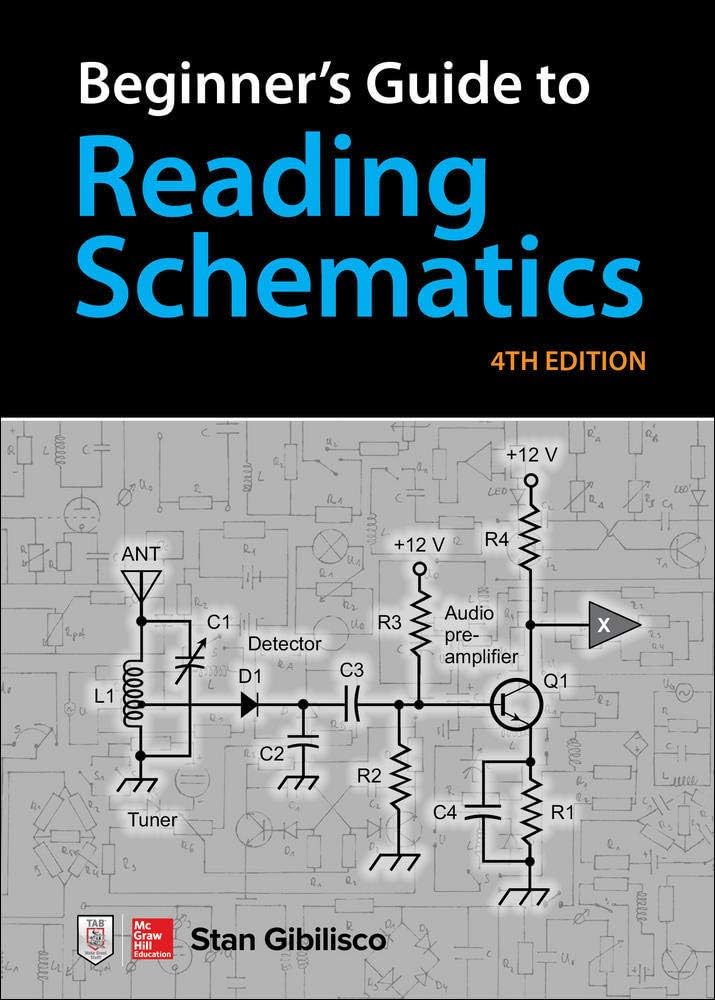
Beginner's Guide to Reading Schematics, Fourth Edition
Product ID: 78011383
Buy anything from 5,000+ international stores. One checkout price. No surprise fees. Join 2M+ shoppers on Desertcart.
Desertcart purchases this item on your behalf and handles shipping, customs, and support to Vanuatu.
Publisher's Note: Products purchased from Third Party sellers are not guaranteed by the publisher for quality, authenticity, or access to any online entitlements included with the product. This updated resource shows how to interpret schematic diagrams―and design your own Written by an experienced engineer, this easy-to-follow TAB guide shows, step-by-step, how to navigate the roadmaps of electronic circuits and systems. Filled with new illustrations and DIY examples, the book clearly explains how to understand and create high-precision electronics diagrams. You will discover how to identify parts and connections, interpret element ratings, and apply diagram-based information in your own projects. Beginner’s Guide to Reading Schematics, Fourth Edition , also contains valuable appendices covering symbols, resistor color codes, and parts suppliers. Up-to-date coverage includes:•Block, schematic, and pictorial diagrams •Resistors and capacitors •Inductors and transformers •Switches, relays, conductors, and cables •Diodes, transistors, Op amps, and logic gates •Electron tubes , cells, and batteries •Voltage dividers and reducers •Simple and complex circuits•Breadboards and wire wrapping •Electronics troubleshooting•Digital electronics and functional circuits•And much more Review: Good book - Great book and it has so much great guidance on how to do schematics Review: Great primer and reference if you're interested in Electronics. - Great book for anyone who wants to learn at a high level about electronic components, and schematics. Easy to read, not meant to be a college text, but is precise and to the point. Handy reference.


| Best Sellers Rank | #9,493 in Books ( See Top 100 in Books ) #1 in Transistors Electrical Engineering (Books) #2 in Digital Design (Books) #2 in Microelectronics |
| Customer Reviews | 4.5 out of 5 stars 1,930 Reviews |
K**K
Good book
Great book and it has so much great guidance on how to do schematics
D**K
Great primer and reference if you're interested in Electronics.
Great book for anyone who wants to learn at a high level about electronic components, and schematics. Easy to read, not meant to be a college text, but is precise and to the point. Handy reference.
A**Y
Truly a Beginner's Guide
As someone who already holds a degree in electrical engineering, I enjoy purchasing these books to help me better understand how to explain the material to entry-level students. I think this book serves as a great and truly entry-level read for someone who is almost completely new to reading schematics. However, I anticipate beginner confusion with the introduction of transformers and their use in both simple and complex schematics. The authors’ two-paragraph introduction to transformers only describes their schematic symbol and does not provide a brief description of their function before they are used in diagrams many times. Despite the potential confusion, I still believe this book is worth reading for anyone interested in embarking on a journey of understanding electronics.
A**B
Easy to understand
Great little book for learning schematics. Easy to understand.
V**E
A good book that will help you read electronics schematics
I love this book. It’s clear defines it subject well and answered some of the more complex and esoteric questions that I had regarding schematics that were not easily answered by Google as well as providing a good guide to the symbols and their variations.
R**Z
Good price
Good for working knowledge
C**E
Excellent packaging! Great seller!
Good packaging! Good product! Would definitely buy from seller again.
T**Y
Spiral book?
The book is physically like a spiral notebook. Not very sturdy. The content is great, though!
S**U
Four Stars
A Good approach to learn how to begin with schematics.
B**X
Good for beginners
Good book for beginner
T**E
Learn from the best.
Helps you understand what should go where.
Z**R
Schematics building book
Covers basics about electronic components in simple and interesting way. Love the small details that author has mentioned in between the lines and also within the tips.
S**S
Very useful
It is easy to understand, great for newbies or for those who need a refreshment
Trustpilot
2 weeks ago
1 month ago