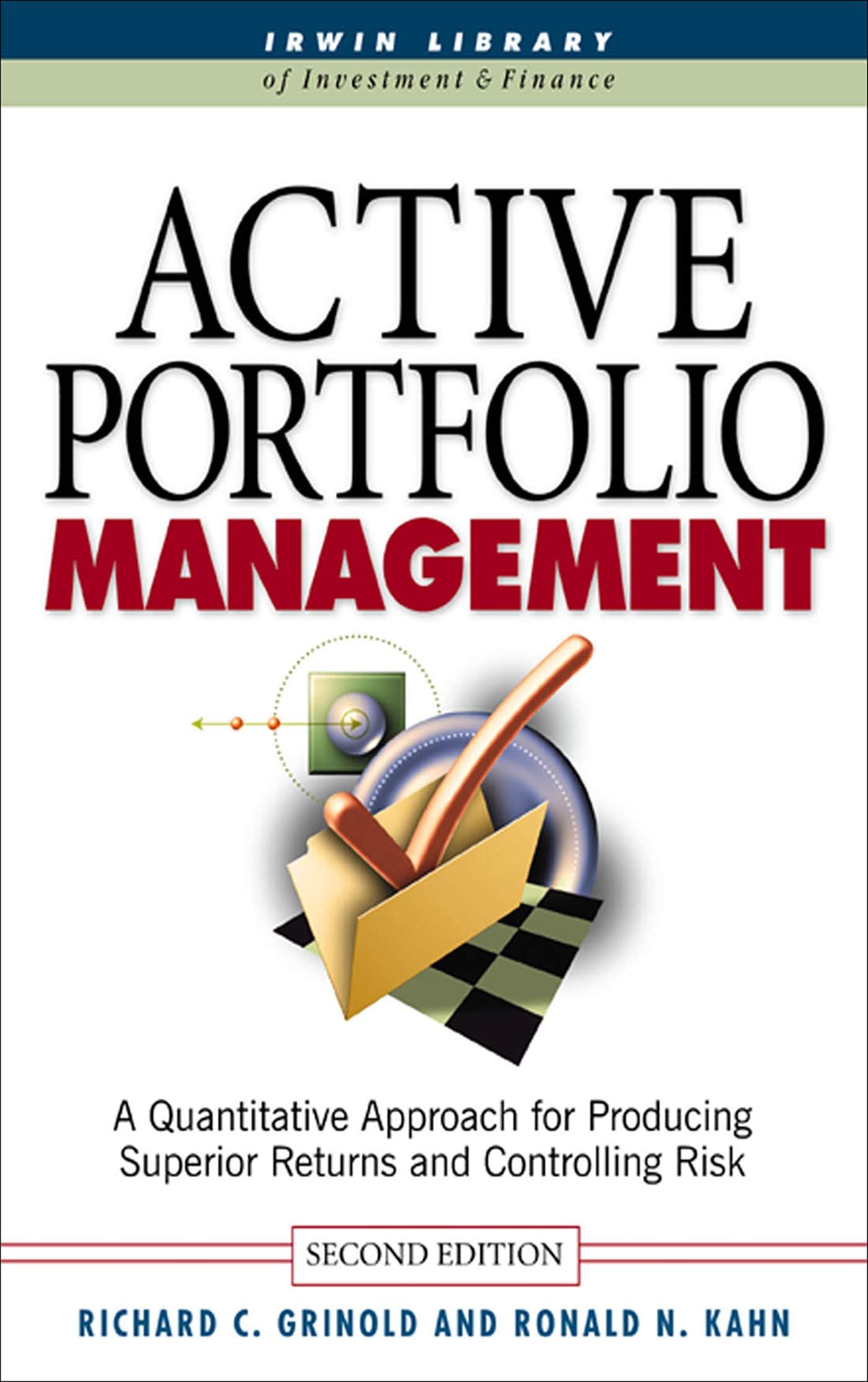
Active Portfolio Management (PB) (McGraw-Hill Library of Investment and Finance)
Product ID: 817788856
Active Portfolio Management (PB) (McGraw-Hill Library of Investment and Finance) eBook : Grinold, Richard C., Kahn, Ronald N.: desertcart.co.uk: Books Review: I think I've read this cover-to-cover half a dozen times ... - I think I've read this cover-to-cover half a dozen times by now. If you're thinking about getting this, you probably should have already done so. Review: Self-contained and broad-explanatory: A new Benchmark! - Those investors and financial analysts familiarized with BARRA results will find in this book an extended explanation about the assumptions, lines of thought, conclusions and possible applications over a wide range of concepts. In our profession it is usual to find papers applying concepts without offering a previous clear and non-ambiguous mathematical definition. This book covers such a fault of precision in our field, introducing gradually the outstanding concepts in literature and showing the multiple mutual relations. Main virtues are: Self-contained and broad-explanatory of the main topics regarding Active Asset Management. A must in order to introduce advanced portfolio analysis. Just a couple of critics (for some people they might also be additional virtues): i) Most of results are obtained using basic matricial algebra and linear programming, so more powerful mathematical tools would lead to more general and forward-looking results (surprisingly, no stochastic calculus in sight, and lack of serious time series treatment!). ii) Some people reproducing step by step every analytical result will discover that, despite the final result is basically correct, some interim results might be incorrect (please contact me for several examples and a list of errata). Specially if you are interested in using the results and concepts, and not so much in the algebraic derivation, this is your new optimal Benchmark.
| ASIN | B005C3WULW |
| Accessibility | Learn more |
| Best Sellers Rank | 598,768 in Kindle Store ( See Top 100 in Kindle Store ) 230 in Professional Financial Forecasting 500 in Mathematics References 664 in Investing |
| Customer reviews | 3.9 3.9 out of 5 stars (68) |
| Edition | 1st |
| Enhanced typesetting | Enabled |
| File size | 10.6 MB |
| ISBN-13 | 978-0071376952 |
| Language | English |
| Page Flip | Enabled |
| Print length | 616 pages |
| Publication date | 16 Nov. 1999 |
| Publisher | McGraw Hill |
| Screen Reader | Supported |
| Word Wise | Enabled |
| X-Ray | Enabled |
T**M
I think I've read this cover-to-cover half a dozen times ...
I think I've read this cover-to-cover half a dozen times by now. If you're thinking about getting this, you probably should have already done so.
S**T
Self-contained and broad-explanatory: A new Benchmark!
Those investors and financial analysts familiarized with BARRA results will find in this book an extended explanation about the assumptions, lines of thought, conclusions and possible applications over a wide range of concepts. In our profession it is usual to find papers applying concepts without offering a previous clear and non-ambiguous mathematical definition. This book covers such a fault of precision in our field, introducing gradually the outstanding concepts in literature and showing the multiple mutual relations. Main virtues are: Self-contained and broad-explanatory of the main topics regarding Active Asset Management. A must in order to introduce advanced portfolio analysis. Just a couple of critics (for some people they might also be additional virtues): i) Most of results are obtained using basic matricial algebra and linear programming, so more powerful mathematical tools would lead to more general and forward-looking results (surprisingly, no stochastic calculus in sight, and lack of serious time series treatment!). ii) Some people reproducing step by step every analytical result will discover that, despite the final result is basically correct, some interim results might be incorrect (please contact me for several examples and a list of errata). Specially if you are interested in using the results and concepts, and not so much in the algebraic derivation, this is your new optimal Benchmark.
R**N
Very good book
Active Portfolio Management is a very good book for who wants to study active management. It's quite straight forward but if you never heard about portfolio management or hedge funds be ready to spend a lot of time googleing. Unless you really want to go deep into formulas you won't need a solid math base, but I've found having it quite useful.
M**N
Don't waste your time and money on this book.
This is an old poorly written book. The formulae doesn't include explanations. The charts are horrible. I read it cover to cover and cannot recommend it to anyone, it is a waste of your time and money. There are much better modern books on this very subject.
M**O
Basics, with missed attempt math
I consider this book as a basics since the authors are actually the first ones to introduce in a whole laws of active management. It turns out that any portfolio manager should get this book and be aware of at least the first part contents including Markovitz, Sharpe ratio, information ratio and law of active management studies. However, the attempt of mathematical understanding of the related concepts is completely missed.
K**N
Badly written but the standard text
A strange book, it is about a mathematical model for portfolio management. In fact it is the standard text for statistical arbitrage hedge funds as well. So it is surprising to find the maths is all in 'technical appendices' which appears to have been written to a different author from the more economics focussed main text. This is pretty confusing, and it doesn't help that they change notation every chapter (although I have to admit I found this a useful prod to check one's understanding). The maths is certainly not abstruse, some matrix algebra, some statistics. The models they present are pretty humdrum these days (everything linear and Gaussian) but it seems nobody else has spelt out the basics so completely and hence this badly written book is on everyone's shelves as the standard reference.
C**A
awful
Terribly formatted. Formulae just appear with no explanation. Not obvious what is a subsection of the current section, and what is in fact a new section. Terms jumbled all over. Variables not explained. How does this stuff get published, let alone become a standard text book?
L**Y
Elegant demonstration of modern finance
Many people object to this book as lacking here and there. Probably true for some who are well ahead in the filed of econometrics and quantitative finance. For this reader, this book has a definite elegance in laying out the underpinning of modern finance. It is also the sort of book that you may put aside and come back from time to time; if you do so it will reward your dedication. I think it will not disappoint.
C**G
IMHO wird in der Finanzmathematik keine "Theorie" so häufig falsch verstanden wie die Modern Portfolio Theorie (MPT). Wobei das "Modern" immer alberner wird, bedenkt man mal wie alt die dazugehörigen Veröffentlichungen sind. Die Idee ist immer die selbe: man hat einen gewissen Anlagehorizont und bewertet jedes mögliches "Asset" bzgl zweier Kriterien: - risk -return. Der Returrn eines Portfolios ist einfach nur die ateilig gewichtete Summe der einzelnen Returns der Assets im Portfolio. Das Risiko kann aber, bei günstigen Abhängigkeitsverhältnissen (ich wähle bewußt NICHT das Wort Korrelation), geringer sein als die Summe der Einzelrisiken. Die Große Frage ist nun: wie erstelle ich nun ein Portfolio mit maximalem Return (oder minimalem Risiko) bei gegebem Risiko (bzw Return) und gegebenr Budgerestriktion ( mein Kapital)? Hier kann man eine ganze Menge Mathematik zum Einsatz bringen. Man kann dies sinnvoll oder weniger sinnvoll tun. Das klassische MPT ist erstmal nicht sinnvoll. Weder kent man den Return der assets noch die Korrelation, noch ist es sinnvoll die Abhängigkeit zwingend nur in Korrelationen zu messen. Hier gibt es aber Erweiterungen des klassischen Ansatzes. Das Problem ist: Ökonomen mögen das nicht, wenn man Sachen einfach mal so macht, weil Sie funktionieren könnten und sinnvoll erscheinen. Warum trifft der "repräsentative Investor" (soll heißen...sind alle gleich, damit man nacher auch schön aggregieren kann:) ) seine Entscheidung nur an zwei Kennzahlen fest? Der "muss" doch auch eine Nutzenfunktion haben? Um die MPT in ein "theoretisch in sich schlüssiges" Modell zu überführen, werden ein Haufen unrealistischer Annahmen getroffen (nur zwei Zeitpunkte...Normal Verteilte Returns oder Quadratische Nutzenfunktion ...beides Schmarn, aber so kann man "rechtfertigen" das der Investor sich nur auf den Erwartungswert und die Standardabweichung zu seiner Entscheidung heranzieht)...die in letzter Konsequenz im CAPM münden. Das CAPM brauch keiner. Das Modell ist unrealistisch und ist an sich für jeden Praktiker wertlos (es versucht auch nicht für irgendwen wervoll zu sein....) Das macht den ursprünglichen Ansatz der Portfolio Theorie aber NICHT auch sinnlos, denn echtes "AKTIVES" Porfolio Management entspringt eher dem "Treynor Black Model". Ziel ist es ja eine Überrendite (mehr als der Marktdurchschnitt) zu erwirtschaften. Und obwohl dieses Buch mit einem Kapitel über das CAPM beginnt, befasst es sich doch im wesentlichen mit den praktischen Problemen des Portolio-Mangements (Forecasting, Parameterschätzung, Transaktionskosten, "Valuation in Theorie und Praxis). Kapitel 17 über Performance Bewertung (wnn war man denn nun "gut")Kapitel 18 über Asset Allocation ist besonders enpfehlenswert. Es sei noch darauf hingewiesen, das es noch wesentlich robustere Methoden gibt, sein Portfolio zu Optimieren....die werden dann mathematisch etwas komplizierter...in der Anwendung aber einfachere. Empfohlen sei hier : Robust Portfolio Optimization and Management (Frank J. Fabozzi)
L**O
システマチック運用のバイブルとも言える一冊。ただ、システマチック運用をしていない運用者にとってもお勧めです。
P**R
Excellent book for whom is looking for a practical approach that at the same time is presented through a rigorous mathematical methodology. The book is absolutely superior over the academic textbooks that usually limit themselves to CAPM and efficient market theory. Grinold and Kahn go much forward and at the same time had managed to clearly and meticulously show the CAPM model, its limitations and the more sophisticated tools developed from it. Beside of showing the active way of managing a portfolio, the serious mathematical presentations through which the different theories such as CAPM are described are very convincing of how difficult it could be to beat the market.
購**者
実務家の立場から書かれたアクティブ投資の理論書。実務書と言えば経験や勘に頼るだけの本が多い中、この本は実務家のための理論を突き詰めている。Superior Information があった場合、それをどのようにアクティブ投資に組み,しかもMPT(Modern Portfolio Theory) やCAPM(Capital Asset Pricing Thoery)をもとに、いかにリスクを最適コントロールするかを論じている。もちろんそのようなSuperior Information 自体を、多くの理論家は、否定するし、それによって行動する”Active Portfolio manager”を、Noise Traderと呼ぶだろう。そのような違いはあるが、実務家の発想を知る上でも興味深い本である。 ついでに、どのような Superior Information があるかを 書いてくれたらよかったのにと思うのは欲が深すぎるのだろうか?
M**T
I bought it for a present
Trustpilot
2 weeks ago
2 weeks ago