Buy anything from 5,000+ international stores. One checkout price. No surprise fees. Join 2M+ shoppers on Desertcart.
Desertcart purchases this item on your behalf and handles shipping, customs, and support to Vanuatu.
🌠 Discover the Universe, One Star at a Time!
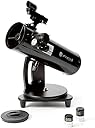
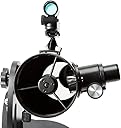
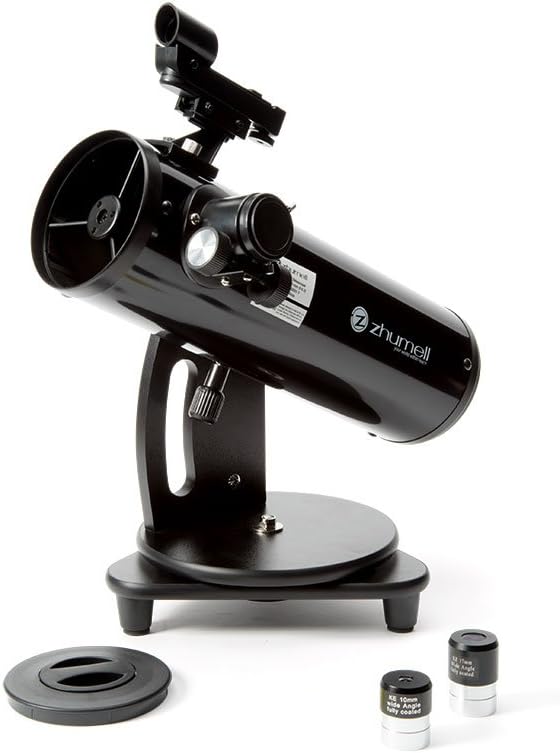
The ZhumellZ100 Portable Altazimuth Reflector Telescope is designed for both novice and experienced stargazers. With a 1.25” focuser, included eyepieces, and a user-friendly red dot finder, it offers a seamless viewing experience. Weighing only 5.25 pounds and featuring a 100mm objective lens, this telescope is perfect for on-the-go astronomy enthusiasts.
| ASIN | B07CD3MS17 |
| Batteries | 1 Lithium Ion batteries required. (included) |
| Best Sellers Rank | #3,245 in Camera & Photo Products ( See Top 100 in Camera & Photo Products ) #52 in Telescope Reflectors |
| Customer Reviews | 4.4 4.4 out of 5 stars (203) |
| Date First Available | May 1, 2018 |
| Is Discontinued By Manufacturer | No |
| Item Weight | 5.25 pounds |
| Item model number | ZHUS001-1 |
| Manufacturer | Celestron Acquisition LLC |
| Product Dimensions | 14.5 x 11 x 11.75 inches |
S**N
I picked this over the Celestron FirstScope
For reference, I am a complete beginner. I did a lot of research prior to getting one of these. After stumbling on r/dontbuyapowerseeker, I felt very lost in the process of getting one. From what I've learned over research, dobsonians are the way to go. They're the best bang for your buck and this particular model doesn't stray away from that. While buying this, I also had bought a Celestron FirstScope. I figured I'd test both to see what works better for me. They both are fantastic beginner telescopes. However, the FirstScope was lacking a few areas that this one fulfilled which is why I picked this over that. I do believe the price difference is well worth the added benefits. So, with that being said, let's get into this. The Good: Lens: The lens that come with are two wide angles that are 10 mm and 17 mm. Both are perfect for viewing and are great for kids since it is so wide that it gives a lot of room to look around. All the pictures taken with exception to the Flame Nebula, were taken on these lens. Portability: The scope itself can be taken off of the clanky mount that its on. This is especially handy when trying to transport the telescope since the mount is awkwardly shaped that it wouldn't really fit in any case. I have yet to find a case for this exact scope, so I made my own out of an old suitcase, but it's not necessarily a necessity. You can perfectly transport this anywhere you'd like. The red dot piece: Probably one of the most underrated tools of a dobsonian, especially when this small, is the red dot finder. You'll find it very hard to use a finderscope with the awkward shape of the dobsonian so it is very nice to have simple red dot sight to angle the telescope at a given location. Just make sure to turn it off one you're done so you don't drain the battery. It really feels like a GPS tracking telescope with how easy it is to find objects with the red dot. The eh: Viewing capability: This is purely based on what comes out of the box. The viewing power is better than the First Scope just because it is a larger and wider, but the scopes that are provided don't get you much magnification for any close ups to planets or deeper space objects. I'd recommend getting a good Barlow lens with this and something lower in mm. A 6 mm or 4 mm will dramatically increase your magnification and with how wide the scope is, it won't compromise brightness significantly. The picture of the nebula was taken on a 6mm lens. Materials: It is a study scope and everything does feel robust, but it is a pain too clean. It's very easy to get finger prints on and cleaning the inside is a long process but necessary for good viewing. It should be known that this is the case with almost every telescope, but if you have OCD like me and hate to see finger prints on it, then you'll be cleaning the outside constantly. The oof: Collimation: So, for most telescopes, you'll have to endure a process of collimation. This basically is aligning your telescope so that you'll be able to see objects with more clarity beyond what the focuser can bring. This telescope, doesn't let you do that. It is a fixed collimation. Albeit, coming out of the factory it is near perfect, but I'm unsure how it will last in the long run. The reason this can be bad is because as a beginner telescope, it's important to learn all of the mechanics of basic viewing and collimation is very important to learn. Platform: This is a standard among almost all tabletop dobsonians. They're very awkward to operate. You will find it difficult to find a spot to view with this given it doesn't have a tripod. DO NOT TRY TO MAKE A TRIPOD. There are reasons why dobsonians excel in stability and are genuinely good at viewing. This is something you'll have to find for yourself. I usually go about putting it on my the back of my car and it works just fine. However, in instances when all you have is the ground. It becomes a little more difficult. Larger dobsonians usually are as tall as you while standing up, so this isn't really an issue for those. Why it's better then the FirstScope: For $40 more, you'll get a better red dot finder, better lens, overall better viewing, stronger base, and sturdier materials. The FirstScope is made of dense plastic whereas this is a thin metal sheet. The First Scope comes with plastic 20 mm and 4 mm lens whereas this comes with metal 17mm and 10 mm (also wide angle). THEY BOTH ARE GREAT BEGINNER TELESCOPES. To be honest, if I was more tight on budget, I'd get the FirstScope because I'm still getting a great viewing experience. It is very hard to find good telescopes with this viewing capability under $100. These 70x400 telescopes that are being sold cannot get nearly the images that this is producing. And for a beginner telescope, why would you even want to try and equatorial mount that the Celestron power seekers are advertising. These both are great telescopes, but the z100 is worth, in my opinion, the $40 more then the FirstScope. Conclusion: It's very hard to find telescopes that aren't plastic junk. To be fair, if you've even found this telescope, consider yourself lucky. Many people get doomed by the 70x400 or PowerSeeker hobby killers and never get to see the true beauty of astronomy. It's a pretty clear choice, in my opinion, that this is the best bang for your buck. Great for kids, great for beginners, great for college students wanting something small for their dorm, great for anyone for that matter. It's one of the best viewing experiences I've seen with a telescope under $100. And if you can shell out the money for Z114 or Z130.. do it. Zhumell has done a fantastic job with this line of scopes and I don't see a better product on the market for this price.
P**L
Great for the Money
This was my first telescope, and it is great for someone just getting into amateur astronomy. The manual that it comes with is very well and clearly written. Manual also includes some tips for beginners. The mount is great, and the two eyepieces that come with it (10mm and 17mm) are amazing. I would recommend to anyone getting it to get a 2x Barlow lens along with it as it’s a good companion to use alongside the eyepieces that it already comes with. If you’re wondering, you can easily see the close planets and Moon with this. You can see the colors and atmosphere of Jupiter and it’s moons, along with a clear picture of Saturn and it’s rings. The Moon is also stunning to look at with this telescope.
T**T
Acceptance trials complete for z100
My first impressions have some reference to the old ct-100. That scope, domestically made- costing virtually 3 times as much - from the early eighties. The included eyepieces are fine heavy-duty Kellners- 17 and 10mm types. The focuser needs some robustness and collimation suffers using fine eyepieces of merit. My notions of a finder would probably push the price up so I just won't go there. Provisions in the base of the scope enable not only the tube itself, but also the mounting system, to be put on some sort of heavy-duty camera tripod. Bravo-Zulu, for keeping the whole package at a hundred bucks, while others have gone up. Will write up some observing experiences later. . The view of the Leo triplet was awsome. Magnification was about 44x using the 9mm nagler. NGC 3628 exhibited a the some indications of a dusty edge. M-65 and M-66 were bright with indications of asymetry. Also used Meade 24.5mm. The f/4 light cone was no problem for these two eyepieces. I felt my eye working too hard with more basic eyepieces. I set it up on the hood of my truck, but did not have enough access to galaxies around the big dipper. M-104 was great, dusty edge detected. I will build some legs and beef up the finder situation. Using a long Cheshire collimator, its easy to see the little focuser needed some tape shims at 120deg apart. Without, max power limited to less than 50x. Building 35mm finder from old binoculars. System could use some tube rings for rotation. Price has gone up, so go for the z130. Update 2: put several layers of 3m masking tape on the top most focuser shim. Put the whole scope on sturdy tripod. Used laser finder, but will put good 35mm right angle finder perhaps with laser. Observed many galaxies between Leo and Virgo. Collimation was better and could make out the special symmetry of M-104. Easily went to 200x with barlow lens. Nagler eyepiece makes it a superb system. Trials completed- giving it another star for physical construction and overall optical performance- improvements to crummy focuser necessary, but can do. In summary, its good points ( price, optical excellence, eyepiece quality ), offset some of the difficulty with the system's accommodation of super eyepieces, ( tube wall is thin though made of steel, so this affects focuser collimation when using heavier eyepieces). Would recommend for those who can travel a little away from the light pollution. A Cheshire eyepiece enable basic improvements in performance. One can turn his vehicle around to access different parts of the sky and no tripod would be needed. A recent improvement will lend itself to the aid of all: used three nylon screws tapped into focuser tube. 10-24 thread tapped with steel screw first. Stabilizes focuser for collimation and support of super eyepieces. This is not your mother's z100.
J**F
Brought this Telescope a few weeks ago and have been enjoying it ever since. If you are a beginner you will have to get used to aiming it and focusing on objects, and whilst this can be pretty frustrating at first, once you get used to this aspect it becomes more and more enjoyable to use. My advice is to get yourself a 'Barlow' lens, which multiplies the magnification of what you can observe, 2, 3 or 5 times depending on what Barlow you opt for. It's tempting to just go for the 5x straight away, but be warned, until you have sussed things out a 5 x will make objects harder to find and then to keep in the eye piece. If you have got a camera with a long zoom lens, you will know that finding, and then holding anything still at full zoom is hard to do. Telescopes are similar, in that you only have to lightly touch the scope for the image in the eyepiece to shake or even disappear from view. That said, you shouldn't really expect anything different with a basic tabletop Telescope; after all, if you had a couple hundred to spend you would be looking for something much more sophisticated. Maybe a scope that found objects and tracked them for you! In my opinion this is a great starter Telescope, which is compact, light and very portable. It requires very little setting up - just put it on a stable flat surface, take the lens caps off and away you go. I took the attached photos with the scope sitting on an inside window ledge. It was fitted with a 2 x Barlow, a Moon Filter, one of the eyepieces that came in the box, and a mid-range Smart Phone (Samsung A51 5g). Took some practice and quite a bit of experimenting, but believe me if an old disabled fart like me can do this, so can you. If you buy one, I hope you master it and enjoy using it. It's a really good feeling the first time you point it at the moon, look through the eyepiece, focus it and and see the surface close up!
C**A
Es una muy buena adquisición. Es importante hacer notar que para ampliar la capacidad de visualización se requiere más oculares y flitros. Los que trae son básicos y logran una amplificación de aprox 40x. Con oculares adicionales se puede llegar al tope teórico focal de este equipo de 200x. Este límite es también el límite máximo en cuidades debido a la contaminación lumínica
D**E
Nice telescope. Bought this for my son last Christmas and have been able to see some pretty cool stuff including Saturn and the rings.
R**.
Unit works well and we enjoy it. We love the small size and ease of taking it anywhere (I downsized from a bigger scope). My only complaint is that I noticed an imperfection (small black spot) on the primary mirror - however it doesn't affect the view (only light gathering ability) so my only suggestion is to peer down and check the mirror when you get it. I didn't bother replacing it, personally. It works fine.
D**N
I bought this on a whim, it arrived in good shape and for the low price it has good optics even with the low cost eyepieces. You need something to sit it on, my solution was a cheap wooden bar stool bought from Canadian Tire, on the bottom of the scope base their is a threaded insert to mount the unit on a standard camera tripod which I tried but found it to be unsteady hence the four legged wood stool, a hole drilled in the middle allowed me to use a short bolt to hold the scope on the stool top with no chance of it slipping off if you knock it in the dark. If you can spend a bit more? the Z114 is the one to buy, almost the same to the Orion Starblast and Edmund Millenium Astroscan 114 with minor cosmetic differences its far more capable and better designed for observing comfort. Also if you have even more money then the Z130 is big enough to keep you busy for many years, however its more bulky and heavy.
Trustpilot
2 weeks ago
3 weeks ago