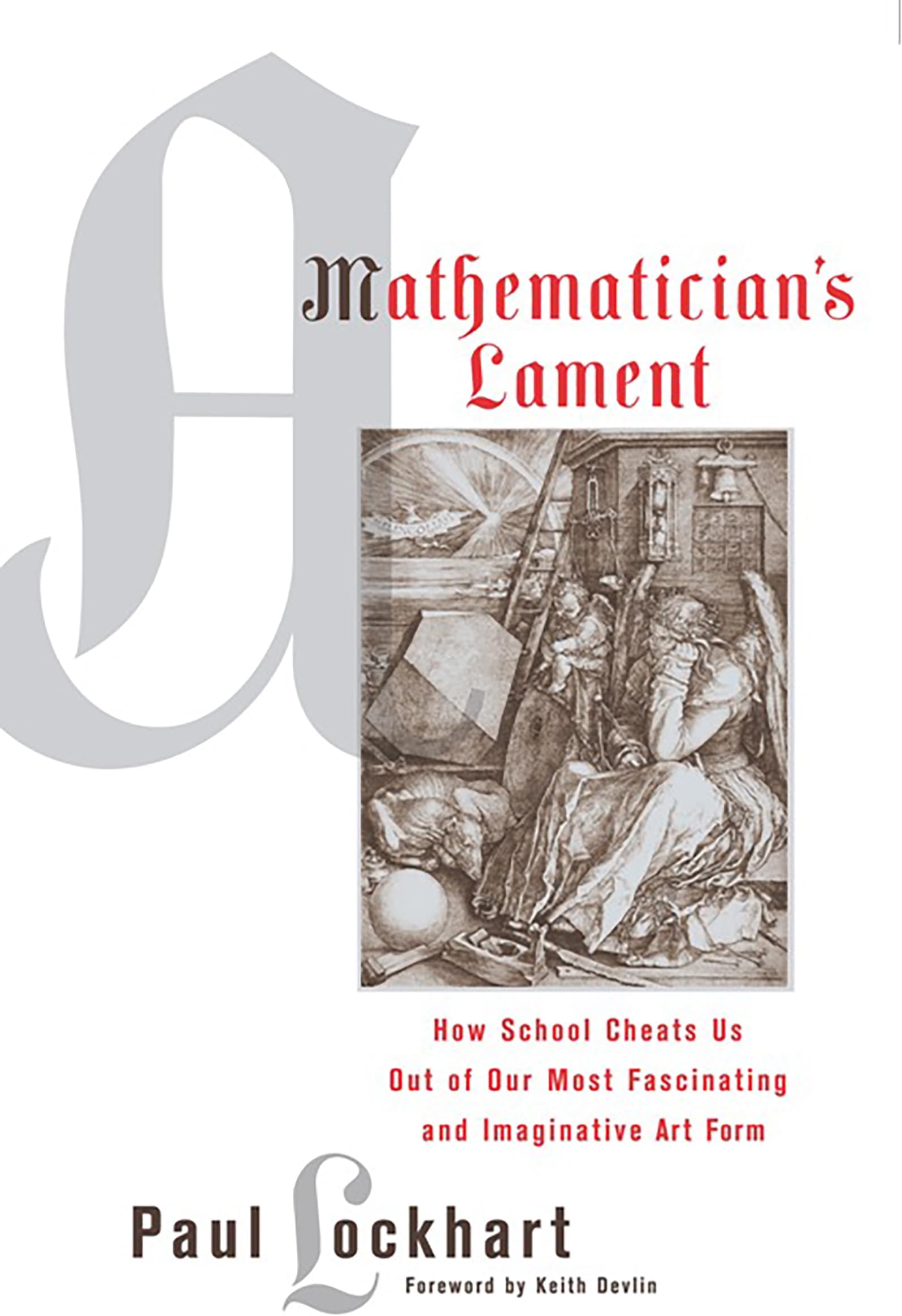
A Mathematician's Lament: How School Cheats Us Out of Our Most Fascinating and Imaginative Art Form
Product ID: 83691302
⭐4.6/5 star rating from 525 readers
🎓Ranks #1,700 in Education Books
📚Top 1,000 in Literary Theory
Buy anything from 5,000+ international stores. One checkout price. No surprise fees. Join 2M+ shoppers on Desertcart.
Desertcart purchases this item on your behalf and handles shipping, customs, and support to Vanuatu.
📐 Unlock the art of math — where logic meets imagination!
A Mathematician's Lament by Bellevue Literary Press is a critically acclaimed book ranked in the top 1,000 in Literary Theory and top 2,000 in Education. With a 4.6-star rating from over 500 readers, it challenges conventional views by presenting mathematics as a deeply creative and imaginative discipline, perfect for professionals seeking to rethink and expand their intellectual toolkit.
| Best Sellers Rank | #37,467 in Books ( See Top 100 in Books ) #558 in Literary Theory, History & Criticism #706 in Education (Books) #3,613 in Higher Education Textbooks |
| Customer Reviews | 4.6 out of 5 stars 528 Reviews |
G**I
Interesting perspective
Loved mathematics and hated art all my life. Had never thought about them being one and the same. Maybe not too late to question other perspectives. Great read
P**A
Brilliant book on how to think math
Loved it. Recommend it to everyone who wants to think and retrospect. Opens up new avenues in your pursuit of life
P**R
Fantastic book on the idea of mathematics
Brilliant. Inspiring. A must read for math teachers or proactive parents.
P**N
This is a must read for anyone who loves maths ...
This is a must read for anyone who loves maths but has been afraid all their life about the subject. Also a must read for math teachers to get an appreciation of how to make this abstract subject really for students.
K**M
About how to learn mathematics
You will learn how to explore mathematics from this writing than the sum of mathematics, which is a very important message.
W**T
Ein sehr besonderes, kleines Buch ...
... schön fände ich es, wenn möglichst viele es lesen - die, die Mathe unterrichten, an der Schule, auch an der Hochschule, in der Lehrerbildung und -fortbildung, in all den Kommissionen, die sich Gedanken darüber machen, was wann, wie und wozu unterrichtet und gelehrt werden sollte. Und wenn die, die es gelesen haben, sich darüber austauschen würden - im Lehrerzimmer, im Kollegenkreis, in all den Gremien und Kommissionen. Fände ich wirklich schön. Schön - wie die Mathematik.
J**L
Maths is art - not science
Every so often, I read a book which I cannot put down. Paul Lockhart's book is one of them. I received it this morning and finished it this afternoon, including some time to work through one or two of his 'maths games.' As reported in other reviews, Lockhart brings a wealth of experience as a university level maths teacher, who decided to take his talents to benefit K12 level students in school. Lockhart is exactly the kind of teacher everyone should have in their maths class. His approach is simple and intuitively sound; namely, that maths as it is currently taught in most school classrooms is not really maths per se; rather it is a training process that rewards those who are good at learning a multitude of facts in the shape of formulae and algorithms, but who are not necessarily inclined towards or even competent at thinking 'outside the box.' As the Forward to the book by Keith Devlin (a maths professor at Stanford University) points out, many successful high-school mathematics students come unstuck when arriving at university to study mathematics, since the approach and character of the subject is so very different. The analogy is that pre-university maths is similar to learning to paint by numbers and that only when one 'arrives' at university is true maths introduced into the curriculum and the student is allowed to pick up a blank canvas to construct a painting. Many cannot make the transition, largely because they lack the mind-set necessary for this unstructured approach. Lockhart appeals to us to appreciate that this transition is not something which should simply occur for a minority of students arriving at university. Rather, real maths should be the starting point of a child's introduction to the subject, so that the beauty and creativity that is at the heart of mathematics can be truly appreciated and crafted by the student. Unfortunately, the existing educational system tends to wrongly assume that maths is really a branch of science and as such should be taught to prepare students to be competent in the use and manipulation of calculus to support their studies in the sciences. In order to reach this level at school, the student is therefore 'trained' from day one in basic maths, to be followed in sequence by more maths, algebra 1, geometry, algebra 2, pre-calculus and finally calculus. Of course, many students leave school or drop the subject at aged 16 and don't really even get exposure to calculus. Unfortunately, well before aged 16, many more students have simply been 'turned off' by maths, since its method of 'training' tends to reward the students who invest in the recipe of learning a mathematical operation, then practising the skill to a level where it is ingrained into the psyche. A good example being the algebraic formula for determining the factors of a quadratic equation where x=(-b+/-SQRT(b^2-4*a*c))/2*a. Whilst useful for solving the specific kind of problem, its relevance to the vast majority of students is such that once they have sat and passed or possibly failed their 16 year old maths exam, then like all the other formulae learnt for 'the exam' it will be willingly forgotten and never used again for the rest of their lives. However, it would be wrong to paint Lockhart as being some free thinking spirit who denies the importance of learning certain facts, even formulae. His point is however, that frequently the student at school is introduced to such topics and concepts like the above formula as simply the next thing to learn and be mastered on the curriculum. Most of the time, the most important question of why does this formula work, or what is the history and reason behind its development is never mentioned. Lockhart's argument is that without expecting a student to be familiar with everything that has been developed in mathematical thinking during the past 3,000 years, it would at least make sense to introduce students to the various areas of the subject by way of exploration; by way of playing games and looking at maths as something to enjoy and experience without artificial exercises. One example of an artificial exercise that Lockhart uses which I enjoyed was his illustration of how in algebra one might be asked to solve the 'real life' problem of the age of your friend Maria, who is ". . . 2 years older than twice her age seven years ago." Lockhart's heartfelt retort to such attempts to make the subject interesting is that these kinds of unrealistic and ridiculous examples are not what algebra is all about. Instead, simply ask the question, "Suppose I am given the sum and difference of two numbers. How can I figure out what the numbers are themselves?" Lockhart states that "Algebra is not about daily life, it's about numbers and symmetry - and this is a valid pursuit in and of itself." Furthermore, Lockhart is not out to attack school maths teachers. He fully recognises that most are 'trapped in the system,' but he appeals to maths teachers to rethink what they are trying to achieve in their classes. Perhaps most importantly, Lockhart's observations go right to the heart of one of the problems of modern education in general, namely, that its objective is primarily to train people for the workforce. Setting aside any Orwellian undertones to such criticism, I wish that government ministers and policy makers would take note of Lockhart's messages. Maths is an art that should inspire and encourage thinking outside the box from the youngest ages. It should not be taught as a series of facts simply to be learnt for performing computations in a series of exams. Such an approach suffocates the intellectual development that real maths can so easily nurture. One may not agree with everything said in this book, since it is first and foremost a lament, but also a call to arms as such it is naturally subjective in nature. However, like all good ideas, anyone reading it could not possibly fail to be stimulated into thinking about these important ideas. Well worth the read.
B**,
Motivation totale pour entrer en match
J'ai toujours eu ce sentiment que le cursus traditionnel était nul. C'est en contact avec le monde des sciences informatiques que j'ai enfin compris la beauté des math appliquées.
M**.
Matemáticas en inglés
Un regalo para mi hijo, que está estudiando matemáticas.
D**E
Surely you're joking Mr. Lockhart
Paul Lockhart, if that is your real name (he wouldn't be the first person in the history of math to be a woman masquerading as a man), channels Kurt Godel in explaining why math can be learned but not taught. Like Archimedes he draws a line in the sand then dares us to cross it and see K-12 math education from a different angle.
Trustpilot
1 month ago
1 month ago