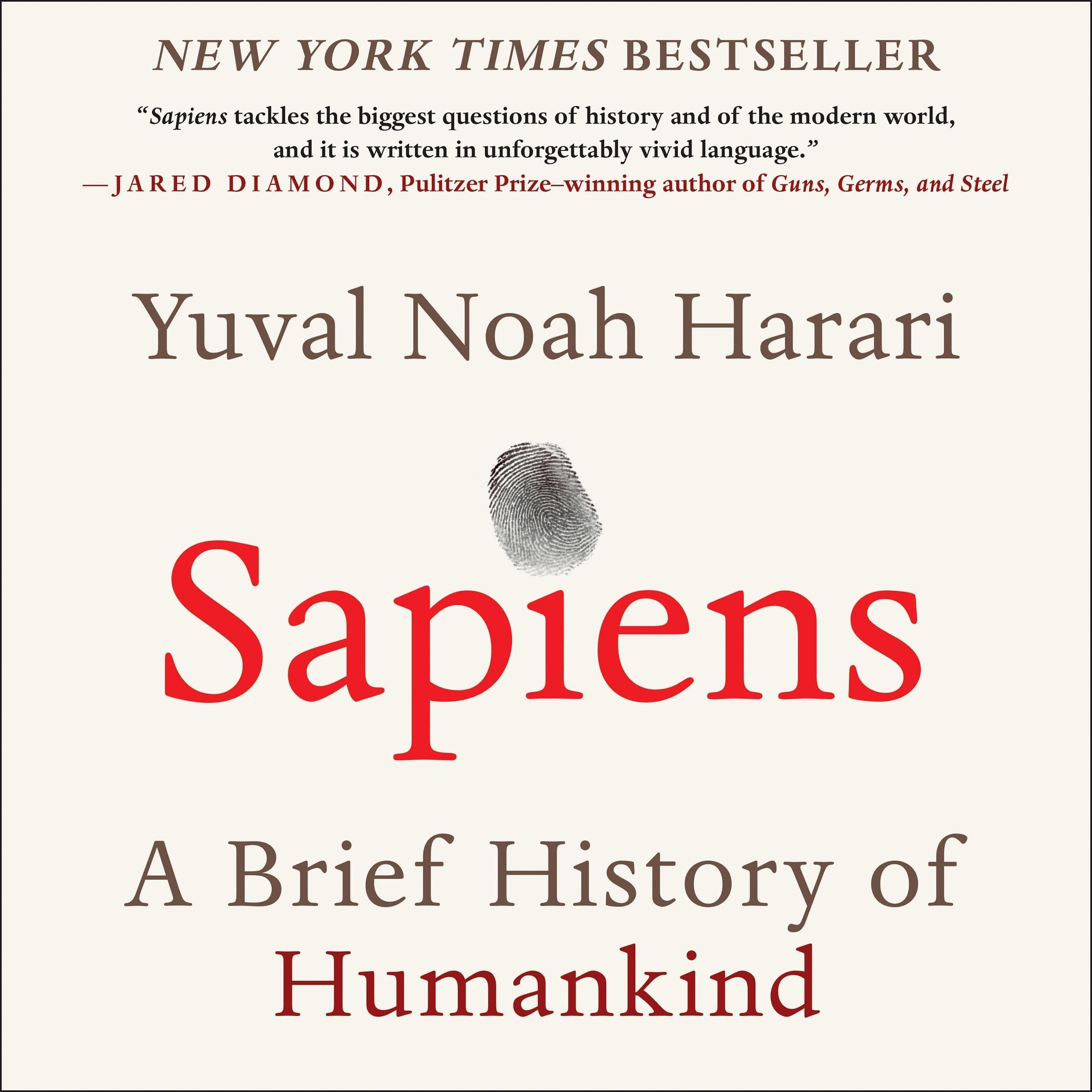
Sapiens: A Brief History of Humankind
Product ID: 89744949
#1 New York Times Bestseller New York Times Readers’ Pick: Top 100 Books of the 21 st Century The Summer Reading Pick for President Barack Obama and Bill Gates Official U.S. edition From renowned historian Yuval Noah Harari comes a groundbreaking narrative of humanity’s creation and evolution—a #1 international bestseller—that explores the ways in which biology and history have defined us and enhanced our understanding of what it means to be “human.” One hundred thousand years ago, at least six different species of humans inhabited Earth. Yet today there is only one—homo sapiens. What happened to the others? And what may happen to us? Most books about the history of humanity pursue either a historical or a biological approach, but Dr. Yuval Noah Harari breaks the mold with this highly original book that begins about 70,000 years ago with the appearance of modern cognition. From examining the role evolving humans have played in the global ecosystem to charting the rise of empires, Sapiens integrates history and science to reconsider accepted narratives, connect past developments with contemporary concerns, and examine specific events within the context of larger ideas. Dr. Harari also compels us to look ahead, because over the last few decades humans have begun to bend laws of natural selection that have governed life for the past four billion years. We are acquiring the ability to design not only the world around us, but also ourselves. Where is this leading us, and what do we want to become? Featuring 27 photographs, 6 maps, and 25 illustrations/diagrams, this provocative and insightful work is sure to spark debate and is essential reading for aficionados of Jared Diamond, James Gleick, Matt Ridley, Robert Wright, and Sharon Moalem. Review: Excellent overview of how modern society got to this point and ways to think about the future - Sapiens is a brief overview to the major stages of human history. It is definitely a unique account in that it focuses on a few major events in human history that catalyzed changes to how people organized. The writing style is engaging and the author always tries to focus on issues from all perspectives and as a consequence many people reading might feel shaken at times or perhaps even insulted. The result is a success though and the author forces the reader to rethink the way they look at human culture and ideological preferences. The author also forces the reader to think about in what light should we be thinking about human progress and the course of history as it is a deep issue that is often glazed over with a final focus on what our conception of progress is for the future given we have put ourselves on the borders of being able to engage in intelligent design of ourselves. Sapiens is split into 4 parts. The first starts with the species which includes those now extinct within the homo genus. The reader learns about the spread of various branches of the family tree and the timing of their diffusion. It gives a sense of the initial diversity proto humans had several hundred thousand ago. We learn that there was nothing inevitable about the human form and how in certain environments larger species evolved and in others dwarfs had a competitive advantage. The author from the beginning convincingly describes how our history is very hard to see as destiny when looking back at the initial conditions we faced. The author describes how around 70k years ago there seemed to be a change in our mental structure that led to an advantage over other proto-human species and we soon eradicated other homo genus competitors. The actual events that catalyzed this is impossible to know and the author describes to the reader the impossibility of looking into the past as the data is non-existent and the best we can do is imagine and such an exercise is largely fruitless. The author also details how the spread of humans led to the death of local ecosystems and notes how humans in Australia and elsewhere led to the extinction of a great number indigenous species. The author then focuses on how hunter gatherers migrated to farming with the Agricultural Revolution which began around 10,000 years ago. The author discusses how individuals had a more difficult lifestyle in agriculture but human density increased. The agricultural revolution can be seen as an oddity through this lens as the happiness of people was diminished though the ability to procreate was amplified. The lifestyle of hunter gatherers was less cyclical than farming as one could move with the seasons and change diet accordingly. Farming forced people in closer proximity with animals which led to higher disease and in addition cyclical crop yields. The author also discussed how farming led to larger communities and as the bonds of association weakened the growth of the state began. The author notes that people can live in communities of 100-150 people before intimate trust breaks down. Early rulers of civilizations all exploited the fact that people were tied to the land in farming communities and things like the pyramids were built due to the ability to organize large labor pools which was only possible when farming could be depended upon. The author discusses how different Hammurabi's code with the declaration of independence. The system of law of the agricultural revolution is profoundly different than today and the author forces the reader to think about whether there is such a thing as right and wrong or is there just context and human construct. The author then starts to focus on perhaps one of the most important human constructs in history - money and religion. The author describes how money allowed people to coordinate to a degree that was impossible in its absence. Barter economies are impractical at very low levels of trade but money solves these problems amazingly well. The author gives some basic economics lessons and describes how money solves issues of trade and created a medium for people to trust one another. The author also discusses religion and how that also allowed people to have something in common with one another on a grand scale. The author discusses how religion shouldn't be viewed through the lens of God alone as religions like Buddhism are not centered on God. The author focuses on what religion does for people and how it creates social relations. The author also discusses the evolution of polytheism to monotheism and dispels with why polytheism seems silly in todays world by describing the conditions in which it arose and was applied. The author then moves into the modern era and discusses the scientific revolution and the growth of capitalism. The author discusses our discovery of our place in the solar system and the transition to the scientific method. The author then re-focuses on money and the transition from money as a medium of exchange to money as a store of wealth and the growth of the banking system as a means of allocating savings to investment. The author very intuitively introduces the concept of the money multiplier and how belief in growth in the future greased the wheels for investment today. The author over simplifies a little and infers that lending in the past was not due to the fact that people were unaware of lending but rather there was no economic growth so loans were seen as much riskier as the world was zero sum. Nonetheless as the merchant class grew and embraced the framework of double entry bookkeeping the power of capitalism to fuel growth emerged with force and propelled smaller merchant nations to take on global roles. These included the likes of Holland and England at the expense of countries like Spain. The author gives good examples of how enforcement of contract and rule of law led commerce driven growth. Interwoven throughout the history are questions of whether growth in and of itself should be a goal and discusses the philosophy of capitalism and libertarian ideology but contrasts it with other conceptions of fairness as well as how markets can fail. The author then moves on to the impossibly deep subject of happiness and asks what it is intrinsically. He goes through monotheist religious conceptions, Buddhist conceptions and biological conceptions and discusses the limitations of each and every view, especially as they are not mutually consistent. He highlights how framing of expectations defines happiness and how things like money are helpful to a point then are of no consequence to happiness. The author then discusses the technological frontier and what current science is doing in the area of biotechnology. This is a motivated overview which then brings up the question of what is the point of those focusing on ethics or the science etc. In particular the author asks whether when we take actions that enhance our "progress" they are driven by deep reflected beliefs about the long term effects. The author frames his question so that answers like extension of human life can no longer seem like undoubtedly beneficial as they have spillover effects on distribution of inequality, livelihood of animals and ecological deterioration. Sapiens gives a history of humankind through a very different lens to other books that I have read. It focuses not on the history of events but on certain social constructs that changed our fundamental means of association. There are of course not discrete events but a continuum that leads to our human history but the author frames things in such a way that his ordering is very intuitive. The author reminds the reader throughout the book that concepts of right and wrong are situational at best and will always be subjective. He continually highlights that our lives are sustained by our beliefs in self sustaining myths. It is a scary thing to realize at times but the lessons being taught are true as there were times where we did not have the same myths and our social construct was entirely different. The author ends with important questions about how to think about the future. It is not a guide to give one a sense of what to do but rather it is a guide against being complacent in the importance of where we stand in history. This is an entertaining and thoughtful book. Review: A simply wonderful book. Six stars. - High level, thought-provoking ideas, lucid exposition, engaging language, and interesting examples. I would recommend this book to ANYONE. In addition to reading, I also listened to the audiobook narrated by Derek Perkins - also highly recommended. The book focuses on "big" history, i.e., macroscopic historical patterns and principles, rather than individual or microscopic historical events and processes. Examples include the three major unification forces of human cultures (money, empires and religions) and the interactions between science, imperialism and capitalism that buttress Western empires' dominion since 1750. Each chapter is organized around these themes, rather than around individual historical regions, eras or institutions (eg, empires and religions) which seems to be the approach of most traditional history textbooks or even university curricula (as judged from for example the course offerings in the History Department of my university: https://classes.cornell.edu/browse/roster/FA15/subject/HIST). [This paragraph contains some personally thoughts only marginally relevant to the book under review; feel free to skip it] Personally, I am utterly enthusiastic about the author’s approach while enormously frustrated about the traditional approach: the traditional approach is like stamp collecting, analogous to providing a long list of mechanical devices without teaching Newton's laws in the case of mechanics, or displaying a wonderful array of organismal diversity without mentioning the unifying principle of evolution in the case of biology, turns people into "scholars" rather than "thinkers" and defeats the overall purpose of our intellectual endeavors. IF there is some element of truth to my impression of history research and education as traditionally practiced having fallen to a lamentable state of stamp collecting, why so? As an outsider of the field I don’t know, and I am speculating that the major reason is we simply don’t know the principles with a level of certainty like that in mechanics or biology, and the minor reason is there is a culture of stamp collecting. In any case, I admire and support the author’s effort which helps to establish the “big history” approach. Once in a while, the author jumped out of any historical context altogether and provided some sweeping accounts on some central questions of history whose relevance holds for history as a whole. Examples include justice in history (Chapter 8), the arrow of history (Chapter 9) and the secret of cultural success (Chapter 13). My personal favorite on this is the chapter on happiness (Chapter 19), which examines the following question: are we getting happier as history rolls along and our power accumulates? By the end of an informative and thought-provoking discussion, the author claimed that the subject has traditionally been shunned by historians despite its central importance and he was trying to fill the gap; I personally believe the claim and think it attests to the author’s courage and intellectual prowess. Staying at the “big history” level, the book contains many thought-provoking ideas. Examples include the point of studying history is not to make predictions but to understand the vast possibilities of our future (in Chapter 13), and we Homo sapiens about to turn into superhumans (in Chapter 20). My personal favorite on this is Agricultural Revolution as history’s biggest fraud (Chapter 5) and the nature of human happiness and how to achieve it (Chapter 19). Connected, the two discussions tell me that humans’ choices and actions may sometimes be fundamentally antithetical and counterproductive to their long-term happiness, which holds profound philosophical and ethical implications to me. The exposition of the book is lucid and the flow natural. To supplement and concretize the discussions on macroscopic principles, the author provided many detailed (microscopic) examples, and here he exhibited great skills in zooming in and out between the two levels and choosing most telling microscopic examples. Examples fall into several categories. In demonstrating that social orders are of an imagined nature, he carefully chose the CASES of the Code of Hammurabi and the Declaration of Independence, and the result is an informative and intriguing comparison (Chapter 6). In showing that in fact the conquered are usually part of the imperial legacies despite their sometimes great reluctance in admitting so, he drew the STORY of siege of Numantia by the Roman Empire (Chapter 11). In explaining the emergence of credit, he concocted a TALE of the fictional characters McDoughnut, Stone and Greedy (Chapter 16). Moreover, the book is scattered with examples down to the more vivid and explicit level, such as a mathematical equation of Relativity to exemplify our mathematical cognition (Chapter 7) and an ingredient list of a hand cream to illustrate the modern industrial sophistication (Chapter 17). Occasionally for some difficult topics in the book it seems a clearer exposition would make it easier for me to understand the author’s argument (eg, on how language enabled us to enjoy competitive advantage over other Homo species and ultimately drive them to extinction (Chapter 2), and the sequence of events that got us trapped in agriculture (Chapter 5)), but having not thoroughly gone through those difficult parts a few times, I understand that it might actually be my understanding deficiency. Moreover, I am aware of some complaints over the potential handwaviness of some of the author’s arguments as exemplified by his overuse of the phrase “exceptions that prove the rule” (eg, http://www.theguardian.com/books/2014/sep/11/sapiens-brief-history-humankind-yuval-noah-harari-review). In this my thought is the following: I see an AUTHOR’s primary duty as to provoke readers’ own thinking rather than to produce bulletproof arguments (this secondary duty of an author would be the primary duty of a SCIENTIST); in other words, if the author is writing an academic paper, he might need to tighten up his arguments, and since he is now writing a general history book, I think he has succeeded in his primary duty superbly. Lastly, I think it is hard to read through the book without noticing its literary appeal. This book is apparently an English translation that the author did himself from the original Hebrew version. The beautiful and idiomatic language adds much to the exhilarating reading experience. The book affects me nontrivially at a personal level. Aside from the philosophical and ethical implications from history on the relationship between our decisions and long-term happiness as mentioned above, the broad spectrum of social norms described in the book broadens my ethical outlook and makes me less dogmatic about whatever ideas I used to hold as absolute principles and cherish unwaveringly (a positive change I think), echoing the point of studying history which in the author’s opinion is to understand the myriad of possibilities (also mentioned above). I feel sincerely grateful to the author and the book in this. It is in part my wish of extending this positive impact of reading this book and understanding history in general to other people that prompted me to write this review. I can think of some minor improvements for the book. Aside from the potential refinements on the exposition and argument mentioned above, I think the book can be supplemented with more data and plots of them, to inject a more quantitative sense to the matters under study. Lastly, I think the Table of Contents should also include sections of each chapter, which I think would help us grasp the overall structure of the discourse and I provide below for the convenience of other readers. For example, with a listing of the sections of Chapter 12 on religion, one can easily see that the discussions go from the transition from animism to god-based religions, polytheism, monotheism, dualism, Buddhism and Humanism. Table of Sections I. The Cognitive Revolution 1. An animal of no significance a. Skeletons in the closest b. The cost of thinking c. A race of cooks d. Our brothers’ keepers 2. The Tree of Knowledge a. The legend of Peugeot b. Bypassing the genome c. History and Biology 3. A day in the life of Adam and Eve a. The original affluent society b. Talking ghosts c. Peace or war? d. The curtain of silence 4. The Flood a. Guilty as charged b. The end of sloth c. Noah’s Ark II. The Agricultural Revolution 5. History’s biggest fraud a. The luxury trap b. Divine intervention c. Victims of the revolution 6. Building pyramids a. The coming of the future b. An imagined order c. True believers d. The prison walls 7. Memory overload a. Signed, Kushim b. The wonders of bureaucracy c. The language of numbers 8. There is no justice in history a. The vicious cycle b. Purity in America c. He and she d. Sex and gender e. What’s so good about men? f. Muscle power g. The scum of Society h. Patriarchal genes III. The unification of humankind 9. The arrow of history a. The spy satellite b. The global vision 10. The scent of money a. How much is it? b. Shells and cigarettes c. How does money work? d. The Gospel of gold e. The price of money 11. Imperial Visions a. What is an empire? b. Evil empires c. It’s for your own good d. When they become us e. Good guys and bad buys in history f. The new global empire 12. The law of religion a. Silencing the lamb b. The benefits of idolatry c. God is one d. The battle of good and evil e. The law of nature f. The worship of man g. Humanist religions – religions that worship humanity 13. The secret of success a. The hindsight fallacy b. The blind clio IV. The Scientific Revolution 14. The discovery of ignorance a. Ignoramus b. The scientific dogma c. Knowledge is power d. The ideal of progress e. The Gilgamesh Project f. The sugar daddy of science 15. The marriage of science and empire a. Why Europe? b. The mentality of conquest c. Empty maps d. Invasion from outer space e. Rare spiders and forgotten scripts 16. The Capitalist creed a. A growing pie b. Columbus searches for an investor c. In the name of capital d. The cult of the free market e. The Capitalist hell 17. The wheels of industry a. The secret in the kitchen b. An ocean of energy c. Life on the conveyor belt d. The age of shopping 18. A permanent revolution a. Modern time b. The collapse of the family and the community c. Imagined community d. Perpetuum mobile e. Peace in our time f. Imperial retirement g. Pax Atomica 19. And they lived happily ever after a. Counting happiness b. Chemical happiness c. The meaning of life d. Know Thyself 20. The end of Homo Sapiens a. Of mice and men b. The return of the Neanderthals c. Bionic life d. Another life e. The singularity f. The Frankenstein prophecy


A**N
Excellent overview of how modern society got to this point and ways to think about the future
Sapiens is a brief overview to the major stages of human history. It is definitely a unique account in that it focuses on a few major events in human history that catalyzed changes to how people organized. The writing style is engaging and the author always tries to focus on issues from all perspectives and as a consequence many people reading might feel shaken at times or perhaps even insulted. The result is a success though and the author forces the reader to rethink the way they look at human culture and ideological preferences. The author also forces the reader to think about in what light should we be thinking about human progress and the course of history as it is a deep issue that is often glazed over with a final focus on what our conception of progress is for the future given we have put ourselves on the borders of being able to engage in intelligent design of ourselves. Sapiens is split into 4 parts. The first starts with the species which includes those now extinct within the homo genus. The reader learns about the spread of various branches of the family tree and the timing of their diffusion. It gives a sense of the initial diversity proto humans had several hundred thousand ago. We learn that there was nothing inevitable about the human form and how in certain environments larger species evolved and in others dwarfs had a competitive advantage. The author from the beginning convincingly describes how our history is very hard to see as destiny when looking back at the initial conditions we faced. The author describes how around 70k years ago there seemed to be a change in our mental structure that led to an advantage over other proto-human species and we soon eradicated other homo genus competitors. The actual events that catalyzed this is impossible to know and the author describes to the reader the impossibility of looking into the past as the data is non-existent and the best we can do is imagine and such an exercise is largely fruitless. The author also details how the spread of humans led to the death of local ecosystems and notes how humans in Australia and elsewhere led to the extinction of a great number indigenous species. The author then focuses on how hunter gatherers migrated to farming with the Agricultural Revolution which began around 10,000 years ago. The author discusses how individuals had a more difficult lifestyle in agriculture but human density increased. The agricultural revolution can be seen as an oddity through this lens as the happiness of people was diminished though the ability to procreate was amplified. The lifestyle of hunter gatherers was less cyclical than farming as one could move with the seasons and change diet accordingly. Farming forced people in closer proximity with animals which led to higher disease and in addition cyclical crop yields. The author also discussed how farming led to larger communities and as the bonds of association weakened the growth of the state began. The author notes that people can live in communities of 100-150 people before intimate trust breaks down. Early rulers of civilizations all exploited the fact that people were tied to the land in farming communities and things like the pyramids were built due to the ability to organize large labor pools which was only possible when farming could be depended upon. The author discusses how different Hammurabi's code with the declaration of independence. The system of law of the agricultural revolution is profoundly different than today and the author forces the reader to think about whether there is such a thing as right and wrong or is there just context and human construct. The author then starts to focus on perhaps one of the most important human constructs in history - money and religion. The author describes how money allowed people to coordinate to a degree that was impossible in its absence. Barter economies are impractical at very low levels of trade but money solves these problems amazingly well. The author gives some basic economics lessons and describes how money solves issues of trade and created a medium for people to trust one another. The author also discusses religion and how that also allowed people to have something in common with one another on a grand scale. The author discusses how religion shouldn't be viewed through the lens of God alone as religions like Buddhism are not centered on God. The author focuses on what religion does for people and how it creates social relations. The author also discusses the evolution of polytheism to monotheism and dispels with why polytheism seems silly in todays world by describing the conditions in which it arose and was applied. The author then moves into the modern era and discusses the scientific revolution and the growth of capitalism. The author discusses our discovery of our place in the solar system and the transition to the scientific method. The author then re-focuses on money and the transition from money as a medium of exchange to money as a store of wealth and the growth of the banking system as a means of allocating savings to investment. The author very intuitively introduces the concept of the money multiplier and how belief in growth in the future greased the wheels for investment today. The author over simplifies a little and infers that lending in the past was not due to the fact that people were unaware of lending but rather there was no economic growth so loans were seen as much riskier as the world was zero sum. Nonetheless as the merchant class grew and embraced the framework of double entry bookkeeping the power of capitalism to fuel growth emerged with force and propelled smaller merchant nations to take on global roles. These included the likes of Holland and England at the expense of countries like Spain. The author gives good examples of how enforcement of contract and rule of law led commerce driven growth. Interwoven throughout the history are questions of whether growth in and of itself should be a goal and discusses the philosophy of capitalism and libertarian ideology but contrasts it with other conceptions of fairness as well as how markets can fail. The author then moves on to the impossibly deep subject of happiness and asks what it is intrinsically. He goes through monotheist religious conceptions, Buddhist conceptions and biological conceptions and discusses the limitations of each and every view, especially as they are not mutually consistent. He highlights how framing of expectations defines happiness and how things like money are helpful to a point then are of no consequence to happiness. The author then discusses the technological frontier and what current science is doing in the area of biotechnology. This is a motivated overview which then brings up the question of what is the point of those focusing on ethics or the science etc. In particular the author asks whether when we take actions that enhance our "progress" they are driven by deep reflected beliefs about the long term effects. The author frames his question so that answers like extension of human life can no longer seem like undoubtedly beneficial as they have spillover effects on distribution of inequality, livelihood of animals and ecological deterioration. Sapiens gives a history of humankind through a very different lens to other books that I have read. It focuses not on the history of events but on certain social constructs that changed our fundamental means of association. There are of course not discrete events but a continuum that leads to our human history but the author frames things in such a way that his ordering is very intuitive. The author reminds the reader throughout the book that concepts of right and wrong are situational at best and will always be subjective. He continually highlights that our lives are sustained by our beliefs in self sustaining myths. It is a scary thing to realize at times but the lessons being taught are true as there were times where we did not have the same myths and our social construct was entirely different. The author ends with important questions about how to think about the future. It is not a guide to give one a sense of what to do but rather it is a guide against being complacent in the importance of where we stand in history. This is an entertaining and thoughtful book.
L**G
A simply wonderful book. Six stars.
High level, thought-provoking ideas, lucid exposition, engaging language, and interesting examples. I would recommend this book to ANYONE. In addition to reading, I also listened to the audiobook narrated by Derek Perkins - also highly recommended. The book focuses on "big" history, i.e., macroscopic historical patterns and principles, rather than individual or microscopic historical events and processes. Examples include the three major unification forces of human cultures (money, empires and religions) and the interactions between science, imperialism and capitalism that buttress Western empires' dominion since 1750. Each chapter is organized around these themes, rather than around individual historical regions, eras or institutions (eg, empires and religions) which seems to be the approach of most traditional history textbooks or even university curricula (as judged from for example the course offerings in the History Department of my university: https://classes.cornell.edu/browse/roster/FA15/subject/HIST). [This paragraph contains some personally thoughts only marginally relevant to the book under review; feel free to skip it] Personally, I am utterly enthusiastic about the author’s approach while enormously frustrated about the traditional approach: the traditional approach is like stamp collecting, analogous to providing a long list of mechanical devices without teaching Newton's laws in the case of mechanics, or displaying a wonderful array of organismal diversity without mentioning the unifying principle of evolution in the case of biology, turns people into "scholars" rather than "thinkers" and defeats the overall purpose of our intellectual endeavors. IF there is some element of truth to my impression of history research and education as traditionally practiced having fallen to a lamentable state of stamp collecting, why so? As an outsider of the field I don’t know, and I am speculating that the major reason is we simply don’t know the principles with a level of certainty like that in mechanics or biology, and the minor reason is there is a culture of stamp collecting. In any case, I admire and support the author’s effort which helps to establish the “big history” approach. Once in a while, the author jumped out of any historical context altogether and provided some sweeping accounts on some central questions of history whose relevance holds for history as a whole. Examples include justice in history (Chapter 8), the arrow of history (Chapter 9) and the secret of cultural success (Chapter 13). My personal favorite on this is the chapter on happiness (Chapter 19), which examines the following question: are we getting happier as history rolls along and our power accumulates? By the end of an informative and thought-provoking discussion, the author claimed that the subject has traditionally been shunned by historians despite its central importance and he was trying to fill the gap; I personally believe the claim and think it attests to the author’s courage and intellectual prowess. Staying at the “big history” level, the book contains many thought-provoking ideas. Examples include the point of studying history is not to make predictions but to understand the vast possibilities of our future (in Chapter 13), and we Homo sapiens about to turn into superhumans (in Chapter 20). My personal favorite on this is Agricultural Revolution as history’s biggest fraud (Chapter 5) and the nature of human happiness and how to achieve it (Chapter 19). Connected, the two discussions tell me that humans’ choices and actions may sometimes be fundamentally antithetical and counterproductive to their long-term happiness, which holds profound philosophical and ethical implications to me. The exposition of the book is lucid and the flow natural. To supplement and concretize the discussions on macroscopic principles, the author provided many detailed (microscopic) examples, and here he exhibited great skills in zooming in and out between the two levels and choosing most telling microscopic examples. Examples fall into several categories. In demonstrating that social orders are of an imagined nature, he carefully chose the CASES of the Code of Hammurabi and the Declaration of Independence, and the result is an informative and intriguing comparison (Chapter 6). In showing that in fact the conquered are usually part of the imperial legacies despite their sometimes great reluctance in admitting so, he drew the STORY of siege of Numantia by the Roman Empire (Chapter 11). In explaining the emergence of credit, he concocted a TALE of the fictional characters McDoughnut, Stone and Greedy (Chapter 16). Moreover, the book is scattered with examples down to the more vivid and explicit level, such as a mathematical equation of Relativity to exemplify our mathematical cognition (Chapter 7) and an ingredient list of a hand cream to illustrate the modern industrial sophistication (Chapter 17). Occasionally for some difficult topics in the book it seems a clearer exposition would make it easier for me to understand the author’s argument (eg, on how language enabled us to enjoy competitive advantage over other Homo species and ultimately drive them to extinction (Chapter 2), and the sequence of events that got us trapped in agriculture (Chapter 5)), but having not thoroughly gone through those difficult parts a few times, I understand that it might actually be my understanding deficiency. Moreover, I am aware of some complaints over the potential handwaviness of some of the author’s arguments as exemplified by his overuse of the phrase “exceptions that prove the rule” (eg, http://www.theguardian.com/books/2014/sep/11/sapiens-brief-history-humankind-yuval-noah-harari-review). In this my thought is the following: I see an AUTHOR’s primary duty as to provoke readers’ own thinking rather than to produce bulletproof arguments (this secondary duty of an author would be the primary duty of a SCIENTIST); in other words, if the author is writing an academic paper, he might need to tighten up his arguments, and since he is now writing a general history book, I think he has succeeded in his primary duty superbly. Lastly, I think it is hard to read through the book without noticing its literary appeal. This book is apparently an English translation that the author did himself from the original Hebrew version. The beautiful and idiomatic language adds much to the exhilarating reading experience. The book affects me nontrivially at a personal level. Aside from the philosophical and ethical implications from history on the relationship between our decisions and long-term happiness as mentioned above, the broad spectrum of social norms described in the book broadens my ethical outlook and makes me less dogmatic about whatever ideas I used to hold as absolute principles and cherish unwaveringly (a positive change I think), echoing the point of studying history which in the author’s opinion is to understand the myriad of possibilities (also mentioned above). I feel sincerely grateful to the author and the book in this. It is in part my wish of extending this positive impact of reading this book and understanding history in general to other people that prompted me to write this review. I can think of some minor improvements for the book. Aside from the potential refinements on the exposition and argument mentioned above, I think the book can be supplemented with more data and plots of them, to inject a more quantitative sense to the matters under study. Lastly, I think the Table of Contents should also include sections of each chapter, which I think would help us grasp the overall structure of the discourse and I provide below for the convenience of other readers. For example, with a listing of the sections of Chapter 12 on religion, one can easily see that the discussions go from the transition from animism to god-based religions, polytheism, monotheism, dualism, Buddhism and Humanism. Table of Sections I. The Cognitive Revolution 1. An animal of no significance a. Skeletons in the closest b. The cost of thinking c. A race of cooks d. Our brothers’ keepers 2. The Tree of Knowledge a. The legend of Peugeot b. Bypassing the genome c. History and Biology 3. A day in the life of Adam and Eve a. The original affluent society b. Talking ghosts c. Peace or war? d. The curtain of silence 4. The Flood a. Guilty as charged b. The end of sloth c. Noah’s Ark II. The Agricultural Revolution 5. History’s biggest fraud a. The luxury trap b. Divine intervention c. Victims of the revolution 6. Building pyramids a. The coming of the future b. An imagined order c. True believers d. The prison walls 7. Memory overload a. Signed, Kushim b. The wonders of bureaucracy c. The language of numbers 8. There is no justice in history a. The vicious cycle b. Purity in America c. He and she d. Sex and gender e. What’s so good about men? f. Muscle power g. The scum of Society h. Patriarchal genes III. The unification of humankind 9. The arrow of history a. The spy satellite b. The global vision 10. The scent of money a. How much is it? b. Shells and cigarettes c. How does money work? d. The Gospel of gold e. The price of money 11. Imperial Visions a. What is an empire? b. Evil empires c. It’s for your own good d. When they become us e. Good guys and bad buys in history f. The new global empire 12. The law of religion a. Silencing the lamb b. The benefits of idolatry c. God is one d. The battle of good and evil e. The law of nature f. The worship of man g. Humanist religions – religions that worship humanity 13. The secret of success a. The hindsight fallacy b. The blind clio IV. The Scientific Revolution 14. The discovery of ignorance a. Ignoramus b. The scientific dogma c. Knowledge is power d. The ideal of progress e. The Gilgamesh Project f. The sugar daddy of science 15. The marriage of science and empire a. Why Europe? b. The mentality of conquest c. Empty maps d. Invasion from outer space e. Rare spiders and forgotten scripts 16. The Capitalist creed a. A growing pie b. Columbus searches for an investor c. In the name of capital d. The cult of the free market e. The Capitalist hell 17. The wheels of industry a. The secret in the kitchen b. An ocean of energy c. Life on the conveyor belt d. The age of shopping 18. A permanent revolution a. Modern time b. The collapse of the family and the community c. Imagined community d. Perpetuum mobile e. Peace in our time f. Imperial retirement g. Pax Atomica 19. And they lived happily ever after a. Counting happiness b. Chemical happiness c. The meaning of life d. Know Thyself 20. The end of Homo Sapiens a. Of mice and men b. The return of the Neanderthals c. Bionic life d. Another life e. The singularity f. The Frankenstein prophecy
S**G
The debunker in chief
This is a review of Sapiens, by Yuval Noah Harari, an Israeli scholar educated at Cambridge. We are all Homo sapiens. Sapiens is Latin for “wise”; sapiens is one of a number of species belonging to the genus Homo, which is Latin for “human”. Some other species of humans are neanderthalensis, rudolfensis, erectus, ergaster. All species besides sapiens are extinct. This book is a vast cornucopia of ideas and will acquaint readers with many areas of culture that may be new to them, and what is said about them is sure to be very surprising to many. The book is about cultural evolution, as opposed to biological (neo-Darwinian) evolution. (“neo-Darwinian” evolution is Darwinian evolution plus genetic theory; Darwin wrote before genetic theory was developed.) Note that cultural evolution is purposeful, goal-oriented, using intelligent design, the opposite of random, purposeless biological (neo-Darwinian) evolution. “[Humans are] now beginning to break the laws of natural selection [i.e., Darwinian evolution], replacing them with the laws of intelligent design [through purposeful cultural evolution].” (397) The core message of this book is that as far as our biological constitution, our DNA, is concerned, we are no better at coping with our environment than pre-historic hunter-gatherers, our ancestors, Homo sapiens who predated 70,000 years ago. We have the same biology that they had. If that is so, if we have no more natural (biological) skills and aptitudes than hunter-gatherers, how has it come to pass that we are skilled enough to split the atom, go to the moon, invent complex electronic communications systems, and all the other features of modern society? Why are we not still grubbing around in the woods for edible mushrooms and other foodstuffs, and trying to catch rabbits and other animals? Succinctly, Harari asserts that about 70,000 years ago the Cognitive Revolution occurred, which was a result of biological (neo-Darwinian) evolution. Before that, sapiens’s language was restricted to words that had as their referents (the things to which the words referred) individual, material things: tree, rock, baby, water, etc. There were no words for abstractions. To coin a phrase, Homo sapiens had only an ostensive language whose words “pointed” to material things. The Cognitive Revolution expanded sapiens’s language by adding a new kind of word, words whose referents do not (materially) exist, abstractions, myths as he says. From having a purely ostensive language, sapiens now had a fictive language, a language that could refer to abstractions, myths. Harari demonstrates how fictive language enabled sapiens to culturally evolve through stages into modern humanity: “Such myths gave Sapiens the unprecedented ability to cooperate flexibly in large numbers.” (25) The consequences were enormous. Further, fictive language will allow humans to culturally evolve into forms that will not be human as we understand that term. See his chapter 20, “The End of Homo Sapiens?” for his thoughts about the future. This is a remarkable and very thought-provoking book, despite being a popular and easy read. Easily read, but not easily coped with. It can send the reader from pessimism to optimism, depression to elation. At places it pushes the most outrageously unexpected situations into your face just to display their incongruity. One might say that Harari is the de-bunker in chief. Prime example: Normally we say that humans domesticated various animals and plants (e.g., wheat) so we could be better served. Harari says that, to the contrary, wheat manipulated and domesticated us; after all, the word “domesticate” derives from the Latin “domus”, i.e., house. Who is living in the house? Sapiens, not wheat. (80-81) Sapiens spend their lives toiling to do the bidding of wheat. The Agricultural Revolution (c. 10,000 BCE) was, and should now be seen as, a fraud: Hunter-gathering sapiens had an easier life than agriculturalists. The Agricultural Revolution was a trap. True, agriculture allowed sapiens to produce a surplus of food beyond the needs of a family. That surplus was expropriated by a new managerial-ruling class of priests, bureaucrats, and kings. He makes a respectable case for this, but it is not convincing. A counterexample: The Iroquois nations were agriculturalists and were rather well off; the Montagnais hunter-gatherer tribes in eastern Quebec had miserable lives (David Hackett Fischer, Champlain’s Dream, 250 et seq.). Despite this kind of eyebrow-raising and occasionally humorous anecdote, the book is very serious and makes important points. Especially interesting is his explanation of the rise of capitalism. Capitalism depends on credit, but credit is a myth, an abstraction whose efficacy depends on the shared belief among all participants in the capitalist enterprise that they all will act upon that shared belief that debts will be repaid. Another of Harari’s implausible views is his assertion that, from the bird’s eye view of macro history, small socio-political groups and sovereign states are gradually becoming absorbed into larger political entities. Examples might be the numerous native American tribes being absorbed into the various nation-states of the Western Hemisphere; and many ethnic groups and sovereignties of Asia being absorbed into imperial Russia and the Soviet Union. But such instances do not make a convincing case for his assertion. To the contrary, the last two centuries have seen the splintering of many larger political entities into smaller states, the results of ethnic and national particularism. Examples: The disintegration of the Holy Roman Empire, the Soviet Union, the Ottoman Empire, and many smaller entities such as the former Czechoslovakia and the former Yugoslavia. Even entities that have had no significant historical sovereignty such as the Basques and Catalans of Spain and the Kurds of the Middle East now want to break out of the states in which they find themselves to form more smaller states. Remember also that many Quebecois and Scots are hoping to exit from the larger states in which they now exist; not to mention Texas. Even the European Union now appears endangered by unexpected, traumatic events. My view is that Harari has confused the rise of worldwide communications and commerce, both raising the image of globalism, one-worldism, with what he sees as the emergence of ever larger, more inclusive sovereign political entities, culminating in a universal political state. Current events do not point in that direction. Perhaps he supposes that after we humans culturally evolve into an advanced form of being, a more rational form, a world state will emerge. I will mention a couple of patent inaccuracies and other implausible statements in the book before I finish with what is for me the most philosophically interesting part of the book. “The leading project of the Scientific Revolution is to give humankind eternal life.” (268) This may surprise many scientists. But consider the consequences of eternal life (Harari does not). First, would anyone really, really want to live forever (aside from being in a mythical heaven)? Think carefully about that. Would you want to keep living in some way after the sun blows up or cools down in ten billion years or so (according to my latest understanding)? Second, consider the demographic absurdity of humans having eternal life. In the absence of a demonstrated ability to colonize other planets or (more improbably) planets in other solar systems and galaxies, humans would have to stop reproducing very soon or the planet would be cheek-by-jowl in short order. At another place, Harari gives a highly simplistic account of Japan’s surrender resulting from the dropping of atom bombs. Truman’s decision to drop the bombs, and Japan’s decision to surrender were very complicated matters. Rather than making inaccurate and misleading simplistic statements about a complex situation which he had no time to describe, he should have omitted mention of Japan’s surrender. At page 377, Harari says “Communists postulate that everyone would be blissful under the dictatorship of the proletariat.” I am very surprised that this got past such a noted scholar and his editors. The dictatorship of the proletariat was Marx’s and Lenin’s understanding of that stage of pre-history during which the party would establish a dictatorship in which the bourgeoisie and bourgeois mentality would be liquidated. The bourgeoisie would be decidedly unhappy, and even the proletariat would have to await complete happiness until the dictatorship would no longer be needed and society would emerge into communism, and history would begin. (Everything that happens before the emergence of communism is called “pre-history” in Marxist thought.) In fact, communist attempts never got past the dictatorship. The most philosophically interesting part of the book is chapter 19, “And They Lived Happily Ever After”. Harari questions whether all this culturally evolved modern modus vivendi with all its paraphernalia has made us, or allowed us to be, happier. If not, what is the point of cultural evolution? Harari launches into a discussion of happiness. I can only give a brief account of this most important part of his book. According to many, happiness comes from chemical processes in the body which give pleasurable feelings. If that is so, all we need is a steady diet of soma, Prozac, or heroin. Harari rightly discards that. Maybe happiness is seeing one’s life in its entirety as meaningful and worthwhile (so you can’t be truly happy until you’re on your deathbed). But what is meaning? We can’t touch it, pick it up, point at it; it is an abstraction, a delusion, a myth. (391) Perhaps there is a synchronicity between our personal delusions of meaning with the prevailing collective delusions. (392) Here I see a hint of Heideggerian influence. Harari thus passes through two possible solutions to the problem of happiness: chemistry and delusion. He offers a third possible solution. Happiness is not a subjective feeling of pleasure or a subjective delusion because, as has been held by religious and ideological thinkers (Christianity, Freud, Darwin and Dawkins), we are ignorant of our true selves (including our delusions) and hence ignorant of true happiness. Harari supports this by a brief essay on Buddhism. (394-396) “[F]or many traditional philosophies and religions, such as Buddhism, the key to happiness is to know the truth about yourself – to understand who, or what, you really are. . . . The main question is whether people know the truth about themselves” (396) Finally, here I agree completely with Harari. I came to this not through religion or philosophy but through personal intuition of what is really important. But that’s probably just another delusion.
R**N
An important work. Thought provoking and wonderfully written
I am writing a review of the first half of this book having completed Parts I and II and will amend it later once I have finished Parts III and IV. The book is so full of ideas and goes in so many different directions at once, I feel that writing an initial review now will help me create a more complete and useful review once I am done with the entire book. My overwhelming impression at this point is that I have learned an awful lot I did not know and thought about a lot of things I have never given much thought to. It is well-researched and full of meaningful context and anecdotes. While at times I wish the back stories were even longer and more well-developed, I understand this could have easily doubled the size of the book, resulting in a much smaller audience. So I get why he kept things brief. He does seem to have provided a reasonable balance between presentation of information and context. This book goes far beyond providing novel encyclopedic knowledge though, it really does makes you think. And in particular it makes you think about the WAY we think and WHY we think that way. Reading this book you will start to see how the forces that shaped our evolutionary path serve as a powerful insight into they ways we behave as individuals, families, and even as whole societies. And it lays bare some of the fundamental reasons for the struggles we encounter within ourselves and with one another. One very powerful idea is that the key feature in the sapiens brain that has allowed us to essentially dominate all life on the planet in the mere blink of an eye, is simply our ability to construct and believe in... fiction. And the author makes his case quite strongly for this notion. I believe he may be correct. And it's truly a paradigm shattering idea. One that should cause the fiercest dogmatic believer in anything to pause and wonder: Am I kidding myself? I do have one rather harsh critique though. There is one chapter in these first two parts which veers wildly of the well-paved highway of analytical thought onto a deeply-rutted fire road of emotionally charged rhetoric. It's a helpful chapter in that it provides a revealing glimpse of the author's motivations. Perhaps if he'd been a more clever influencer he would have toned it down a bit. Unfortunately, with its inclusion, Parts I & II become a political cupcake with a rich icing of scientific inquiry smothered over it to make it more appealing to critical thinkers. This tipping of the author's hand is instructive even if unintentional. And it reveals a shocking hypocrisy as he creates a bit of his own fiction through emotional appeal and conjecture, abandoning the healthy counter-pointed arguments and solid logical reasoning in the early chapters. I'll give it 5 stars for now because it's clearly an important work and a Must Read either way. But we'll have to see if he redeems himself in Parts III & IV.
L**Y
Invites the ordinary person to re-evaluate commonly held beliefs about evolution and history
The brilliance of “Sapiens” is that it encourages the ordinary person to peek through a doorway into a critical analysis of the complex tapestry of human evolution and history. I understand if you are a World History scholar you would be familiar with all of these theories, and might prefer all of the points of view be presented with sources cited as a research paper. And someone caught up in the treadmill of life such as me would never read it. In the age of specialization we live in now, it is far too easy for the vast majority of us to pass through life caught up in the mores of our societies, fixated on the microscopic details of each of our respective fields of specialization without seriously questioning any of it. This is not to say the points made in the book should be accepted uncritically; in fact, one of the underlying and most important messages of the book is the need for critical examinations of our belief systems. I was fascinated by the idea that our common systems of belief – religion, natural law, government law, economic theories, and so on - are all based on fictions that are given power to the degree that groupings of individuals are willing to accept them. I was familiar with this notion in a peripheral way – the point was certainly driven home during the mortgage market collapse in 2007. When people stopped believing in the value of mortgage-backed securities, the value collapsed and threatened the viability of our entire financial system. But the fact that all of human evolution and civilization has been powered by the unique ability of homo sapiens to create and believe in fictional realities is very intriguing. The book is worth reading for this insight alone, but there is far more to it than that. “Cold indifference driven by economic greed” - I was struck by a passage that compared the numbers of those who have been intentionally harmed due to nationalism and religion to those who have been brutalized, tortured and killed simply due to cold indifference driven by economic greed. The owners of the slaves who lived short, hellish lives on sugar plantations were not motivated by animosity towards the slaves – they did it because it was the only way to profit on the production of sugar – labor costs would have been far too high otherwise to justify the investment. Just as is the case with the cruel treatment of farm animals today; babies separated from their mothers at birth, never allowed to play or socialize, fattened in confined pens for a few short months, and then slaughtered in a horrific way. The industrial age, and factories – child labor, 18 hour days, 7 day work weeks – this existed once in the U.S. and still exists in other countries today, justified because it encourages growth, spending, and boosts the economy. The passages on religion and spiritual beliefs are certainly sobering; after thinking about it for some time, I decided that if my belief in spirituality is a comforting fiction, that I will continue to allow myself to retreat to it. We are so embedded in a world of imagined reality it is impossible to distinguish the objective from the subjective anyway. For example, a view of human history such as Sapiens is based on an interpretation of the world as perceived through our senses, but can we really trust our senses? Does the color blue exist, or is it a product of our collective imagination? There is a point in our written history in which the color blue is never mentioned. As it is, Sapiens successfully argues the power of sheer belief to give rise to reality – the very house I live in exists because someone at some point looked at the spot of land it is on, and imagined a house standing there. If our realities are shaped by the power of our imaginations, I will continue to hold on to my belief in a spiritual version of my mother because it is so important to me. Sapiens is indeed engaging, but I would not necessarily describe it as “fun,” – some of the insights are too dreadful and sobering to describe it in such a flippant way – but it is important to step off the treadmill of life from time to time to ask the questions that the book encourages us to examine. It is indeed a gift to have such a clear, thoughtful, 10,000 foot analysis of human systems and belief presented in such a compelling and thought-provoking way. Sapiens serves as an excellent starting point for further research and analysis.
D**M
The Big Bang and the Human Story
A contemporary, scientific view of life on earth differs dramatically from the biblical perspective. To begin with the earth is not at the center of the universe. Nor, is it even at the center of our peripheral solar system. All right fine, you may say, we know all of that. But then, what if we were to stretch this new scientific perspective into an entirely consistent world view from the vantage point of the singular event 14 billion years ago (the Big Bang) that we now consider the beginning? The result of such a Cartesian discourse is a serious stretch for most. Yet, this is the journey that Yuval Noah Harari takes us on in his book, Sapiens: A Brief History of Humankind. The journey and the revelations will be disconcerting to many. Harari though is an excellent guide and his style, that of a non-confrontational story teller, palliates the bitter truth. That at least is my view of his work. But then I am a fellow traveler. I wrote a book some years ago (2008), The Bridge, where I developed these same ideas and perspectives. To me it is most rewarding to see an historian of Harari's stature embrace such insights. I should confess here that I found myself speculating on how Wallace might have felt upon reading Darwin's publication. And memories of the ebb and flow of ideas. Perhaps I should continue by simply stating the case: What are these common ideas? To start with the Big Bang was an absolute beginning. It is meaningless to ask what came before, since time and even space began with the singularity. Following the Big Bang billions of years passed before the earth was even formed. Billions of stars were formed before our own sun was born. The conditions on our planet earth happened to be favorable for the emergence of life (although we still have difficulty even in defining what life is precisely). Life forms then evolved for a few billion years more before we Sapiens appeared. There is no direction to evolution or purpose underlying natural events or human history. Nature has no discernible purpose. Step by step Harari guides the reader through this chronology of events. In fact he includes a timeline of the story as an introduction. Harari goes on to explain that Sapiens then underwent a cognitive revolution through the development of speech and a greatly expanded consciousness. This cognitive revolution facilitated the growth of common myths that enriched the ability of communities to cooperate. For thousands of years though this cooperation remained at a local level. Once agriculture was invented further growth in the capacity for cooperation arose allowing a dramatic increase in social complexity. From that point on we enter the period of human history. Harari estimates that this cognitive revolution occurred about 70,000 years before the present, nearly 14 billion years after the Big Bang. The cognitive revolution has proven to be quite significant of course. Its impact has already reshaped life on earth (to the detriment of most other species). But, the inception of the revolution is inseparably bound together with the proliferation of myths. Many authors have dealt with questions of mythology and contemporary religions often with the intent of debunking unfounded beliefs. Harari examines this issue of social belief structures from a rather different perspective. First he expands the discussion to include much broader elements of social organization. All communities he says are fictive; they are imagined realities. Again, many will be comfortable with such arguments as a critique of religion. But how about race, or nation states or empires? Harari even offers the example of business corporations as fictive social structures. So, all social structures are ultimately based in fiction. Yet these fictions, these shared beliefs, allow groups to identify themselves as ‘we’ and to thus establish rules of engagement and cooperation. These fictions, therefore, permit the emergence of ever increasing degrees of complex interaction. Harari pursues the human story up to the present and beyond. However, he deals with history at a macro level considering major trends. His book is not about the twists and turns of history or the details of specific periods or regions. Rather he observes trends from a satellite perspective, as though an alien observer, and points out the turning points, the paradigm shifts. Quite correctly, I think, he suggests that history has been a progression of empires. Then, with the industrial revolution and the colonial period about five hundred years ago "The entire planet becomes a single historical arena." The trend since then is toward a single empire or some form of international governance. Despite hiccup-examples such as 'Brexit' this looks like a reasonable deduction. But, at this juncture Harari and I part ways. My personal inclination is to reflect upon how humanity might move from our current state toward a peaceful and just form of international governance. Harari observes that we may be incapable of reaching a consensus on the sort of future we want. Instead he looks for new discoveries or trajectories that will define our future, such as technology and genetic design. Humans themselves are today becoming gods capable of 'intelligent' design. But is rather impossible for us to predict how such new technology will impact the future. Regrettably he is probably right.
D**S
Partly excellent and partly biased
Sapiens is partly excellent and partly biased. It became a bestseller because the author wrote what the readers want to hear, I am afraid. His central thesis is that what differs sapiens from other animals is our ability for fiction, to believe in a myth that can be shared by huge crowds of people. This is an interesting perspective, but fiction and myth is perceived by most of us as something that not is true – as opposed to science. I would rather say that imagination is the most human of abilities, to imagine something that perhaps can be developed or done before it exists. Even science depends on imagination. Sapiens is an intriguing well-written book that appeals to our curious minds, but there are surprisingly few references and lessons drawn from earlier authors related to human history and development (in the text, but a comprehensive list at the end). With regard to humans as animal species, the best seller from the 60ties, “Naked ape” by Desmond Morris should at least have been mentioned. When he discusses the social organisation of foragers, weather they lived unorganised, in sexual promiscuity or in matriarchal or patriarchal family structures, he is hardly referring to previous knowledge or theories. He is not mentioning very influential social scientists such as Johann Jacob Bachofen for example, a professor of Roman Law in Basel in mid 19th century. Bachofen studied the origin of family, property rights and law and wrote the book “Myth, Religion and Mother Right” which was highly influential within the development of social science. Karl Marx, Engels as well as founder of cultural anthropology, Henry Morgan, drew much of their conclusions regarding ancient development from Bachofen. His findings were that human societies started as promiscuous relations that then became matriarchal but gradually was taken over by patriarchs. He based his conclusions on studies of archaeology, ancient law and literature. Havari could have saved many words by referring to earlier scientists (but it would be harder to so easily reach at his conclusions). Havari lumps all sorts of common ideologies together as fiction invented by humans, including religion. He sees it from an entirely materialistic side, with no lessons drawn from psychology, for example that religion very well might have evolved naturally in order to explain humans place in the world and humans relation to power – instead as just a story created by priests who wants to control peoples minds. As opposed to all these fictions is evolution, the truth that not can be questioned! But he does not explain what caused the Big Bang that started it all. After all, also the Big Bang and the following evolution is a theory, based very much on mathematics, which has been invented by sapiens. How can we be so damn sure that this is the only and entire truth? We cannot even fully explain what matter really is, the wave – particle duality. String theories, parallel universes, the mathematical universe are all serious and accepted theories in science today. In that perspective, to be so damn sure about the correctness of evolution theory cannot be but another religion. When he turns into political science in his chapters about empires he becomes just to simplistic or rather dogmatic post-colonialist. Empires arises just because a minority group dominates the others with violence and have created a fiction story about their superiority. Countries become rich just because they exploit the poorer. But its more complex; Roman Empire was able to create institutions, rules of laws and impressive logistic systems. You cannot do that just by oppressing others. It is done because someone was able to imagine something that could be created. When they became successful, the Romans felt superiority just like employees of Apple Computer probably feel they are superior to employees of Kodak for example. The chapters about empires are just wrap-up of selected opinions rather than anything near serious science. The chapters about religion are so biased and selected to the author’s purpose that it is difficult to take it serious, except its excellent outline on essential Buddhism. His claim that Christianity was just a sect when Constantine selected it as state religion is just so contrary compared to much more serious historical investigation. Simon Baker in his book about Roman History suggest that about 10 % of the population in the empire was Christian by 325 AD, much because the anti authoritarian message of the New Testament appealed to common man and therefore became a political force. Constantine simply took command over the religion instead of having to fight against it. Further more; Christianity is purely monotheistic only in the Old Testament that is partly shared with Islam, but not in New Testament, which was why the priest and heretic, Marion, 86 - 160 AD and others suggested that Old Testament should be excluded from the Bible. The chapters about capitalism are excellent and give a new angle on development of liberalism, especially the role of financing and imagined cooperation’s. However, his view of the traditional family and kinship-based societies is utterly romantic. He states that the brake of family rule was caused by the industrial revolution. However, the clan and kinship based political structures broke down much earlier in some parts of the world and a more merit based society could develop. The interesting thing is that it was just in those societies the industrial revolution could take place, while those societies where family, tribal and clan based rule still exist are among the least developed and least industrialised. Throughout the book, Havari shows a very ambivalent attitude towards modern western world – a development that can both be admired and hated. However, he seems to be sure that sapiens were better off in the Eden before agriculture and development of technologically advanced societies. I suggest that he consider throwing his computer and belongings away and move to a tribal society living in harmony with nature in Amazonas for example, where Eden still exist.
P**R
The Intersubjective Realm
I don't do book reviews too often. But this was definitely one of the most important books I've ever read. For me it was a massive shift in perspective that cleared up a lot of confusion I had about history and our strange modern life. The thesis is simple and profound; Q: What makes Homo Sapiens so different from the rest of the animal kingdom, and why are we so dominant? A: Our ability to create and share our Fictions; "the Inter-Subjective Realm." I had studied many different philosophies over the years but I had never heard of this phrase, the "Inter-subjective Realm." And now, it is staring me in the face as obvious. I've heard similar references about 'artificial worlds' or 'hyper-realities', but usually these things are characterized as a distraction or a kind of human malfunction (i.e. kids addiction to video games). Harari demonstrates in a convincing way that it is our Fictions...and our ability to share them, that give us immense power in nature. It is clearly this ability which sets us apart from the other animals. Many mammals can flexibly cooperate in small numbers through intimate acquaintances (say up to the Dunbar number, think of Chimps and Wolves). With this ability these small bands can adapt to changing group politics and to new environmental challenges. On the opposite end of the spectrum, some species can cooperate in huge numbers through hard-wired instincts (i.e. think of ants, or migratory or co-evolutionary species). Those species can do amazing things with their large numbers of individuals but they cannot adapt quickly to change as their behavior is 'hard-wired', only modified through eons of natural selection. However us humans can do both; we can flexibly cooperate in small or unlimited numbers, and in unprecedented ways. The mechanism behind this is our Fictions; which provide us the ability to communicate, simulate, plan, coordinate, and adapt in unlimited numbers. It is our Fictions that allow us to exceed the creative and manpower limits of modest numbers. Our Fictions are a kind of Software that we can use to rapidly adapt to the world around us. We can march in huge armies for a united cause for a monarch, then turn around and have a revolution which overthrows the King who launched the movement. So what are these Fictions? They are our Languages, our Gods, our Nations, our Corporations, and much more. Money is a kind of shared Fiction that establishes trust. Brands and Companies are fictional inventions, and so are religious or philosophical ideologies and idols. Our most cherished rituals and beliefs that we assume to be 'true' are the most powerful of all our Fictions. Fictions allow us to not only speak the same language, but to share the same customs, beliefs, and rituals. They allow us to follow the same laws & customs, to share strategies, and even swap dreams. So a devout Catholic can travel to Europe for the 1st time and meet another devout Catholic who is a stranger, yet instantly they can collaborate on an important project. Muslims could do the same with each other, as could employees of Volkswagen, or fans of the New England Patriots who have never met. Despite having no intimate acquaintance, they can meet for the 1st time and feel kinship. They can collaborate via their titles, beliefs, rituals, and procedures. Fictions allow us to specialize and to diversify in amazing ways. A scientist who studies the water cycle, a hydrologist, a structural engineer, a builder and a politician can come together to create a dam (something beyond any single person's reach). In this doing this, they can alter the course of major rivers, a capability which was formerly the exclusive domain of the Gods of Old. We can even work together to build a ship that travels to the Moon, something WAY beyond the imagination of the ancients who wrote our 'Holy' books. Our Fictions are not only our means to achieve power in nature, they are also the embodiment of our power in the real world. Indeed it is legal fictions like Gods and Nations and Companies...not individuals, that have the true power and influence in the real world. Even when an individual appears powerful or famous...its not the physical person per se with whom the power resides. In truth it is the 'Celebrity', the brand, or the LLC. Even the author of Sapiens is not working right now to achieve a book sale on Amazon. His likeness, his celebrity, his ideas and his copyright are doing the real work. That's also how an Elvis who has been dead for 40 years can still sell $70 million worth of merchandise in 2017, and his Estate can buy property, hire employees and feed his decedents. That's a pretty impressive feat for a (long since) dead guy! With this understanding of Fictions in mind, suddenly this crazy world actually makes a bit of sense. Seemly disparate things: bureaucracy, religions, Celebrity worship, LLC's, people's addiction to Facebook, the immersive quality of stories and movies, even Idealism itself...it's all related to our Fictions. Our technologies also feed this passion and ability for shared imaginings. First with the invention of writing which allowed for accounting, bureaucracy, and the creation of laws, commandments, and legends. Then came an extension of those abilities with photos and films, TV and movies, and more recently the internet and social media. So what's to come? I'd guess immersive environments, gamification, shared realities, and interactive collaboration. But the real technology then and now has always been our ability to imagine and embody our ideas into shared Fictions.
Z**E
High quality print, in the perfect size 👌🏻
👌🏻
J**O
awesome
awesome
K**A
Mindblowing
Brilliant!
O**O
Eclairant et inspirant
Ce livre est une grande réussite ! A lire absolument pour tout personne intéressée par l'histoire longue, et les questions existentielles fondamentales associées. Il décrit les grandes phases de l'humanité, articule les passages de l'une à l'autre, et s'efforce d'identifier les courants de fonds de l'histoire, les dynamiques stables, mais aussi son aspect chaotique i.e. imprévisible. Ce survol historique est TRES bien écrit. Dense mais j'aimais étouffant. Bien documenté mais pas ostensiblement érudit. Très structuré et facile à suivre, mais puissant. Il y a aussi dans le ton une certaine décontraction rafraîchissante. Lorsque des questions n'ont pas de réponses définitives (souvent sur un sujet pareil) l'auteur décrit clairement les opinions scientifiques les plus fréquentes et ne conclus en général pas définitivement. Dans l'ensemble l'approche parait d'une grande honnêteté intellectuelle. Et je le répète, c'est un régal à lire ! Ce lire m'a fait pensé à 'Guns, Germs and Steel' de Jared Diamond. Et effectivement, celui ci est mentionné dans les remerciements de fin de livre comme quelqu'un qui lui a appris à rechercher la vision d'ensemble.
こ**や
速読用教材に最適
英語の原書は難解な単語に構文と長い文が多くて1ページ読むのにすごく時間がかかるから大変だと思ってる人に本書はおすすめ。420ページ以上ある本だが、まず一文が短く、段落も短い。あまり難解な語彙は出てこないので気楽に読める。論旨明快で、一体どういうことだと頭をひねることもない。北村一真氏がこれからは大学入試の材料としてお目にかかることが多くなりそうと予言していたので買って読んでみたが、たった1日で50頁近く読み飛ばせた・・・しかも、なんとなく意味がわかるレベルではなく、完璧に読みこなせた上でだ。いや満足、満足。充実感たっぷり!その上、実に興味深い内容で、語り方も上手い。速読で大量に読んで英語力を養いたい人は、是非試して見るべし。どうでもいいけど、著者のハラリ氏はゲイなんだね。でもオックスフォードで博士号を取った歴史学者だ。だから文章も軟らかくウイットに富んでるのかもね。
Trustpilot
3 weeks ago
3 days ago