Buy anything from 5,000+ international stores. One checkout price. No surprise fees. Join 2M+ shoppers on Desertcart.
Desertcart purchases this item on your behalf and handles shipping, customs, and support to Vanuatu.
🎬 Elevate your audio game—because your visuals deserve sound as sharp as your vision.
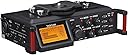
The TASCAM DR-70D is a rugged, portable 4-channel audio recorder designed for videographers and content creators. Featuring four combo XLR/TRS inputs with phantom power, dual built-in stereo microphones, and high-quality HDDA preamps with 64dB gain, it supports SD cards up to 128GB for extended recording sessions. Its compact, camera-mountable design and safety track dual recording mode make it an essential tool for professional-grade on-set audio capture and seamless post-production workflow.


| ASIN | B00OY6718K |
| Best Sellers Rank | #49,850 in Musical Instruments ( See Top 100 in Musical Instruments ) #80 in Portable Studio Recorders |
| Brand | Tascam |
| Compatible Devices | Personal Computer |
| Customer Reviews | 4.4 out of 5 stars 394 Reviews |
| Digital Recording Time | 100 hours |
| Format | WAV |
| Global Trade Identification Number | 00043774031139 |
| Hardware Interface | USB |
| Headphones Jack | 3.5 millimeters |
| Item Type Name | DR-70D |
| Item Weight | 1.2 Pounds |
| Manufacturer | Tascam |
| Memory Storage Capacity | 1 GB |
| Mfr Part Number | DR-70D |
| Microphone Form Factor | Built-In |
| Microphone Operation Mode | Stereo |
| Model Number | DR-70D |
| Number of Batteries | 4 AA batteries required. (included) |
| Screen Size | 1.5 |
| UPC | 043774031139 |
| Unit Count | 1.0 Count |
| Warranty Description | 90 days labor, 1 year parts. |
J**N
Brilliant!!
I come at audio for video with a pretty strong audio background. Tascam has a reliable reputation in the audio industry so when I needed an audio recorder I favored the DR100 mk2 over other brands like say Zoom that have tended to be sort of cheapo equipment in that other industry. The 100mk2 had several major flaws: 1. It's form factor and construction - though great for a handheld audio recorder, it was super awkward to mount with camera hardware, wireless mic receivers, etc... on top of this it had sort of cheap feeling construction 2. It's gain attenuator switch applied to both recording channels instead of having individual controls which created all sorts of havoc working with microphones with radically different gain expectations 3. The inability to partial use of onboard mics along with external was annoying too. The reason I list these issues is because the DR-70D handles all of these problems and more. It's form factor could not be more perfect for working with other video gear. Even if you don't use the feature of screwing it into your camera's tripod attachment (which is genius btw), you can use that feature bolt the d70 into a camera strap or use the screen guards as a convenient attachment for other shoulder straps. Plus it's built tough! The 70D has very discreet controls for each recording channel. You can freely assign inputs and input gain. On top of all that, they've added combo connectors so quarter inch feeds off of a sound board don't need to be converted to xlr, there are 2 more connectors and corresponding tracks, and there are a bunch of other bells and whistles like safety track recording and stereo mapping. The onboard controls are very intuitive too. Finally, the fact that the device outputs 4 discreet audio files when you transfer files to your editor is a nice touch. The simplicity of being able to just drag and drop the files into an editor without splitting them or having to worry about pan settings and whatnot was a great piece of forethought on the engineers part. All this and it's a really inexpensive device! All this is to say that I am very impressed and Tascam is fully redeemed in my eyes.
E**H
Excellent multichannel sound with SDI Timecode Input at a reasonable price!!! Flexible form factor.
This is the second unit I purchased for my Film and Television production class. The first one worked flawlessly until a student dropped it and broke the SDI input, which was a major reason for purchasing this model. We need timecode jam sync so students can learn tradition sync sound film production technique. This Tascam recorder is the least expensive option I've found with a professional timecode in port and high quality audio preamps. If you don't need timecode sync then get the cheaper version without the SDI in port. It's functionally identical. If you need timecode sync then this is a fantastic and reasonably priced option that will not disappoint. Quickly, for those who aren't sure why they might need timecode sync, here are a couple of examples: 1) You want to record high quality audio with professional mics but your camera doesn't have the necessary inputs or function. You will need a separate audio recorder. While it's possible to sync the audio in post through matching waveforms, the best way to accomplish this is with matching timecode. 2) You want to sync multiple cameras and audio. This might be necessary for recording a live event or concert. Practically speaking, the only way to do this reliably is with timecode. You can't rely on picture and audio staying in sync because some cameras may be far enough away from the audio source to create a delay between the visual and the audio. It must also be said that you could use a timecode generator that outputs timecode to an unused audio track. That would eliminate the need for the timecode input. That's an acceptable option but a proper timecode input is the better, more professional, and more flexible option and doesn't require special software to use.
A**R
Great audio recorder - only use memory cards on Tascam's recommended list
I purchased this to capture individual tracks from the mixer when my guitar/vocal duo performs. 4 tracks is perfect. I own a DR-05 that I've used to capture audio of practices and performances and it has worked VERY well for me for the 5 years that I've owned it. With the success of the DR-05, I figured I'd stick with Tascam for a multitrack digital recorder. The form factor is great. It's sturdily build with a metal chassis. The buttons feel solid. The level controls for each channel are a little tight, but not a big deal. It is easily set up and pretty intuitive. I was able to remove the mount on top since I won't be using this with a DSLR. They even give you little rubber plugs to plug the holes if you choose to do this. Sound quality of the recordings is fantastic. I am recording 4 individual mono tracks at 16bit/44.1kHz. Beware that it is very picky about memory cards. I had purchased a 128GB PNY card to use with it. It is the same card that has worked wonderfully for me in my Canon HD camcorder. With this card, the DR-70D would record for an hour or so and stop with a "file write error". This happened numerous times and with multiple cards. I decided to try a SanDisk card from Tascam's recommended list. This works perfectly fine.
D**E
First impressions thus far - A solid little recorder for DSLR use or 'bag' use
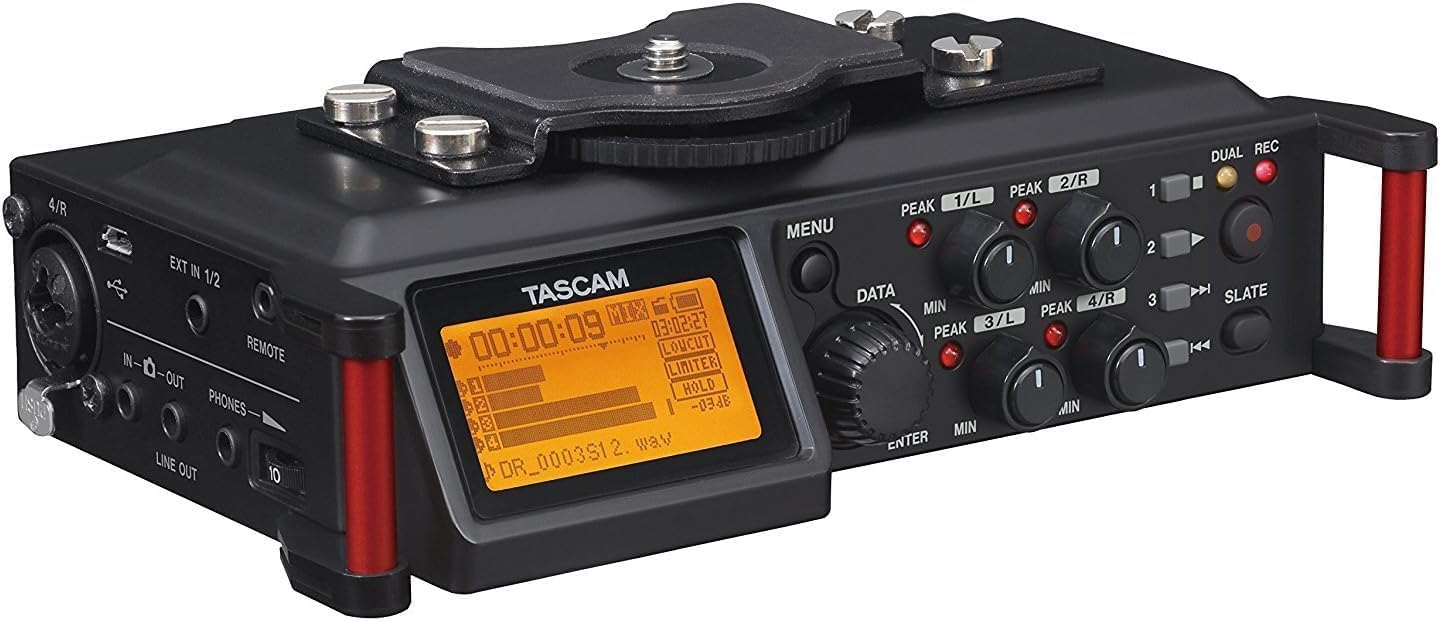
Let's get the most important thing on the table right now: this thing is $300. I've spotted some negativity over various bits of this mixer/recorder around the net, and just about all that negativity is either unfounded and/or completely oblivious of the value that this thing is for its feature set. Show me another 4 track, 4 pot(control knobs) phantom powered recorder on the market for anywhere near this price? Sure you can pick up some higher end mixer/recorders used, but the 70d was targeted at a specific crowd: DSLR/single shooters. So let's dive in. Let's start with a little highlight breakdown: -$300 is damn cheap for a 4 track recorder -Nice size, not too tall, and just wide enough to fit proper controls and screen -4 XLR/TRS inputs, line/camera out, camera in -Phantom power for all XLRs -Sufficient gain settings for inputs and outputs -Limiters and lowcut -SD card in the rear(can't see where else they could have fit it anyways) -Battery/SD door can be annoying, i might just take it out. -Wish all the 1/8" ports were 1/4", but again, size limitation, so can't really nitpick -Battery life is OK, but Zoom's are amazing. -A compressor would have been nice -MP3 option would have been nice -It would have been great if it could make bacon pancakes Overall there's not much you can complain about for 300 bucks Layout & Design It's like a 60d, but shorter and wider, which is a nice change. It's about as small as i think is possible for a 4 XLR unit. It'll fit quite nicely under a full size DSLR, but looks pretty big under anything smaller such as a mirrorless camera. None of that really bothers me though, because it just comes off as a wider base on your tripod, i haven't had it get in the way at all. 3 of the XLRs are on one side, the 4th being on the opposite side. This may sound odd, but having that 1 XLR on the opposite side can come in very handy depending on your setup and wiring. The rest of the connections are on that side as well, nothing sticks out of the front or back. Speaking of the rear, that's where the two onboard mics are, as well as the 4 AA battery bay and SD card port. If your doing camera mounted work, this is totally OK, if you plan on bag work, it could be annoying, but then again: where else could they have stuffed the batteries? I do think they could have squeezed the SD card port somewhere else, but once again, i'm not going to nitpick at this price. Speaking of bag work (what the audio pros do with having all their gear in their audio bag doing production audio) The 70d does have the form factor to work well in a bag despite its relatively tiny footprint. Although it seems targeted at the sole shooter/rungun/under camera type crowd, i do see this as an affordable first mixer/recorder for someone wanting to get into production sound work. It has the essentials, but do some digging and make sure it has everything that you need, as higher end recorders of course come with additional features and tools. The front end of the unit has a small but decent screen, a big enough knob to control it, a record button, slate button, some lights, and those ever useful 4 control knobs. Many recorders sacrifice having a knob-per-input because you typically would make such adjustments with a separate mixer. In this case, the target market being those who likely wouldn't want yet another box to haul/mount/plug, they gave it all 4 knobs. From what i'm told, these are digital knobs, not analog, meaning when you turn the knob it's making a digital adjustment and i found when making fast/big changes it can feel a bit disconnected. Meaning, the change in gain/volume comes a bit after your actually turn the knob. I've only really noticed it in extreme testing of ramping the knobs quickly. Sound quality Subjective for sure, but it's as you can expect from a lower end Tascam, which is to say pretty darn good! It goes up to 24bit, 96khz. There is zero point in doing side by side comparisons with higher end units, because A: this is certainly not higher end, and B: your end viewer isn't getting a side by side to know that the audio could have been better. The rated noise floor is respectable, but not quite as good as higher end models. That said, my subjective ear liked what i heard. One thing that concerned me was an odd amount of noise i had for one of my mics, but it seemed to go away with my general troubleshooting of unplugging/replugging/powercycling. It only occurred with 1 mic, so i cannot blame the 70d outright without further testing. So what i boil that down to is that for this price, you're getting as good a quality as you can expect, it's higher end sound than your camera's built in recorder, and if you think you need better than that, you should be hiring a dedicated audio professional. Clicks? Many folks are wondering if this has one of the 60d faults: since it's digital knobs, the 60d suffered from faint but noticeable clicks when adjusting the levels. Thankfully, that appears to be worked out on the 70d, the level adjustments sound smooth. The only instance i heard a click was with the build in mic, the knob turned all the way down aka OFF, and heard a click just as i started upping the level. This did not occur when i tried the same test on a shotgun mic. Build quality It feels like a mix of metal and plastic, overall feels very good. Both the top and bottom have rubber to ensure good connections, and the camera's bolt goes on/off in a matter of seconds with the large screw head. Knob wise, it feels all plastic, but doesn't feel too cheap. Connection wise, the XLRs all snap in nicely and feel secure. As for the other connections... well, they're all 1/8"(cam/line/headphones/EXT) and micro usb, not great, but for the money it's serviceable. They definitely could have squeezed at least 1 or 2 of those 1/4", but no use in wishing. I did notice my unit's SD card port on the inside is slightly askew, which doesn't really affect anything, just makes the SD card have a slight resistance going in. Menu & features The menu is pretty simple and straightforward, the only shortcuts to get through are the 1,2,3,4 buttons which can jump you through the input settings, otherwise you just use the main dial to pass through each sequentially. You can turn on/off phantom to any of the XLRs, and the 4 inputs are paired in 2s (1/2, 3/4) And you can have it record stereo files accordingly, or mono files. You can also adjust the left/right pan of each pair: channel 1 & 2 can each be totally left/right, or can be mixed together, or dialed to be somewhat left/right. Effects wise, you get a few useful basics: Low cut, & Limiter. Format wise, you only get standard WAV, and BWF, which is a wav with metadata. Operation/Reliability Thus far, it's been mostly smooth, i did have it lock up once, a reboot got it back to normal. During recording i haven't had any hiccups. The battery life indicator hasn't been the most consistent, jumping down pretty quick then hovering around low for quite awhile. I'll need to have a few more tries with different sets of rechargeable. Sum it up It's $300. Seriously, go try and find something comparable for that price. It's by no means perfect, but it has the essentials in there to give DSLR/rungun/single shooters a relatively painless bump in audio inputs and quality. And if you're someone who wants to get into production sound and don't have a big budget, i'd definitely take this over a higher end unit and spend the remaining budget on quality shotgun/wireless mics. But that's just this one guy's opinion, you should of course check out a few more ;)
B**A
My new best friend.
This thing rocks my world. I record a podcast on it. Each speaker gets a track, so people with bad mic technique are easy to fix in post without messing up everyone else's sound. I don't have to carry a laptop with me to make it work. I haven't really used the built-in mics, but they seem as good as anything else you find on recording devices. On a per-track basis, you can control gain with the knobs, a separate customizable gain boost in the menu, panning, phantom power, recording on or off (no wasting disk space and battery to record silence from empty mic ports like on the Zoom H4N), and probably more that I'm forgetting. Battery life is okay, mostly I use it plugged in. One weird quirk: powering it with third party cables may not work properly, but the one that comes in the box works fine. Switches to battery power if it comes unplugged (but don't let it jiggle in and out or it can shut off). Mic ports are super secure, in fact so secure that I worry I might damage the device if I'm not careful in unplugging mics. Build quality feels about medium-durable. I've read that the tripod/camera mounts aren't well built and can damage the device if used roughly, so I don't use them and I treat the whole thing with kid gloves. The little circle thing on the top rattles, which is bad, but I cut off a thin slice of foam from the packaging and stuck it under and now it's still and silent. The knobs are a little hard to control individually, but if you have small to medium hands you'll be fine (mine are dainty and womanish). The battery compartment is fiddly but okay. Date and time resets when you change the batteries, but all other settings are stable. Formatting time on a 32 gig card is faster than my H4N on an 8 gig card. Sound quality is excellent. Having a headphone port and a separate line out is really nice. The device confirms phantom power usage whenever it's switched on, which is great (easy to forget you turned it on for a track). For the price, there is no competition. Fancy mixer interfaces still need a separate computer to work. Nobody has it cheaper than Amazon, at least not right now. Treat it gently and accept the occasional little bump in the road, and you'll love it like you've never loved a gadget before.
R**.
such a great little device
such a great little device. did a wedding and a voiceover for a film, its so small and lightweight and with 2 onboard mic's you don't need anything else for your DSLR camera for guerrilla interviews, but having 4 xlrs recording to 4 channels at a time with little to no self noise or coloration is truly everything anyone should need. Look no further. battery or USB powered. I carry an extra battery pack and plug in USB as the AA batteries can go fast. but they are easy to change. and mounting a camera to the top or bottom, along with another device, or just tripod, really makes this super versatile. recommend a a sescom attenuation cable to allow you to pass sound through to your camera so its recorded in two places or just to save yourself from having to sync audio for situations where you don't otherwise need to (one or two mics that are well balanced, etc. Recommend: Sescom LN2MIC-ZMH4-MON 3.5mm Line to Mic 25dB Attenuation Cable for Zoom H4N with Headphone Monitoring Jack
J**H
I really like this recorder
I really like this recorder. I used it on a shoot recently and it worked very well. It was a small shoot with talent of varied degrees of acting training. Some quiet some louder. I ran 48 volt phantom power to one mic at a time and recorded a safety track and used the low cut filter and had the screen light on constantly. The shoot took about all day. I bought a 14 dollar power supply and velcro'd that to the bottom of the recorder. It powered it all day long without issue. Never switched batteries inside the recorder once and only charged the power bank at lunch as a precaution. Menu is decent when you get the hang of it. I changed from mid setting to low setting in between takes for shots with screaming and audio was coming out clean in the phones. The recorder is small and light. I used an old gun sling strapped to the red rails on the recorder and kept it hanging around my neck and a shoulder pretty much all day. Holding the boom was the bulk of the work as the recorder is pretty light. USB power and a gun sling isn't the most pro rig I've heard of but certainly worked and worked well. For indie film productions you really can't beat these preamps. Only thing I've heard of is that the 3.5mm jack out is pretty noisy. I haven't used it myself but if you're looking for a small affordable option that will beat the hell out of in camera audio, You can't really beat the price and quality of this little recorder. I'll upgrade soon to a better recorder but only because I want to get paid for doing location sound. I assure you I'll keep this and use it as a backup though.
J**E
Build quality is too flimsy, especially battery / SD card door.
I'm amateur musician, and have been recording with a computer interface and dedicated preamps until now, an Audiofire 12 and ART Pro MPA II Reference. The recording quality is very high, but the process entails using a 30ft snake cable between my music room where my grand piano and harpsichord are, and my home office where the desktop computer is located along with recording gear. The 30ft snake runs along the entry to the house which is rather inconvenient when having guests. The snake also means my home office door can't be closed. And the computer isn't completely silent either, though it's located 30ft away. My husband has never been happy with the presence of the snake in the entry way. From a workflow point of view, I also don't want to go to another room to start the computer and record myself. When I play, the last thing I want to think about is computers, and shutting down every process on the machine, turning off power savings, and so on. I sometimes do a lot of takes - 20+ at a time, and then subsequently review edit the footage on the computer. Sometimes, I go back from the computer to playing/recording if I'm not happy with any of the takes. Or I often just call it a night, too. Music more of a nightly hobby for me. I purchased the DR-70D recorder with the intention of locating it close to my instruments and use permanently in place, which would allow me to easily start/stop takes without going to the home office. However, recording onto SD cards meant I would be inserting and removing the SD card from the DR-70D hundreds of times over the life of the device if not thousands, in order to transfer the footage to the computer. As soon as I unpacked the DR-70D from its box, I opened the door that holds the AA batteries and SD card. Opening it was not intuitive, to say the least. It is held by a sort of flexible ribbon that begs for breaking. It was immediately clear that the card/battery door wouldn't hold up to hundreds of times of opening and closing, as I was planning on. I packed the DR-70D right back into the box. I didn't do a single recording, and did not evaluate the quality of the preamps or A/Ds, as I was very sure the device was unsuitable for my usage due to the built quality. I have ordered a Tascam DA-3000 instead, which hopefully is better built as far as the card door and slots go. It is however much bigger, and far more expensive, between 2.5 and 4x the price of the DR-70D, depending sales for each model. The DA-3000 also doesn't have built-in preamps, which means I have to move my ART preamp out of my recording room, too. And finally, I have to get some sort of rack case for the DA-3000 and ART preamp to use them in the music room, as I don't have any rackmount furniture in my home office, just home theater A/V shelves, and there are other devices on them which I don't want to move. This means I will be spending >$1000 on my computer-free recording setup, and it won't be portable, but I didn't really care about the portability aspect in the first place. I also won't have to mess with batteries or battery packs. At least for this amount, I will get 192kHz converters. The DR-70D only does 96 kHz. The Windows drivers for my Audiofire 12 also only go to 96kHz, even though the hardware supports 192 . And of course, the DA-3000 supports DSD recording too. I should thus end up with a much better recording quality overall than the DR-70D can provide.
B**X
Très bon produit. Je recommande.
Très bon produit. Simple et efficace. Consomme pas mal de batterie. Prévoir des rechargeables 4xAA.
T**M
If 4 tracks suits your needs go for the DR-70D
Well made and of sturdy construction, being surprisingly heavier than anticipated but that is so much better than being light and flimsy. The case is made from a mixture of metal and plastic and has a sturdy camera mounting plate on the top. The Tascam DR-70D is designed to sit under a DSLR. However, I have purchased it to work with my Canon Legria HFG25 Camcorder which is a semi-pro device with poor audio facilities, hence my purchase of this unit. The menu hierarchy appears quite easy to follow having a rotary control to maneuver around the options that you can also press to confirm selection. However, this is let down by the failure in the manual to point out that the user also has to press the forwards and reverse keys to move around sub menus, which took a few minutes to work out by trial and error. The unit is quite easy to set up giving the user several options on how they may wish to employ the device. The tracks each have their own level control which is nice and the recording can be setup in several ways employing the tracks separately, in stereo or a mixture of the two. Many of the settings are set up through the menu system which could prove tedious but one must remember this device has intentionally been designed small to sit under a DSLR set up on a video rig. There is therefore not space for numerous occasional controls. You can download the manual before purchase which gives you a lot of information about the DR-70D capability so I won't reiterate it here but save it to say, this little baby does offer a formidable recording facility that far, far out ways the audio capability on pretty well any camera or camcorder. The user who employs this device regularly, will soon become conversant with the control regime and will not be dissatisfied with the quality of the recorded sound file especially if one takes the time to set up the various filters if needed. Some have compared this unit with the ZOOM 6 Handy Digital Recorder, wrongly saying that the DR-70D is a better value out of the two. This is not the case as the Zoom 6 has 6 tracks not 4 like the DR-70D and despite its similar physical size, Zoom have managed to fit a lot of the controls on the front panel and there are more control facilities overall on the Zoom 6. They are both good value but are different animals in terms of capability. They both need a sizable SD card if your going to record large files. The SD card is extra i.e. not included in the original purchase price. The connections are varied and quite well thought out. As on the Zoom 6, the DR-70D sports dual-purpose sockets each capable of accepting XLR and TRS plugs in the same socket. If using XLR, then you can set a phantom voltage of 0, 24 or 48 volts for your mic if required. Another useful facility is the ability to route from and to your camera from the DR-70D and also monitor with headphones. You can also mix down your 4 tracks to a stereo out put if so desired. I recommend down loading the manual before purchase to fully acquaint yourself with the DR-70D capability. If 4 tracks suits your needs go for the DR-70D you'll not be disappointed.
F**O
Recomendado
Lo mejor por el precio, me encanta
J**.
Si te interesa el audio de tus videos...
...y eres un productor de video que trabaje solo y sin un gran presupuesto, este dispositivo es imprescindible. Por experiencia, algunos sabemos que cuando usamos grabadoras de audio aparte, algunas veces y generalmente por nerviosismo se nos olvida pulsar luego del video la de la grabadora de audio con las desagradables sorpresas que esto conlleva. En estos casos es impagable la capacidad que tiene esta DR 701D de ser disparada su grabación por la misma cámara de video vía HDMI grabando, además, señal de código de tiempo. Esto permite una sincronía mediante el código de tiempo, como por ejemplo con Premiere. Debes confirmar que tu cámara puede usar esta función y en la web de Tascam hay un listado. Al día de hoy no está, pero en mi caso confirmo que con la Lumix FZ2000 funciona. Edito para añadir fotos con la grabadora intalada en una situación real de trabajo.
E**S
Uso en set complicado pero bueno
Uno de los grandes pros, es que puedes alimentar esta grabadora con baterías USB. Un tabique ADATA de 20,000mAh te da poder por más de 72 horas de grabación con 2 phantom, desde hace unos 2 años que llevo con esta grabadora nunca se me ha descargado una batería, y aunque así fuera, siempre cargo con al menos 2 de repuesto, ya que son sumamente económicas (salen en menos de $500) y tienen si compras ADATA o alguna marca de renombre, te salen sumamente confiables. El gran problema de las grabadoras de campo de Tascam son sus menús poco intuitivos y nada amigables al usuario sin experiencia. Recomiendo ampliamente que antes de llevarla a trabajos en set, donde cualquier error puede costar que no te contraten de nuevo, debes practicar y sobre todo conocer perfectamente los menús, para que por memoria muscular sepas como solucionar cualquier inconveniente que pueda surgir.
Trustpilot
1 month ago
3 weeks ago