Buy anything from 5,000+ international stores. One checkout price. No surprise fees. Join 2M+ shoppers on Desertcart.
Desertcart purchases this item on your behalf and handles shipping, customs, and support to Vanuatu.
โ๏ธ Power Up Your World!
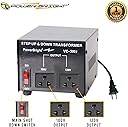
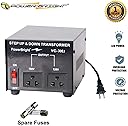
The 500 Watts Japanese Voltage Transformer is a versatile step-up and step-down converter designed for small electronic appliances, ensuring compatibility in both 120V and 100V countries. With CE certification, fuse protection, and a user-friendly design, itโs the perfect travel companion for your devices.


| ASIN | B07F1G8NBP |
| Best Sellers Rank | #245,570 in Tools & Home Improvement ( See Top 100 in Tools & Home Improvement ) #780 in Electrical Adapters |
| Brand Name | PowerBright |
| Current Rating | 3.75 Amps |
| Customer Reviews | 4.1 4.1 out of 5 stars (148) |
| EU Spare Part Availability Duration | 1 Years |
| Item Dimensions D x W x H | 4.7"D x 4.7"W x 6"H |
| Item Weight | 5.94 Pounds |
| Manufacturer | PowerBright |
| Model | VC300J |
| Mounting Type | Wall Mount |
| Part Number | VC300J |
| Power Source | AC |
| Specification Met | CE |
| UPC | 841915000613 |
G**N
Smaller than expected
VC-300J - This is the 300w unit. It is smaller than I expected it to be, which is great, and is very heavy. Looks like itโs made from quality aluminum cover and it feels very sturdy. It worked as expected (Iโm using it for a turntable) and is super quiet (no 60hz hum). Came with simple and clear instructions in proper English.
J**F
Converts Japan to USA voltage and vice versa, and works well
This is one of those devices that you know you need if you need it, and there are surprisingly few of them out there. If you just look up "voltage converters", almost all of them will convert between "110/120" and "220/240". This one does one very different, kind of niche thing - it converts between 100 and 120. I didn't find many of these on Amazon when I bought this, and I ended up buying two of them some years apart as a result. So why would you need to switch between 100 and 120 volts? First, these are the voltages used in Japan and the USA, respectively. They are pretty close and some devices will just work going back and forth between voltages. That's especially true when trying to use American products (120 volt) in Japan (100 volt), where they may often run less efficiently and may seem sluggish, but most things will work. The reverse is not necessarily true, though, and putting 120 volts into a 100 volt device could kill it pretty quickly. Usually not right away, but if a device's internal components are expecting 100 volts, putting 20% more juice in is probably going to be out of tolerance. So it can reduce a device's lifespan, sometimes pretty dramatically. It does depend on the power supply, and you can look on the back of a device to see what voltage it will accept - some do say something like 100-240 volts, and those can be used basically anywhere. But others, especially older devices, might just say 100 volts, meaning that's what their power supply and other components are designed for. So I initially bought this for some Japanese stereo components I have to use in the US... expensive components that I really just didn't want to take any chances with. I tested the output from my 120 volt US outlet through this converter using a Kill-a-Watt device, and it was bang-on 100 volts. Not just close to it; it was exactly 100 volts. The construction of this converter feels pretty beefy to me; it's nice and heavy, and neither of mine were dented or damaged in any way when I got them like I've seen at least one other reviewer say. I've been running mine 24/7 for basically years now with no issues (there is an on/off switch, but I just leave mine on and turn the devices connected to it off, so they act like they're plugged in to any other outlet). There is no audible hum or any other sound coming from it, and while I'd always love anything to be smaller, it's small enough to tuck it away off to the side of a shelf or whatever, on the floor with the power cords and surge protector. I guess I should mention that this is a 300 watt max device, so you wouldn't want to be plugging in something like a hair dryer, space heater or a toaster into it. Anything that generates heat or cool air is going to use almost the maximum power an outlet will supply, which for a Japanese device would be about 1,000-1,200 watts, and for an American device more like 1,500 watts. Don't do that with this. A modern desktop computer is also really a no go, since they can use between 500 and 1,000 watts depending on the internal components and what you're doing. But the type of stuff I'm plugging in, which is all just stereo equipment, uses between 9 and 40 watts max, so I've even got a little power strip that I plug them into, and that goes into the converter. At full bore, the most I'd be using is about 90 watts total with three separate devices, so that's fine. Just look at the wattage requirements for whatever you plan to use this with. Oh, and I'm now in Japan and this converter does go both ways; there's just a switch on the back. I'm actually now using it for my 120 volt devices in Japan. The reason for that is that things like turntables and cassette decks will run slow when given lower voltage than they're designed for, which is obviously not ideal for music. So I've basically just switched which components are connected to the converter; my Japanese components go to the regular wall outlet now, while my American components are plugged into the converter. Again, not an easy device type to find if you need this specific voltage conversion. And it works really well.
M**W
Does the job, but universal outlets not great
Haven't had it long enough to evaluate quality as a whole, but it is doing the job I needed: powering a stereo imported from Japan that requires 100V. The only complaint so far is the "universal outlets" - they are not easy to get a 2-prong plug into. The vertical prongs want to go into the sideways "clamps" that appear designed for the sideways prongs I've seen on some plugs. You have to kind of spread them apart to get the prongs in between them. This may be intentional to put adequate pressure on the plug, but it makes it a bit of a hassle to plug something in.
F**.
Japanese to American transformer
Seems like an excellent transformer. This thing has some heft it's is a brick. As others have mentioned quality transformer with suspect and substandard assembly. Smashed insulation, black wire in picture, and exposed cold solder joint. Working correctly however after a quick observation it probably should have a good once over before it's left unattended.
A**R
Safety Hazard but if you're qualified to work with electricity you can fix this.
An inexpensive transformer to step power down to run Japanese (or other country) devices that need 100 Volts AC instead of 120 Volts (USA). HOWEVER: The case material is very VERY thin, and the transformer is very heavy, so it's almost certain yours will arrive all bent up, which makes it dangerous to use. If that's the case, then DO NOT PLUG IT IN! Just return it and get a refund, because the next one will probably come bent up also. Now, I've been working with electronics and electricity for many years, and I accept responsibility for my own actions and accept all risk for taking things apart, and I know the warranty on mine expired as soon as I took my tools to it. So, I fixed mine. Without advising anyone to do what I did, I'll tell you what I did so I could keep this instead of returning it. First, I took the cabinet apart, and loosened the transformer from the base. I straightened up all the bent sheet metal that had the transformer bent and at risk of shorting out the power lines. Then, I cut out the old two prong cord, because this unit comes with three prong outlets that are supposed to be grounded. So, I installed a three prong power cord and made sure the green wire was tied to ground, the blue wire was tied to the neutral side of the outlet, and the BROWN wire was tied to the hot side. I tested all this with a DMM. In the course of doing this, I found a bad solder joint (a wire just popped off on its own), and fixed that, and I put shrink tubing on all connections to provide additional protection. If you don't understand any of the electrical terms I used above, and don't know the difference between "hot", "neutral", and "ground" (or "earth"), then just return yours. Try your luck at not getting one that's bent up, or just ask for your money back. Funny thing: Right after I got this, I found, at the swap meet, a very old, vintage step down transformer from the 1950s or '60s, which does the same thing, so I didn't really need this after all! Well, now I guess I have one to give away in case I sell something in the USA that was meant for Japanese 100 Volt power.
T**H
Does Exactly What It's Supposed To Do
Purchased this to run Japanese voltage electronics. Works perfectly. Build quality is excellent. I leave the switch on the back on all the time and the unit does not generate excess heat. The only thing is that I did not get the extra fuses pictured on the purchase page - they could be inside the unit. Would purchase again.
S**O
No funciono
E**.
Verified voltage and so far itโs working perfectly
K**V
Perfect for my Japanese PlayStation 2!
T**.
Opened the box and the fuse inside was blown. No backup fuses supplied. No instructions. Looks like cheap Chinese quality. Dead on arrival.
P**N
ITS OK
Trustpilot
1 week ago
2 weeks ago