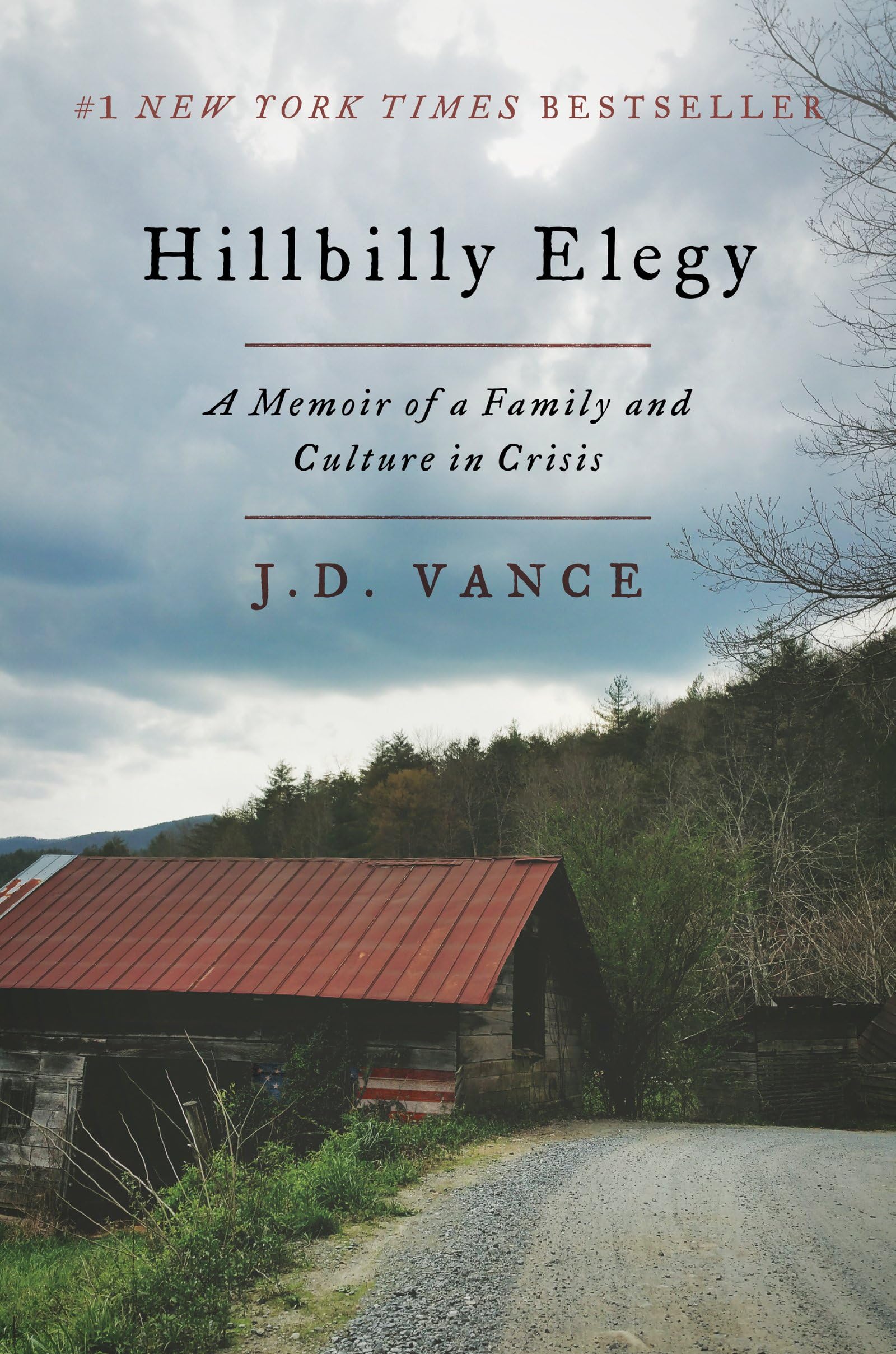

Hillbilly Elegy: A Memoir of a Family and Culture in Crisis
Product ID: 29946817
Buy anything from 5,000+ international stores. One checkout price. No surprise fees. Join 2M+ shoppers on Desertcart.
Desertcart purchases this item on your behalf and handles shipping, customs, and support to Vanuatu.
Hillbilly Elegy: A Memoir of a Family and Culture in Crisis [Vance, J. D.] on desertcart.com. *FREE* shipping on qualifying offers. Hillbilly Elegy: A Memoir of a Family and Culture in Crisis Review: Inspiring - I read The Hillbilly Elegy by J.D. Vance because it is on my daughter’s reading list this summer and reading what she reads allows me to connect with her through our life long love of books. The Hillbilly Elegy is the best book I’ve read in a long time. The last book I read on my daughter’s list was Ayn Rand’s Anthem, and the classical rhetorical laced with her “I” agenda made me graze pages like a fat cow eager for slaughter. Kill me, please! No offense to Rand, she has her merits, but I wanted a story. I am a big tootsie pop (sucker) for good stories. Now several key ingredients make up a well-constructed story beginning with a Shakespearean understanding of the human condition. 1. Vance understands the human condition. The human condition are the characteristics, essential events, and particular events which evolve around birth, growth, and inner and outer conflict. “Mamaw could spew venom like a Marine Corps drill instructor, but what she saw in our community didn’t just piss her off. It broke her heart.” Vance understands what motivates the anger behind his Mamaw’s words, and it cuts at the core of the human condition. Vance’s book is loaded with this understanding, not just Mamaw, but his father and the reason he gave him up in the first place, his mother and her continuous struggle with drugs and men, his Aunt Wee, and his sister Lindsay, and finally his own human condition revealed in the monster dream at the end. 2. Themes of forgiveness bathed in hope and the strength to overcome adversity. Vance came from dirt poor and turned Ivy League Yale graduate now living the American dream. He didn’t make that journey with the human feelings of anger and resentment that often blames others for their circumstances; He made it with love, forgiveness and understanding. “For me understanding my past and knowing I wasn’t doomed gave me the hope and fortitude to deal with the demons of my youth.” 3. Humility: Vance credits his success hugely to his mamaw and papaw. “Few of even my closest friends understood how utterly hopeless my life would have been without Mamaw and Papaw. So maybe I just wanted to give credit where credit is due.” He doesn’t only credit Mamaw and Papaw, but a whole slew of blue-collar workers who helped him to achieve his Ivy League dream. These people include his sister, his cousin Gail, his Aunt Wee and even his mother, despite her many problems, instilled in him a lifelong love of education. Vance says, “Remove any of these people from the equation and I’m probably screwed.” 4. Accessibility: The Hemingway/Shrunk in White style of writing has a conversational syntax that can be grasped by anyone. Vance may be Ivy League now, but he still has the heart of his hillbilly ancestors and he knows how to speak to them and for them. 5. Humor: This book will make you laugh out loud despite some of the horrific circumstances in Vance’s childhood, the laughter was the hope as conveyed in many of Mamaw’s speeches, especially this particular one on bullying. “And she said something I will never forget: ‘Sometimes, honey, you have to fight, even when you’re not defending yourself. Sometimes it’s just the right thing to do.’ Then she taught me a move, a swift hard (make sure to turn your hips) punch right to the gut.” 6. Solutions: Glass Castle by Jeanette Walls is similar to Vance’s Hillbilly Elegy because it shows a tough upbringing turned successful; however, as good as that story was, Walls did not offer any solutions for the homeless. Now, I’m not saying Vance offers great solutions for the problems with poverty in our country, but he does offer simple solutions, ones involving self-examination and our role in society. Recently, someone told me to read Black Rednecks and White Liberals by Thomas Sowell (the title made me hesitate reminding me of a book Tom Buchanan liked in The Great Gatsby), now while this book probably offers great solutions; It was not what I looked for with Vance’s book. In Vance’s book I looked for a story about a poor boy who went Ivy. Vance’s book is a memoir and the parallel to Sowell’s non-fiction book just doesn’t work here. I recommend Vance’s book to all of those people who still believe in the American Dream and the hope and love where good family support fuels the dream. Vance’s tone is so optimistic for those wanting to follow a similar path, and even more so to everyone who wants stability, a home, a family and love. Review: More questions than answers - J.D. Vance chronicles his "upwardly mobile" journey from a dirt-poor boy in the backwoods of Kentucky, to a Yale-educated lawyer in Washington D.C. It is quite a journey, to be sure. J.D.'s story is one of family ties, bad choices, cyclical dysfunction, and in some cases, redemption. "Hillbilly Elegy" first landed on my reading list due to an article in my newsfeed that listed Vance's memoir as potential insight into the group that supposedly swung this year's election in favor of Donald Trump - poor, working-class whites in the country's rust belt. We do indeed get an insider's glimpse into the mindset and lifestyle of the poor, white communities in Appalachia and surrounding regions. Yet politics and analysis is minimal, so any link between the group in question and our president is left mostly as an exercise for the reader. The book is fascinating on many levels, the least of which was the dichotomy between the strong family ties upon which the hillbillies draw their strength and honor, and the dysfunction, cheating, brawling, and deep-seated anger present in their everyday lives. Blood is indeed, thicker than water. To me, the real question is just how we break the cycle of poverty and bad choices. One particular story Vance relays typifies the scenario played out over and over in his community. A young man with a pregnant girlfriend landed a decent job in a tile warehouse. This man was chronically late, missed work at least once a week, and took hour-long bathroom breaks. Though warned repeatedly, his behavior did not change. Yet when he was finally fired, he lashed out at the manager for being inconsiderate of his difficult home situation (which, of course, he created in the first place!). This mindset of blaming others is very prevalent throughout the book. The author, however, places some of the blame at the foot of the conservative rhetoric - instead of pushing the poor to engage their issues, "the message of the right is increasingly: It’s not your fault that you’re a loser; it’s the government’s fault." I think this is a bit of a cop out, and to be honest, struck me as pandering to liberal elite that runs most of the media in this country. I would suggest that the creation of our massive welfare state, and the dependence of the poor on government handouts with little to no accountability is much more responsible for the poor's inability to truly confront their station in life. Similarly, Vance takes some time to disparage evangelical theology as taught by the church his dad attended. To be sure, there is often much to disparage. In fact, the suspicion of science and government held by his dad's church mirrors the attitude of many of my fellow evangelical brothers and sisters. Yet, the irony that his dad's home life was one of the few peaceful and stable families in his entire existence is not lost on Vance. In fact, he admits, "Dad embodied a phenomenon social scientists have observed for decades: Religious folks are much happier. Regular church attendees commit fewer crimes, are in better health, live longer, make more money, drop out of high school less frequently, and finish college more frequently than those who don’t attend church at all." Sometimes I think society at large wants the results of what they find in the church and organized religion, yet chafe at the thought of being told what to do, and what behavior is acceptable and what is not. The fact that possibly you can't get one without the other is a possibility our "enlightened" minds simply do not want to consider. And what is it, exactly, that these church-going people find at church? It's not a "phenomenon," as Vance categorizes it, but the power of Jesus Christ. I feel I would be remiss, as well, at this point not to push back against a sentiment Vance conveys as popular truth - evangelical churches are shedding members at an alarming rate. As a proof-point, he references an article from the Huffington Post that makes the tired claim that evangelicalism is being rejected by the current generation. Huffington Post, the darling child of hipsters and liberals everywhere, has never been a friend of evangelicals, and I would hope other, more balanced studies would be considered. The book, "Christians are Hate-Filled Hypocrites...And Other Lies You've Been Told" is a good place to start. Using strong scientific and statistical analysis, it directly refutes some of the very studies mentioned in the HP article. Anyway, I digress. Admittedly, conservative politics and the supposed failure of evangelicalism are overall a smaller focus in the book. For the most part, Vance simply recounts the story of his life, and that of his closest relatives. It is fascinating, heart-breaking, and often akin to watching the proverbial train wreck. In fact, I wonder if that is one reason the book has been so popular. For most of us, we can read about the dysfunction so prevalent in Vance's upbringing and pat ourselves on the back - we're not perfect, but at least we're not as bad as that Vance clan! Only near the end of the book, in Chapter 14, does Vance attempt some deeper analysis and retrospective thinking. And I would hope we would do the same. The situation surrounding poor, working-class whites in the Midwest, similar to that surrounding African Americans in urban settings, is complex and difficult, with no easy answers. But that doesn't mean we should't still be tackling these inconvenient issues. Everything from how we respond to the poor, to how we treat our spouse, is on the table. I appreciate Vance airing out his dirty laundry. I doubt many of us would want our family's deepest and darkest secrets to be exposed in a book for all to read. But in doing so, he gives us the opportunity to participate in the plight of an entire segment of our population that, until the last year, was rarely spoken of. --------------- I noticed desertcart and Goodreads have a slightly different meanings to their 5-point scale. I thought it was odd to have a different rating for the same book on two different sites, so I came up with my own scale below. For the record, it is fairly close to desertcart's scale, but allows me to be consistent between both sites. 5 - Fantastic. Life-altering. Maybe only 25 in a lifetime. 4 - Very good. 3 - Worth your time. 2 - Not very good. 1 - Atrocious


| ASIN | 0062300547 |
| Best Sellers Rank | #11,685 in Books ( See Top 100 in Books ) #10 in Government Social Policy #59 in Memoirs (Books) #62 in U.S. State & Local History |
| Customer Reviews | 4.4 4.4 out of 5 stars (124,772) |
| Dimensions | 6 x 0.93 x 9 inches |
| Edition | Reprint Ed. |
| ISBN-10 | 9780062300546 |
| ISBN-13 | 978-0062300546 |
| Item Weight | 1.1 pounds |
| Language | English |
| Print length | 272 pages |
| Publication date | June 28, 2016 |
| Publisher | Harper |
W**L
Inspiring
I read The Hillbilly Elegy by J.D. Vance because it is on my daughter’s reading list this summer and reading what she reads allows me to connect with her through our life long love of books. The Hillbilly Elegy is the best book I’ve read in a long time. The last book I read on my daughter’s list was Ayn Rand’s Anthem, and the classical rhetorical laced with her “I” agenda made me graze pages like a fat cow eager for slaughter. Kill me, please! No offense to Rand, she has her merits, but I wanted a story. I am a big tootsie pop (sucker) for good stories. Now several key ingredients make up a well-constructed story beginning with a Shakespearean understanding of the human condition. 1. Vance understands the human condition. The human condition are the characteristics, essential events, and particular events which evolve around birth, growth, and inner and outer conflict. “Mamaw could spew venom like a Marine Corps drill instructor, but what she saw in our community didn’t just piss her off. It broke her heart.” Vance understands what motivates the anger behind his Mamaw’s words, and it cuts at the core of the human condition. Vance’s book is loaded with this understanding, not just Mamaw, but his father and the reason he gave him up in the first place, his mother and her continuous struggle with drugs and men, his Aunt Wee, and his sister Lindsay, and finally his own human condition revealed in the monster dream at the end. 2. Themes of forgiveness bathed in hope and the strength to overcome adversity. Vance came from dirt poor and turned Ivy League Yale graduate now living the American dream. He didn’t make that journey with the human feelings of anger and resentment that often blames others for their circumstances; He made it with love, forgiveness and understanding. “For me understanding my past and knowing I wasn’t doomed gave me the hope and fortitude to deal with the demons of my youth.” 3. Humility: Vance credits his success hugely to his mamaw and papaw. “Few of even my closest friends understood how utterly hopeless my life would have been without Mamaw and Papaw. So maybe I just wanted to give credit where credit is due.” He doesn’t only credit Mamaw and Papaw, but a whole slew of blue-collar workers who helped him to achieve his Ivy League dream. These people include his sister, his cousin Gail, his Aunt Wee and even his mother, despite her many problems, instilled in him a lifelong love of education. Vance says, “Remove any of these people from the equation and I’m probably screwed.” 4. Accessibility: The Hemingway/Shrunk in White style of writing has a conversational syntax that can be grasped by anyone. Vance may be Ivy League now, but he still has the heart of his hillbilly ancestors and he knows how to speak to them and for them. 5. Humor: This book will make you laugh out loud despite some of the horrific circumstances in Vance’s childhood, the laughter was the hope as conveyed in many of Mamaw’s speeches, especially this particular one on bullying. “And she said something I will never forget: ‘Sometimes, honey, you have to fight, even when you’re not defending yourself. Sometimes it’s just the right thing to do.’ Then she taught me a move, a swift hard (make sure to turn your hips) punch right to the gut.” 6. Solutions: Glass Castle by Jeanette Walls is similar to Vance’s Hillbilly Elegy because it shows a tough upbringing turned successful; however, as good as that story was, Walls did not offer any solutions for the homeless. Now, I’m not saying Vance offers great solutions for the problems with poverty in our country, but he does offer simple solutions, ones involving self-examination and our role in society. Recently, someone told me to read Black Rednecks and White Liberals by Thomas Sowell (the title made me hesitate reminding me of a book Tom Buchanan liked in The Great Gatsby), now while this book probably offers great solutions; It was not what I looked for with Vance’s book. In Vance’s book I looked for a story about a poor boy who went Ivy. Vance’s book is a memoir and the parallel to Sowell’s non-fiction book just doesn’t work here. I recommend Vance’s book to all of those people who still believe in the American Dream and the hope and love where good family support fuels the dream. Vance’s tone is so optimistic for those wanting to follow a similar path, and even more so to everyone who wants stability, a home, a family and love.
J**R
More questions than answers
J.D. Vance chronicles his "upwardly mobile" journey from a dirt-poor boy in the backwoods of Kentucky, to a Yale-educated lawyer in Washington D.C. It is quite a journey, to be sure. J.D.'s story is one of family ties, bad choices, cyclical dysfunction, and in some cases, redemption. "Hillbilly Elegy" first landed on my reading list due to an article in my newsfeed that listed Vance's memoir as potential insight into the group that supposedly swung this year's election in favor of Donald Trump - poor, working-class whites in the country's rust belt. We do indeed get an insider's glimpse into the mindset and lifestyle of the poor, white communities in Appalachia and surrounding regions. Yet politics and analysis is minimal, so any link between the group in question and our president is left mostly as an exercise for the reader. The book is fascinating on many levels, the least of which was the dichotomy between the strong family ties upon which the hillbillies draw their strength and honor, and the dysfunction, cheating, brawling, and deep-seated anger present in their everyday lives. Blood is indeed, thicker than water. To me, the real question is just how we break the cycle of poverty and bad choices. One particular story Vance relays typifies the scenario played out over and over in his community. A young man with a pregnant girlfriend landed a decent job in a tile warehouse. This man was chronically late, missed work at least once a week, and took hour-long bathroom breaks. Though warned repeatedly, his behavior did not change. Yet when he was finally fired, he lashed out at the manager for being inconsiderate of his difficult home situation (which, of course, he created in the first place!). This mindset of blaming others is very prevalent throughout the book. The author, however, places some of the blame at the foot of the conservative rhetoric - instead of pushing the poor to engage their issues, "the message of the right is increasingly: It’s not your fault that you’re a loser; it’s the government’s fault." I think this is a bit of a cop out, and to be honest, struck me as pandering to liberal elite that runs most of the media in this country. I would suggest that the creation of our massive welfare state, and the dependence of the poor on government handouts with little to no accountability is much more responsible for the poor's inability to truly confront their station in life. Similarly, Vance takes some time to disparage evangelical theology as taught by the church his dad attended. To be sure, there is often much to disparage. In fact, the suspicion of science and government held by his dad's church mirrors the attitude of many of my fellow evangelical brothers and sisters. Yet, the irony that his dad's home life was one of the few peaceful and stable families in his entire existence is not lost on Vance. In fact, he admits, "Dad embodied a phenomenon social scientists have observed for decades: Religious folks are much happier. Regular church attendees commit fewer crimes, are in better health, live longer, make more money, drop out of high school less frequently, and finish college more frequently than those who don’t attend church at all." Sometimes I think society at large wants the results of what they find in the church and organized religion, yet chafe at the thought of being told what to do, and what behavior is acceptable and what is not. The fact that possibly you can't get one without the other is a possibility our "enlightened" minds simply do not want to consider. And what is it, exactly, that these church-going people find at church? It's not a "phenomenon," as Vance categorizes it, but the power of Jesus Christ. I feel I would be remiss, as well, at this point not to push back against a sentiment Vance conveys as popular truth - evangelical churches are shedding members at an alarming rate. As a proof-point, he references an article from the Huffington Post that makes the tired claim that evangelicalism is being rejected by the current generation. Huffington Post, the darling child of hipsters and liberals everywhere, has never been a friend of evangelicals, and I would hope other, more balanced studies would be considered. The book, "Christians are Hate-Filled Hypocrites...And Other Lies You've Been Told" is a good place to start. Using strong scientific and statistical analysis, it directly refutes some of the very studies mentioned in the HP article. Anyway, I digress. Admittedly, conservative politics and the supposed failure of evangelicalism are overall a smaller focus in the book. For the most part, Vance simply recounts the story of his life, and that of his closest relatives. It is fascinating, heart-breaking, and often akin to watching the proverbial train wreck. In fact, I wonder if that is one reason the book has been so popular. For most of us, we can read about the dysfunction so prevalent in Vance's upbringing and pat ourselves on the back - we're not perfect, but at least we're not as bad as that Vance clan! Only near the end of the book, in Chapter 14, does Vance attempt some deeper analysis and retrospective thinking. And I would hope we would do the same. The situation surrounding poor, working-class whites in the Midwest, similar to that surrounding African Americans in urban settings, is complex and difficult, with no easy answers. But that doesn't mean we should't still be tackling these inconvenient issues. Everything from how we respond to the poor, to how we treat our spouse, is on the table. I appreciate Vance airing out his dirty laundry. I doubt many of us would want our family's deepest and darkest secrets to be exposed in a book for all to read. But in doing so, he gives us the opportunity to participate in the plight of an entire segment of our population that, until the last year, was rarely spoken of. --------------- I noticed Amazon and Goodreads have a slightly different meanings to their 5-point scale. I thought it was odd to have a different rating for the same book on two different sites, so I came up with my own scale below. For the record, it is fairly close to Amazon's scale, but allows me to be consistent between both sites. 5 - Fantastic. Life-altering. Maybe only 25 in a lifetime. 4 - Very good. 3 - Worth your time. 2 - Not very good. 1 - Atrocious
相**介
From the opening till the end, the author has calmly and objectively relived his own history. Very insightful, and though not all facts are so merry, the entire tone of the book remained somehow positive and upbeat. Excellent read.
S**A
As a non-American this book is a great insight into the American mindset. JD Vance has been tagged by Trump as his running mate and I was curious about the man as to me he was an unknown entity. I was pleasantly surprised as the book is written with an unprecedented wisdom and empathy. I considered watching the Netflix film but realized that the book, being written from a personal perspective, could never be translated effectively into film. I wanted to “hear” the story “directly from the horses mouth”. I will be giving this book as a gift to friends if only to help some see past anti-Republican and Anti-American sentiments to the complex people behind.
F**R
Great book.
W**O
Autobiographie des vielleicht nächsten US Präsidenten?
B**N
I was hovering between 4 & 5 stars for this book, but, what I can say is that it is the sort of book you can't seem to put down. It was a real eye-opener into the world of hillbilly America. The story was raw to say the least, yet JD Vance rose above all the obstacles of his early life and family history to reach be the second-in-command to the President of the United States of America. I honestly believe and hope that one day he will be President. There are many similarities between JD Vance's story and that of our own Jacinta Price, raised in remote Aboriginal communities, and now making her mark in Australian politics. Who knows what the future holds for these two battler survivors.
Trustpilot
2 months ago
5 days ago