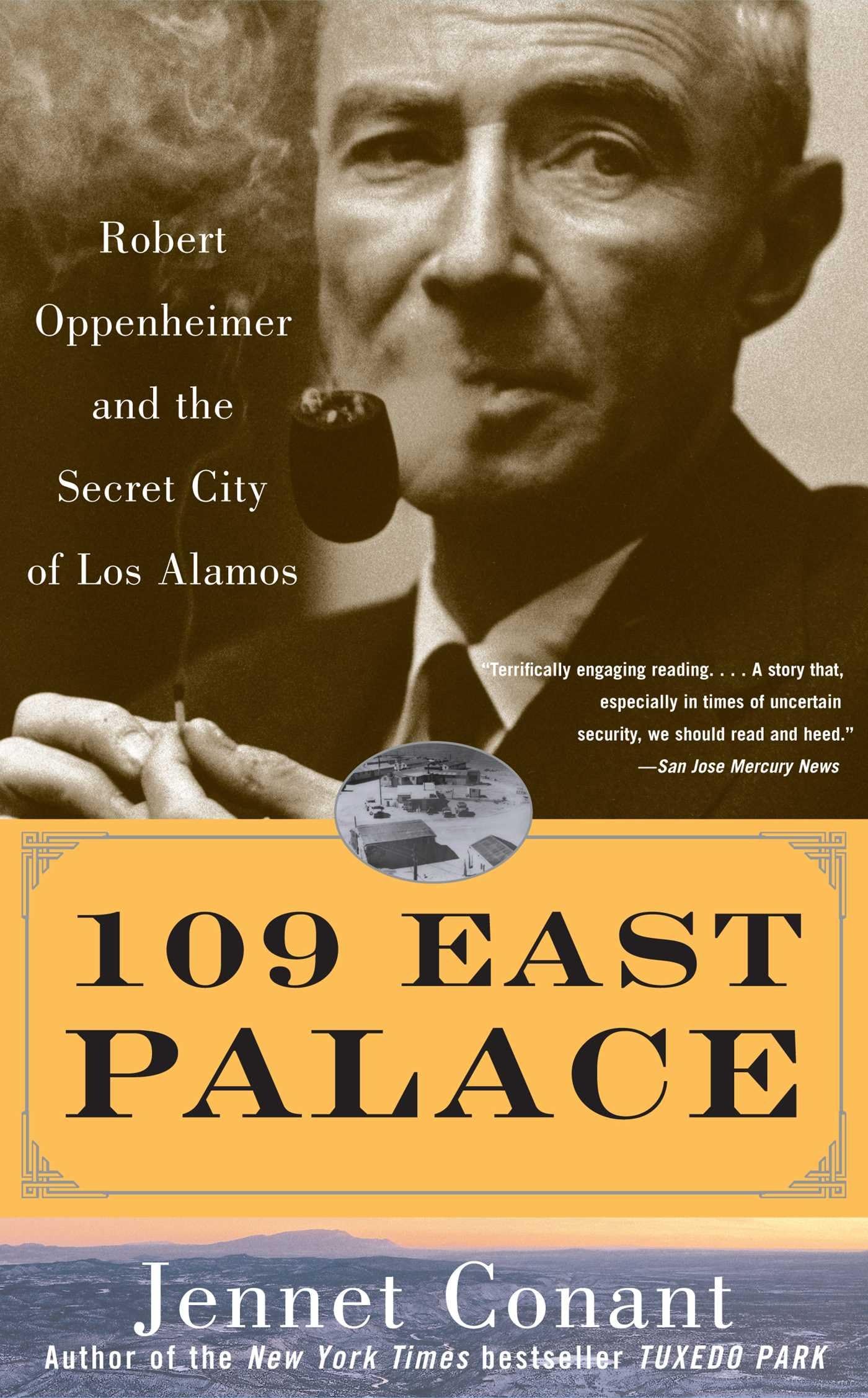
109 East Palace: Robert Oppenheimer and the Secret City of Los Alamos
Product ID: 1298256
Buy anything from 5,000+ international stores. One checkout price. No surprise fees. Join 2M+ shoppers on Desertcart.
Desertcart purchases this item on your behalf and handles shipping, customs, and support to Vanuatu.
109 East Palace: Robert Oppenheimer and the Secret City of Los Alamos [Conant, Jennet] on desertcart.com. *FREE* shipping on qualifying offers. 109 East Palace: Robert Oppenheimer and the Secret City of Los Alamos Review: The people that made the Manhattan Project a success. - What a great read. I can’t say enough about the insight Jennet Conant puts into this work. She has done a masterful job weaving the intricacies of the bomb development, political up-heavel and meshing of over inflated egos into a precise, easy to digest, complex subject matter. We all know Oppenheimer was dubbed, the “Father of the Atomic Bomb,” but how was he able to do it is the real story. We were in a race to beat Germany to the draw. Everyone knew, if Hitler got there first, he’d waste no time nuking Moscow, London, Warsaw or any other target in Europe. General Groves chooses Oppenheimer to lead the charge at Los Alamos. Talk about two diametric individuals, Oppie is the quintessential academian while Groves is hardcore military. War does make strange bedfellows. But the glue that holds this tenuous détente together is Dorothy McKibbins whom Oppie hired. Without her organizational skills and calm demeanor, it’s questionable whether the Manhattan Project would have succeeded. She was the prop master behind the curtain that allowed the performers to shine. You name it and she saw it was handled even it wasn’t in her job title: housing, food, transportation, entertainment, lost luggage, passes, credentials. No one stepped foot into the compound until she vetted him or her. The only time she allowed a stranger onto the base was when a B-29 pilot arrived late for a meeting. She sized him up in a few minutes and decided, he was okay. The pilot? None other than Colonel Paul Tibbets. I’d say she was a good judge of character. No matter what task Oppie asked Dorothy to perform, she never balked. She, like many women were mesmerized by this soft spoken giant in the world of Physics. Whether he knew it or not, he had quite an effect on the female persuasion, yet stay true to his wife Kitty. Without going into too much detail, she loved this man for his energy, kindness, compassion and wit. Oppie’s drawback was his intelligence and superior attitude. Many of his colleagues embraced it while others, who felt his harsh wit, held high resentment, including the military. After the war, we are aware of the McCarthy hearings and how they were designed to weed out any and all people who were remotely connected to the Communist Party. Many of the scientists who worked on the bomb, for whatever reasons had joined the party, but were not active. It was the thing to do. The identification of Fuchs and the Rosenbergs as Russian spies added salt to the wound. Oppenheimer would be grilled at congressional hearings for not releasing the name of a would-be informant. His naivety of political workings would be his temporary downfall in the public eye. No textbook or theorem could prepare him for the inner workings of Washington. This is an excellent read for anyone interested in the inner workings of Los Alamos and the individuals who launched the world into the atomic age. Five Stars! Review: Beautifully written; impeccably researched; almost impossible to read. - I am amazed at the work that Ms. Conant put into this book. It is a marvel of both research and writing. However, for me, there is one major flaw: the type is so small that I had to put on reading glasses two times stronger - and then got eyestrain if I read for too long. What a shame to make an amazing piece of journalism such a trial to enjoy! Still - I highly recommend this book. If you have strong reading glasses!


| Best Sellers Rank | #207,400 in Books ( See Top 100 in Books ) #38 in Nuclear Weapons & Warfare History (Books) #753 in World War II History (Books) #859 in U.S. State & Local History |
| Customer Reviews | 4.6 4.6 out of 5 stars (1,400) |
| Dimensions | 5.5 x 1.1 x 8.44 inches |
| Edition | Reprint |
| ISBN-10 | 0743250087 |
| ISBN-13 | 978-0743250085 |
| Item Weight | 14.7 ounces |
| Language | English |
| Print length | 448 pages |
| Publication date | May 8, 2006 |
| Publisher | Simon & Schuster |
J**N
The people that made the Manhattan Project a success.
What a great read. I can’t say enough about the insight Jennet Conant puts into this work. She has done a masterful job weaving the intricacies of the bomb development, political up-heavel and meshing of over inflated egos into a precise, easy to digest, complex subject matter. We all know Oppenheimer was dubbed, the “Father of the Atomic Bomb,” but how was he able to do it is the real story. We were in a race to beat Germany to the draw. Everyone knew, if Hitler got there first, he’d waste no time nuking Moscow, London, Warsaw or any other target in Europe. General Groves chooses Oppenheimer to lead the charge at Los Alamos. Talk about two diametric individuals, Oppie is the quintessential academian while Groves is hardcore military. War does make strange bedfellows. But the glue that holds this tenuous détente together is Dorothy McKibbins whom Oppie hired. Without her organizational skills and calm demeanor, it’s questionable whether the Manhattan Project would have succeeded. She was the prop master behind the curtain that allowed the performers to shine. You name it and she saw it was handled even it wasn’t in her job title: housing, food, transportation, entertainment, lost luggage, passes, credentials. No one stepped foot into the compound until she vetted him or her. The only time she allowed a stranger onto the base was when a B-29 pilot arrived late for a meeting. She sized him up in a few minutes and decided, he was okay. The pilot? None other than Colonel Paul Tibbets. I’d say she was a good judge of character. No matter what task Oppie asked Dorothy to perform, she never balked. She, like many women were mesmerized by this soft spoken giant in the world of Physics. Whether he knew it or not, he had quite an effect on the female persuasion, yet stay true to his wife Kitty. Without going into too much detail, she loved this man for his energy, kindness, compassion and wit. Oppie’s drawback was his intelligence and superior attitude. Many of his colleagues embraced it while others, who felt his harsh wit, held high resentment, including the military. After the war, we are aware of the McCarthy hearings and how they were designed to weed out any and all people who were remotely connected to the Communist Party. Many of the scientists who worked on the bomb, for whatever reasons had joined the party, but were not active. It was the thing to do. The identification of Fuchs and the Rosenbergs as Russian spies added salt to the wound. Oppenheimer would be grilled at congressional hearings for not releasing the name of a would-be informant. His naivety of political workings would be his temporary downfall in the public eye. No textbook or theorem could prepare him for the inner workings of Washington. This is an excellent read for anyone interested in the inner workings of Los Alamos and the individuals who launched the world into the atomic age. Five Stars!
W**R
Beautifully written; impeccably researched; almost impossible to read.
I am amazed at the work that Ms. Conant put into this book. It is a marvel of both research and writing. However, for me, there is one major flaw: the type is so small that I had to put on reading glasses two times stronger - and then got eyestrain if I read for too long. What a shame to make an amazing piece of journalism such a trial to enjoy! Still - I highly recommend this book. If you have strong reading glasses!
A**Z
The human side of the Manhattan project - Well paced and informative
There are a lot of books about the the Manhattan project . This book concentrates solely on Los Alamos which most people think was the entirety of the Manhattan project; it wasn't. Los Alamos was an isolated boys school whose location was known to Robert Oppenheimer who thought it would be an ideal spot for a secret project. The initial plan was for a laboratory of just a few people. This is the story of how this plan grew into a facility with several thousand people who all first came to the site through a small office based at 109 East Palace in Santa Fe. How the chaos was managed by a small staff was another endeavour that is often overlooked when contemplating the achievements of Los Alamos itself. This is full of very human and personal stories woven together in a very enagaging style by Jennet Conant. I found it very a enjoyable and illuminating book which added colour and flavour to the story of Los Alamos. I did feel it went a bit past its remit by talking about the post-war story of Oppie and McCarty but this didn't spoil the book. If you have an interest in World War II history and the Manhattan project this is a fascinating book about the period which brings a necessary human scale to the story.
J**.
All the Kings horses and all the Kings men
A wonderful book, filling in so many of the blanks. It was written from a personal perspective with so much information that enables you be there while this monumental task was being undertaken. It continues on to the happenings that occurred in the coming years to many of the scientists and to Oppenheimer particularly. McCarthyism played a part in the mood of the country during this time and many jumped on board. It seemed some to make a name for themselves. It calls to mind “No good deed goes unpunished “
A**R
The author gives an inside view as to the different personalities which actually helped me enjoy the movie Oppenheimer
K**R
A brilliant account of the Manhattan Project, the development of the atomic bomb, and its key players and after-effects. I have sampled many books on this subject, varying from very factual accounts of the science and politics to very personalised memoirs and biographies. This is the only book so far on the subject that I have managed to read all the way to the end without skipping anything. I wouldn't hesitate to recommend this book to anyone with an interest in the subject. It is very easy to follow, even for those who know little about the history, and it presents the story and the facts and the people in a very human way. By the end of the book, which ends with the last days of several of the key players, I was left feeling like I knew these people, touched by their passing and taking a moment to pause and consider their lives and work and how everything came together to form what is now regarded as one of the most tragic offences in military history, a unique episode in our semi-recent past. I did find myself having several of those "what if?" moments where you consider how one minor detail being different could literally have changed the course of history on a worldwide scale. This is particularly true of Dorothy's part in the project and it is fascinating to see this civilian/military endeavour described almost first hand. Having already been familiar with the basic facts from history lessons, I found myself appreciating what I already knew on a much more personal level and in a much more detailed and 'real' way - thinking about these big historical events in everyday terms is often difficult and most people tend to retain only important dates and one-line biographies, rather than an accurate overall picture. Reading the book, I felt drawn into a truly unique society that was formed nearly 70 years ago now, but feels somehow recent - it wasn't within my lifetime but it is within living memory and it feels like a modern tale that you can relate to in a way that you may never be able to relate to something that happened prior to the industrial revolution or in ancient Greece. It summarises a lot of content into a readable, simple story peppered with quotations from those involved and snippets of contemporary letters and memos. The foreword includes a quote from the author's grandfather and administrator of the Manhattan Project, James Conant, which sums up the book in many ways: "They won't believe you, when the time comess that this can be told. It is more fantastic than Jules Verne." With 109 East Palace, Jennet Conant takes a story which is in many ways fantastic and unbelievable, and makes it seem as realistic as it actually was, fascinating and compelling, a reminder of an amazing human achievement with a greater impact upon the world than the key individuals perhaps realised at the time. Ethical and moral questions abound and you can summon up some amount of empathy for everyone described in the book. That is what makes this book, in my opinion, very well written. That said, my inner grammar Nazi was dismayed and disappointed to find that there is not a single possessive apostrophe in this entire book. It is absolutely full of references to "Oppenheimers hat" and "Morrisons wife" and there are absolutely no apostrophes on the horizon. There are also a few missing words here and there and some maybe-typo-maybe-mistake issues (slight for sleight, an incorrect use of a 'sic'). The author being a journalist and professional writer, and the book presumably having been proof read and edited, this astounded me. It was only a mild annoyance to be honest and it didn't hamper my understanding or enjoyment to any great extent, but worth noting nonetheless. Hopefully these errors will be corrected in future editions if this is pointed out. It also survives the Kindle test - it is well laid out and not riddled with typographical and spacing problems. The black and white pictures at the end lend themselves well to this format and all of the indexing and footnotes are really well executed and without bugs.
H**N
tres bon livre, une représentation psychologique des physiciens consciencieux impliqués dans le projet manhattan de nouveau mexique, usa.
R**A
Unliked the reality of the projects difficulty and the moral struggles to continue to plan a mass murder the human struggle
C**A
Very interesting read - having visited many of the locations in the book, it was superb reminiscence. Delivered expediently too...
Trustpilot
1 month ago
4 days ago