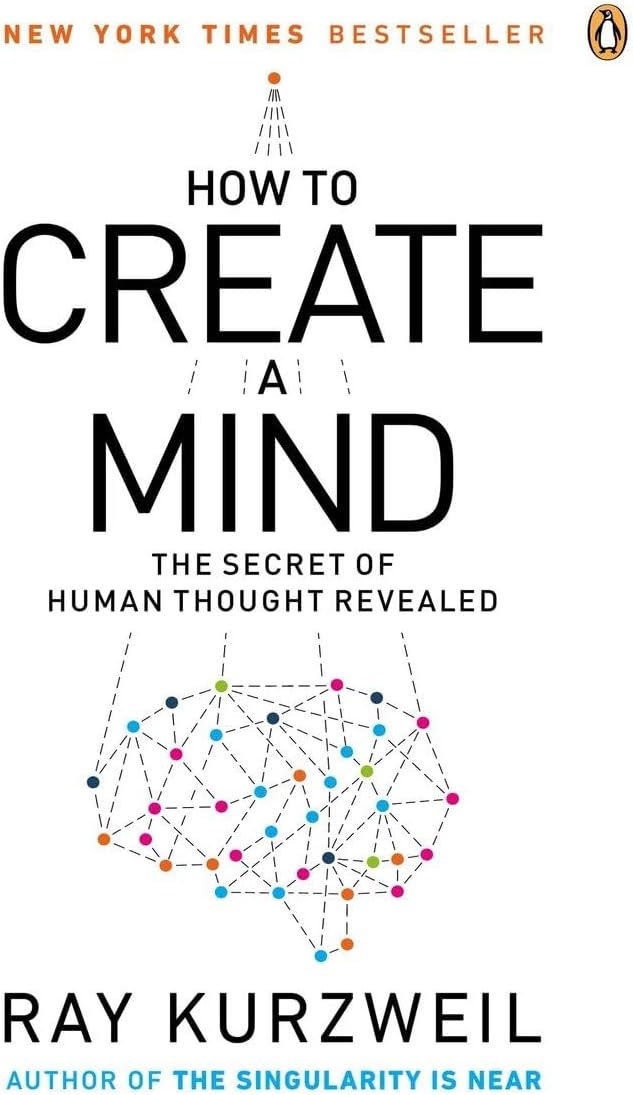
How to Create a Mind
Product ID: 77633495
Review: Ultimate - Awesome book for AI interested and kundalini reader with background of molecular biology and physics Review: Like a sine wave - Ray Kurzweil is a celebrated researcher and technology evangelist. This is an established fact. This book is an example of his evangelism, belief and hope to build a system that can surpass human intelligence. The book starts on a very interesting description of how human brain has evolved by learning to challenge the obstacles put forward, whether for survival or in the form of age old traditions. It describes the mindset of Einstein as to what lead to the discovery of special theory of relativity and other such inventions by other scholars. It also describes the ideology of Alan Turing and his work to build the first computing machine along with the fundamentals it laid down for today's science of AI and computers as a whole. The writer's vast knowledge about computing, its history, understanding and hold on the subject is highly appreciable and a class apart. It moves on to describe at length the structure of human brain, the pitched theory of its working in the form of algorithms such as PRTM (pattern recognition theory of mind) and LOAR (Law of Accelerated Return). Further on, it also projects why unsupervised learning aspects of clustering and reinforced learning in the form of HHMM (hierarchical hidden Markov model) as the central algorithm of brain functioning. Uptill this point the book is gripping, and the reader is submissive of the writer description and knowledge. However, this is the point when you reach the 180 degree of the sine wave. The writer goes ahead in the direction of answering more complex questions like consciousness of brain and links it to vastly different outlook. This is when the book dips to the lows due to loss of flow and repeated axioms (not proofs but only quoted opinions from other different writers, linguistics and philosophers) Nonetheless, the articulation on faith and the divide between Western World and Eastern world on the subject of faith is an interesting read, and here is where the sine wave tries to come up again. As expected it dies out towards the end, leaving the reader with quite many unanswered questions and thoughts, which may be a reflection of writer's mind also. If you are looking for a head start on the subject of brain mapping, it's structure, working and algorithmic functioning, then definitely it is worth the read. But as the writer himself conveys at different places, the human mind is much more than simple algorithms. Machines of the future have to challenge to surpass for them to be bigger than the greatest evolution of nature. An important point to be noted is that the writer has taken approximations and statistical hypothesis about the neocortex and its constituent neurons to an all together different level. So much of approximation and hypothetical analysis does make the reader skeptical about the truth value of such axioms.


| Best Sellers Rank | #11,412 in Books ( See Top 100 in Books ) #5 in Neuroscience #36 in Computer Science Books #40 in Artificial Intelligence |
| Customer Reviews | 4.4 out of 5 stars 1,568 Reviews |
N**.
Ultimate
Awesome book for AI interested and kundalini reader with background of molecular biology and physics
A**A
Like a sine wave
Ray Kurzweil is a celebrated researcher and technology evangelist. This is an established fact. This book is an example of his evangelism, belief and hope to build a system that can surpass human intelligence. The book starts on a very interesting description of how human brain has evolved by learning to challenge the obstacles put forward, whether for survival or in the form of age old traditions. It describes the mindset of Einstein as to what lead to the discovery of special theory of relativity and other such inventions by other scholars. It also describes the ideology of Alan Turing and his work to build the first computing machine along with the fundamentals it laid down for today's science of AI and computers as a whole. The writer's vast knowledge about computing, its history, understanding and hold on the subject is highly appreciable and a class apart. It moves on to describe at length the structure of human brain, the pitched theory of its working in the form of algorithms such as PRTM (pattern recognition theory of mind) and LOAR (Law of Accelerated Return). Further on, it also projects why unsupervised learning aspects of clustering and reinforced learning in the form of HHMM (hierarchical hidden Markov model) as the central algorithm of brain functioning. Uptill this point the book is gripping, and the reader is submissive of the writer description and knowledge. However, this is the point when you reach the 180 degree of the sine wave. The writer goes ahead in the direction of answering more complex questions like consciousness of brain and links it to vastly different outlook. This is when the book dips to the lows due to loss of flow and repeated axioms (not proofs but only quoted opinions from other different writers, linguistics and philosophers) Nonetheless, the articulation on faith and the divide between Western World and Eastern world on the subject of faith is an interesting read, and here is where the sine wave tries to come up again. As expected it dies out towards the end, leaving the reader with quite many unanswered questions and thoughts, which may be a reflection of writer's mind also. If you are looking for a head start on the subject of brain mapping, it's structure, working and algorithmic functioning, then definitely it is worth the read. But as the writer himself conveys at different places, the human mind is much more than simple algorithms. Machines of the future have to challenge to surpass for them to be bigger than the greatest evolution of nature. An important point to be noted is that the writer has taken approximations and statistical hypothesis about the neocortex and its constituent neurons to an all together different level. So much of approximation and hypothetical analysis does make the reader skeptical about the truth value of such axioms.
P**S
Amazing
Gives good insights of functioning of brain along with how modern technologies are using the Neuroscience to make machine intelligent by mimicing human brain!
S**H
A must read
If you are a science enthusiasts then go ahead and buy this book, can't keep this book down.
S**I
Awesome book
I liked it!! Must buy. Reached early as well.
S**N
Decent one-time read
First couple of chapters are amazing and will hold you but slowly you would lose the interest as in some portion, it becomes repetitive.
A**H
is a wonderful and fascinating book
How to Create a Mind.. is a wonderful and fascinating book. Ray Kurzweil has taken every pains to make it readable for all kinds of reader, However to my perception the reader must have a scientific bent of mind to appreciate the book in full. I was inspired by the book and immediately I purchased 'The Singularity is Near' by the same author through Amazon. I ordered two more copies of the How to Create a Mind .. through Amazon for presenting to my friends, however the order did not materialize.
A**R
Five Stars
Very informative and easy to comprehend even for a non specialist like me...
Trustpilot
4 days ago
2 months ago