
DOWNLOAD THE APP


Customer Services
Copyright © 2025 Desertcart Holdings Limited
DOWNLOAD THE APP
Full description not available
A**N
An essential understanding of how we make decisions, very well told.
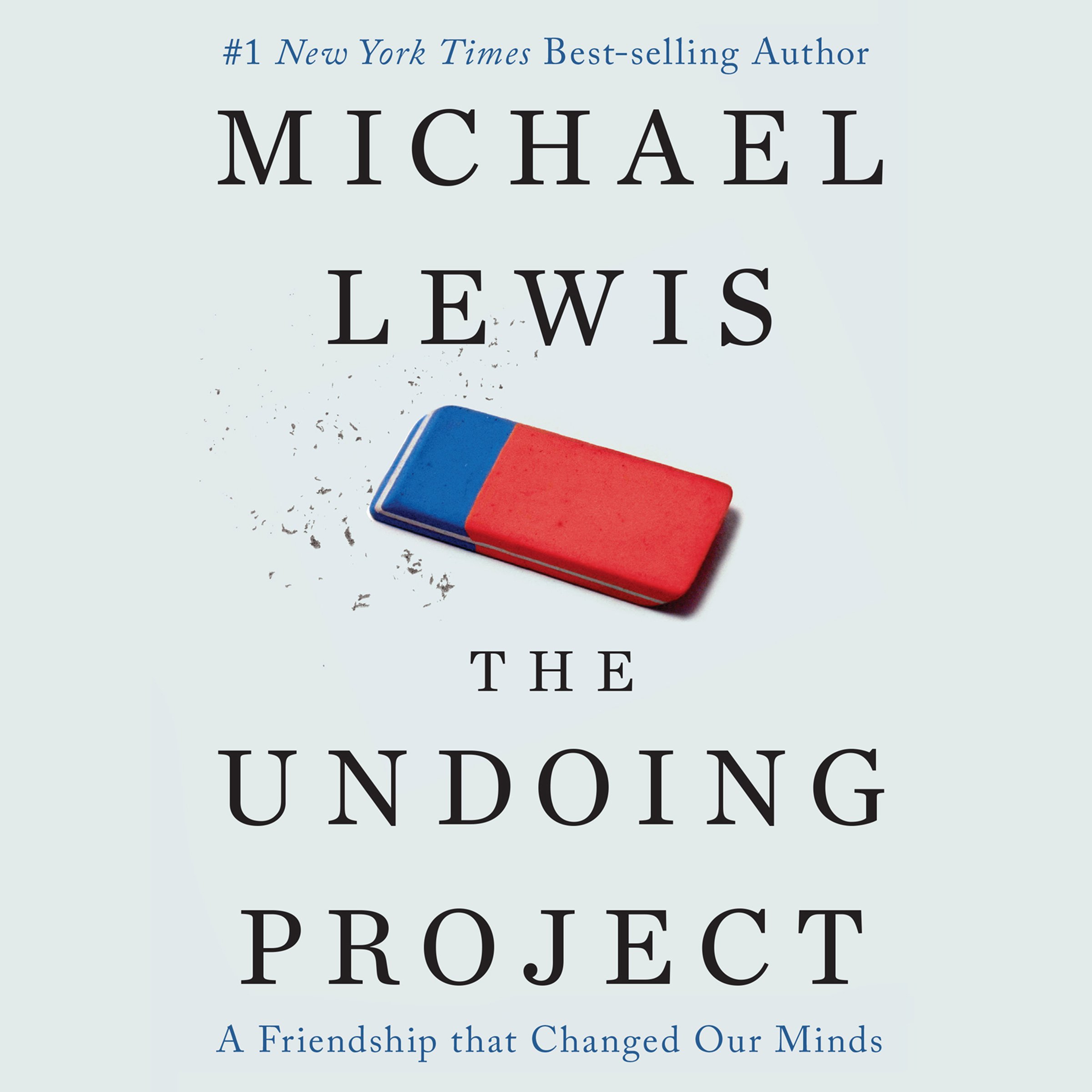
Popular writers like Michael Lewis and Malcolm Gladwell sometimes get a bad rap from purists who regard them as popularizers and simplifiers of complex ideas, and that their simplifications do an injustice to the subtleties and deep thinking that go into the original work that they are summarizing and describing. In the case of Michael Lewis' new book, The Undoing Project, that sort of puristic arrogance would be completely out of place. Daniel Kahneman and Amos Tversky formed an intellectual partnership from which an entirely new mode of thinking about the limits of human rationality and decision-making has led to a new academic discipline that now goes by the name of 'Behavioral Economics'.Almost by accident, Kahneman and Tversky, two Israeli psychologists with a shared interest in the psycho-dynamics of decision-making, discovered to their mutual surprise that each had skills and aptitudes that the other needed in order to make their ideas about the psychology of decision-making come alive. Amos was the extrovert, a mathematician whose approach whose approach to decision-making was grounded in mathematically-described similarity, measurement, and probability theory. By contrast, Danny Kahneman was the fearful and anxious introvert, and a Holocaust survivor.Where Amos Tversky was fixated on establishing the mathematical foundations for human decision-making, Kahneman's perspective was much broader, and much more subtle, focusing on cognitive biases and other ways in which people fool themselves into thinking that they are acting rationally, when in fact they are not.Of the two, Tversky was the intellectual star, a penetrating intelligence that could analyze and unpack any sort of problem into its component parts; but it was the humanistic Kahneman that made behavioral economics and its underlying psychology accessible to the world.Together, Tversky and Kahneman collaborated in research studies into why people so often acted irrationally when they so easily could have made better decisions that would have conformed more closely to logical rationality. Logic, rationality, and past experience might point in one direction; but somehow people made decisions based upon other criteria, and psychologist wanted to find out why such flawed decision-making so often occurred.Michael Lewis tells a wonderful story about how Kahneman and Tversky worked together for nearly three decades. In fact, so closely do they work together that neither could tell where their individual contributions to their joint work began or ended. Each brought his respective strengths and weaknesses to that partnership; and in the end, when Kahneman felt himself slighted by others within their profession giving principle credit to Tversky for their joint efforts, he ended his collaboration with Tversky on a note of bitterness. Not surprisingly, with their friendship in tatters and each of them seeking other people to work with, neither of them did as well as he had when they were working together. Amos Tversky died of cancer in 1996; and in the end there was a sort of rapprochement between them, but it wasn't really the same. The irony is that in 2002, Kahneman won the Nobel Prize in economics for the work that he and Tversky did over the preceding decades. Had Tversky lived, he most assuredly would have shared that Nobel Prize with Kahneman, as the contributions of each of them were essentially two sides of the same coin.I have to confess that I actually read 'The Undoing Project' cover to cover over a period of two days; but I could only do so because I had spent what amounted to weeks pouring over Kahneman's 2011 book, 'Thinking, Fast and Slow', reading and re-reading much for three and four times as I absorb what Kahneman had to say about the psychology of human decision-making under conditions of adversity and uncertainty. That said, I would also have to give a shout out to Michael Lewis for the way in which he described the ideas that Daniel Kahneman and Amos Tversky so brilliantly developed in their long collaboration. Not too many people I know would be willing to plow through Kahneman's catalog of cognitive biases and other cognitive impediments to rational thinking and decision-making, all in one fell swoop. Lewis makes it easy, or at least seemingly so. What is important is that the reader gets a clear understanding of the changes in both psychology and in economics, and in business decisions, that's Tversky's and Kahneman's seminal work has made as part of the business and economics canon that we read about today. In the three weeks or so in the run-up to the December 6, 2016, release date for 'The Undoing Project', I noted that the New York Times had three separate articles summarizing Lewis' book, and why they considered it so important. To the Times' endorsement, I would add my own.Lewis spends a great deal of time and effort to make the ideas that Tversky and Kahneman developed accessible to people who are nonspecialists, i.e., general readers who have an interest in the subject, but who could easily become lost in the mathematics or the professional jargon that so often accompanies these types of intellectual developments. He writes about the things that people know about – sports, athletes, and the stuff we read about in the newspapers daily, and maybe wonder why things turned out as they did, or did not, as the case may be. I liked it, and I think most people will like it also. Best of all, I think readers will see a bit of themselves and all of the discussion that there is about why people, even the smartest of us, frequently make poorly thought out decisions, and how we can make better ones.
M**H
Behavioral finance - avoid being prey on the way to a Nobel Prize
I tend to get excited when the best story tellers write a new book, and when the book covers a topic I have been focused on recently this is even more so. Such was the case when Lewis covered the Nobel Prize winning duo of Daniel (Danny) Kahneman and Amos Tversky, two psychologists who developed much of the base work behind behavioral finance. I also see its roots in Robert Cialdini’s books (Influence, Pre-suasion). While Kahneman (Tversky died in 1996 so did not share in the Nobel) wrote Thinking Fast and Slow to share their life work, here Lewis tries to identify why they worked so well together. In fact I don’t recall him talking about thinking fast (immediate response) or slow (long-term investor) at all. It reads somewhere between biography and non-fiction about behavioral finance.Some of the more interesting thoughts in the book have nothing to do with behavioral finance, but have lots to do with psychology. Lewis discusses Daryl Morey, who I would call a basketball sabermatrician. He has been GM for the Houston Rockets since 2007 using tactics similar to those described for baseball in the book Moneyball (also by Lewis). In this same chapter Lewis provides a definition of a nerd – a person who knows his own mind well enough to mistrust it. This sounds like something Charlie Munger would say (high praise).Both Kahneman and Tversky lived in Israel, where everyone serves a stint in the military, and both saw action in the Six Day War in 1967 and the Yom Kippur War in 1973 (when they returned from America to take up arms). Kahneman helped the Israelis design better tools for selecting officers and training pilots. Tversky was a paratrooper. Both were professors at Hebrew University at the beginning of the first war.Our mind tricks us. After the fact, we know exactly why we saw the event coming that no one anticipated (see Taleb’s Black Swan) and surveys weigh more heavily toward events that have recently occurred. The reasons often given relate back to our days as prey on the plains of Africa (thinking fast keeps you alive in that context – you run away from a predator, as fast as you can). One of the ways to catch these inconsistencies is to devise three options, where a person chooses A over B, B over C, and C over A. This violates the law of transitivity, familiar to anyone who has ever studied algebra or logic. Lewis provides many of these examples, as did Kahneman in Thinking Fast and Slow, and I fall for nearly every one. Even after I’ve seen them before (sometimes, occasionally, I remember).K/T developed several heuristics, where laws of chance are replaced by rules of thumb. “We often decide that an outcome is extremely unlikely, or impossible, because we are unable to imagine any chain of events that could cause it to occur. The defect, often, is in our imagination.”• Representativeness – we see a previously developed mental model rather than thinking through the facts as presented (and are generally correct). This creates systematic errors, such as looking at a kid and immediately deciding whether they are athletic. Looking at the negative can help avoid these problems. For example, the WW2 bombs landing in London appeared to target certain areas, but really were random. If you have 23 randomly selected people in a room, the odds are better than half that at least two share a birthday.• Availability – we more easily recall memorable events.• Conditionality – we make contingent assumptions when none are stated. We assume normal operating conditions (e.g., normal distribution, VaR). “…people don’t know what they don’t know, but that they don’t bother to factor their ignorance into their judgments.”• Anchoring (and adjustment) – if you are shown a large (or small) number, for example, then your response is then large (or small).• Simulation – what could happen dominates what is likely to happen – this can lead to analysis paralysis (I find it difficult to overcome this when investing for my personal accounts – it’s hard to pull the trigger).• Recency bias – recent events influence our probability assumptions.• Hindsight bias - once we know how something turns out, our recollection is that we predicted it in advance (similar to Black Swans – Taleb)How do ideas form in our mind? Is it conscious, or indirect? When we study in school, or for a credential, the focus is on repeating the “right” answer. While hard to grade, I’ve always thought it would be better to provide an answer and ask the student to improve it.Who knew that a bad experience could be remembered more fondly if the final part of the event was not so distasteful – the peak-end rule? This was tested using colonoscopies that ended with the medical instruments brought out of the body slowly or quickly. Doing so slowly made it more likely that the person would return for future tests.The risk manager will discover, usually the hard way, that avoiding a risk receives no reward but if you miss a risk then you will get the blame. This is a human bias.Accounting does not consider the impact on the environment, to limited supply, or to emotions. Utility theory overstates the value. Risk aversion is a fee willingly paid to avoid regret. In any case we all prefer to avoid pain more than we want to secure gain. We react more to relative changes than absolute ones, and probability is not straightforward.The benefits of a group often conflict with the benefit to an individual. Antibiotics are such an example. In total, limiting antibiotics is better because viruses have less chance to mutate successfully. For an individual, antibiotics are either useful or neutral. There is no downside to an individual to being treated with antibiotics.One of the fascinating revelations in the book (for me, at least) was the need to invert. “How do you understand memory? You don’t study memory. You study forgetting.” As we study other topics we should look for opportunities to utilize this strategy.While much of the interest in this branch of psychology is applied to investment strategies, K/T worried more about geopolitical biases and the series of avoidable mistakes that could be made by political leaders relying on gut feel. They thought that intelligence reports written as essays should be replaced by probabilities. Telling a story is not helpful in this context, but politicians tend to be afraid of numbers. We have seen evidence of this recently as briefings to the US president are said to be focused on charts and short sound bites.As you read about financial economics, this should not be your first book. I believe it is more useful to someone already familiar with the concepts from other sources. For someone starting out on this topic I personally like Why Smart People Make Big Money Mistakes and How to Correct Them by Gary Belsky and Thomas Gilovich to start and then Thinking Fast and Slow by Kahneman before reading the Lewis book.
Trustpilot
1 month ago
1 month ago