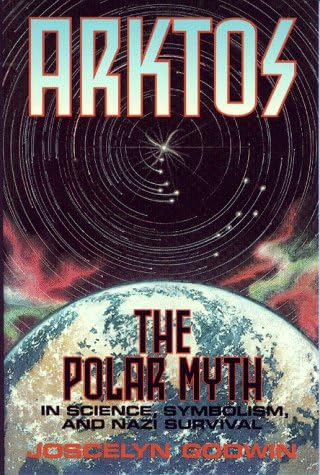
ARKTOS: The Polar Myth in Science, Symbolism & Nazi Survival
Product ID: 15420398
Buy anything from 5,000+ international stores. One checkout price. No surprise fees. Join 2M+ shoppers on Desertcart.
Desertcart purchases this item on your behalf and handles shipping, customs, and support to Vanuatu.
ARKTOS: The Polar Myth in Science, Symbolism & Nazi Survival [Godwin, Joscelyn] on desertcart.com. *FREE* shipping on qualifying offers. ARKTOS: The Polar Myth in Science, Symbolism & Nazi Survival Review: Hyperborea Revealed! - Long has man hungered for a return to a Golden Age, an era before the present one when he lived in idyllic bliss and was free from all the constraints and toils of modernity. This book tells the fascinating tale of a source of hidden wisdom carried down through the ages preserved in the archetype of the Poles. The author examines the presence of this tradition in the writings of many eccentrics, cranks, mystics, visionaries, scientists, and science-fiction writers. He looks chiefly at the writings of H. P. Blavatsky and Rene Guenon, and he tells the tale of the "Aryan race" as revealed through a set of polar mysteries. Everything from the Nazi secret societies (e.g. the Thule society), to the neo-Nazi Black Order, to the spirituality of the polar tradition, to the mad and bizarre ramblings of insane prophets is told in full detail. Writers such as Evola, Schwaller de Lubicz, and Serrano are examined and their possible links to fascism explained. The author also deals with the Theosophists, the mysticism surrounding the poles, and the idea of a Ruler of the World who lives in Tibet, Aghartha, or Shamballah. Much is dismissed as mere nonsense, but also the true secret behind these myths is hinted at. Finally, scientific evidence surrounding the Earth's tilt and the precession of the equinoxes is presented, and the writings of the "illuminates" are compared with those of modern day geologists. The reader is left spellbound by tales which are not only totally bizarre (e.g. the hollow earth theory of Teed, that we live inside a hollow earth on it's concave inner surface), but which often also become incoherent and border on paranoid delusion. (There is a link here between these authors and madness.) The real question that needs to be asked is, What does it all mean? In one particularly disconcerting passage at the end of the section on the "Spiritual Pole", the author sums up what he believes to be the presence of the polar archetype in many diverse writers and visionaries. He then goes on to say that the pole must not be political because of its use by the Nazis (in the Thule Society). I feel he is disingenuous here after citing example after example of writers who used the polar idea precisely as a cover for political aims. Obviously the pole is political, and it remains so. I believe it would be more correct to say that not only is the pole political, but also that it's politics are too deeply entrenched for us to fully understand at this time. Perhaps, it is universally present in the mind of man, biding it's time, until the dispossessed individual is put under sufficient stress that it reveals itself to him and provides him with an interpretative framework to understand the world through (viz. Jung's "collective unconscious"). When someone turns to wonder, What is this all for?, this is when the archetypal appearance of the pole becomes manifest to him. It is an angry reaction to those societal forces which would attempt to oust tradition and reconstruct society along more "satisfactory" lines. As such, it is not revolutionary, but restorationist in nature. This is the meaning of the polar symbolism and its use by the various writers and prophets presented in this book. Fundamentally, it is a call for a return to tradition, the only tradition that predates the modern era and that will restore order to the chaotic world in which we live. Review: Well-researched and engaging exploration of a fascinating subject! - "Arktos: The Polar Myth" by Joscelyn Godwin is a fascinating exploration of the mythology surrounding the polar regions of the Earth. The book provides an in-depth analysis of the various cultural and religious beliefs associated with the polar regions, as well as their significance in modern times. Godwin begins by examining the origins of the polar myth, tracing its roots back to ancient cultures such as the Greeks and Norse. He then delves into the beliefs of various indigenous peoples, including the Inuit, Sami, and Yakut. The author provides a detailed examination of the religious beliefs and practices of these cultures, highlighting the unique ways in which they view the polar regions. Throughout the book, Godwin weaves together mythology, history, and spirituality to create a compelling narrative that is both informative and thought-provoking. He explores themes such as the symbolism of ice and snow, the relationship between humans and nature, and the role of the polar regions in shaping our understanding of the world. One of the strengths of "Arktos" is Godwin's ability to connect the mythology of the polar regions to modern culture. He examines the influence of the polar myth on art, literature, and popular culture, from the poetry of Robert Frost to the films of Werner Herzog. He also discusses the impact of climate change on the polar regions, and the implications this has for the mythologies associated with them. Overall, "Arktos: The Polar Myth" is a well-researched and engaging exploration of a fascinating subject. Godwin's writing is clear and concise, and his insights into the polar myth are both informative and thought-provoking. Whether you are interested in mythology, spirituality, or environmentalism, this book is sure to offer new insights and perspectives. Highly recommended.
| Best Sellers Rank | #975,295 in Books ( See Top 100 in Books ) #1,320 in Ancient & Controversial Knowledge #1,536 in Supernaturalism (Books) #1,902 in Unexplained Mysteries (Books) |
| Customer Reviews | 4.3 4.3 out of 5 stars (59) |
| Dimensions | 6 x 1 x 9 inches |
| Edition | Revised ed. |
| ISBN-10 | 0932813356 |
| ISBN-13 | 978-0932813350 |
| Item Weight | 13.6 ounces |
| Language | English |
| Print length | 272 pages |
| Publication date | August 1, 1996 |
| Publisher | Adventures Unlimited Press |
N**M
Hyperborea Revealed!
Long has man hungered for a return to a Golden Age, an era before the present one when he lived in idyllic bliss and was free from all the constraints and toils of modernity. This book tells the fascinating tale of a source of hidden wisdom carried down through the ages preserved in the archetype of the Poles. The author examines the presence of this tradition in the writings of many eccentrics, cranks, mystics, visionaries, scientists, and science-fiction writers. He looks chiefly at the writings of H. P. Blavatsky and Rene Guenon, and he tells the tale of the "Aryan race" as revealed through a set of polar mysteries. Everything from the Nazi secret societies (e.g. the Thule society), to the neo-Nazi Black Order, to the spirituality of the polar tradition, to the mad and bizarre ramblings of insane prophets is told in full detail. Writers such as Evola, Schwaller de Lubicz, and Serrano are examined and their possible links to fascism explained. The author also deals with the Theosophists, the mysticism surrounding the poles, and the idea of a Ruler of the World who lives in Tibet, Aghartha, or Shamballah. Much is dismissed as mere nonsense, but also the true secret behind these myths is hinted at. Finally, scientific evidence surrounding the Earth's tilt and the precession of the equinoxes is presented, and the writings of the "illuminates" are compared with those of modern day geologists. The reader is left spellbound by tales which are not only totally bizarre (e.g. the hollow earth theory of Teed, that we live inside a hollow earth on it's concave inner surface), but which often also become incoherent and border on paranoid delusion. (There is a link here between these authors and madness.) The real question that needs to be asked is, What does it all mean? In one particularly disconcerting passage at the end of the section on the "Spiritual Pole", the author sums up what he believes to be the presence of the polar archetype in many diverse writers and visionaries. He then goes on to say that the pole must not be political because of its use by the Nazis (in the Thule Society). I feel he is disingenuous here after citing example after example of writers who used the polar idea precisely as a cover for political aims. Obviously the pole is political, and it remains so. I believe it would be more correct to say that not only is the pole political, but also that it's politics are too deeply entrenched for us to fully understand at this time. Perhaps, it is universally present in the mind of man, biding it's time, until the dispossessed individual is put under sufficient stress that it reveals itself to him and provides him with an interpretative framework to understand the world through (viz. Jung's "collective unconscious"). When someone turns to wonder, What is this all for?, this is when the archetypal appearance of the pole becomes manifest to him. It is an angry reaction to those societal forces which would attempt to oust tradition and reconstruct society along more "satisfactory" lines. As such, it is not revolutionary, but restorationist in nature. This is the meaning of the polar symbolism and its use by the various writers and prophets presented in this book. Fundamentally, it is a call for a return to tradition, the only tradition that predates the modern era and that will restore order to the chaotic world in which we live.
J**R
Well-researched and engaging exploration of a fascinating subject!
"Arktos: The Polar Myth" by Joscelyn Godwin is a fascinating exploration of the mythology surrounding the polar regions of the Earth. The book provides an in-depth analysis of the various cultural and religious beliefs associated with the polar regions, as well as their significance in modern times. Godwin begins by examining the origins of the polar myth, tracing its roots back to ancient cultures such as the Greeks and Norse. He then delves into the beliefs of various indigenous peoples, including the Inuit, Sami, and Yakut. The author provides a detailed examination of the religious beliefs and practices of these cultures, highlighting the unique ways in which they view the polar regions. Throughout the book, Godwin weaves together mythology, history, and spirituality to create a compelling narrative that is both informative and thought-provoking. He explores themes such as the symbolism of ice and snow, the relationship between humans and nature, and the role of the polar regions in shaping our understanding of the world. One of the strengths of "Arktos" is Godwin's ability to connect the mythology of the polar regions to modern culture. He examines the influence of the polar myth on art, literature, and popular culture, from the poetry of Robert Frost to the films of Werner Herzog. He also discusses the impact of climate change on the polar regions, and the implications this has for the mythologies associated with them. Overall, "Arktos: The Polar Myth" is a well-researched and engaging exploration of a fascinating subject. Godwin's writing is clear and concise, and his insights into the polar myth are both informative and thought-provoking. Whether you are interested in mythology, spirituality, or environmentalism, this book is sure to offer new insights and perspectives. Highly recommended.
J**L
Writing a book about esoteric geography was a great idea, but why all the attention to neo-Aryan ...
I was intrigued by some of the more abstract questions Godwin lays out at the beginning. Has the tilting of the planet's axis left humans with a sense that our world is somehow "fallen" -- that the skewed axis speaks of a fallen order? Does the year's nearness (and not-quiteness) to the number 360 evoke a similar sensibility in our collective unconscience? Or, the nearness of the astrological year to the number 25,920 (ie, 360x72)? What about the fact that the sun and moon appear to be almost the same size in the sky? There was a Jungian direction Godwin would have gone with this inquiry. I think that would have produced a more serious book. Instead the book gets seriously bogged down by heavy treatment of the usual posse of aryosophist charlatans: Blavatsky, Crowley, Serrano, etc. Writing a book about the poles and esoteric geography was a great idea, but why all the attention to neo-Aryan myths cooked up in the 19th and 20th centuries? Why not Inuit myth? Why not Sami myth? Why don't we learn something about indigenous groups in Tasmania or Tierra del Fuego who were aware of Antarctica? A missed opportunity.
A**.
Recommend it!
So much knowledge! So little has been written about this topic that can actually be considered serious until this book! So good!
T**.
No issues
No issues
H**G
Jocelyn Godwin, emmène son lecteur dans l’exploration du mythe polaire, céleste et terrestre, là où se croisent les théories scientifiques et les croyances religieuses les plus décoiffantes. Le lecteur est assuré d’être en bonne main avec ce prof de l’Université de New York, spécialiste des traditions ésotériques occidentales. Érudit et didactique, il a étudié une somme encyclopédique de sources diverses pour dresser un état des lieux impressionnant, et ne se départit jamais de la logique quand il s’enfonce dans les eaux troubles de l’occulte. il observe ironiquement que le mythe polaire, on le doit paradoxalement au siècle des Lumières, avec Bailly, Buffon, Court de Gébelin, Voltaire, Kant, von Herder et von Schlegel qui étaient bien heureux de se débarrasser de leur filiation biblique, sémitique et méditerranéenne pour le remplacer par une origine Indo-européenne plus conforme à l’idée qu’ils se font de la race blanche. Mais ils ne se voyaient rien de commun avec ces « Scythes », terme fourre-tout utilisé à l’époque pour désigner tous ces basanés, les Kalmucks, les Bouriates et les Mongols qui peuplaient les steppes de Sibérie, et c’est donc avec soulagement qu’ils acceptaient sans aucune réticence intellectuelle l’hypothèse d’une filiation avec une prétendue race Aryenne venant des pôles. A partir de là s’était élaborée, avec von List, von Liebenfels, Blavatsky, Saint Alveydre, Guénon, Evola,Serrano, Roerich, Parvulesco, pour ne citer que quelques uns, toute une série de théories cosmologiques, mystiques, philosophiques, autour d’un Age d’or perdu, associé à une race ancienne qui vécut dans l’Antarctique, et qui inspira par la suite l’idéologie néo-nazi, avec ses bases secrètes en Antarctique, ses OVNI, ses variantes de la Terre Creuse et des royaumes d’Agartha et de Shambala. Nicholas Goodrich Clarke estime que Godwin touche là le cœur des interrogations de l’homme sur son destin cosmique, avec l’éternel problème du bien et du mal. L’ennui, observe Godwin, c’est que chacun, lorsqu’il fait état d’une race primordiale assimilé au Bien, a tendance à s’y identifier, rejetant du coup le reste de l’humanité dans le camp du Mal du fait qu’ils n’ont pas la même couleur de peau.
B**F
This is such a scholarly book that I'm not in a position to judge the accuracy of Godwin''s mythopoesis. But his conclusion brought tears to my eyes. Et in Arcadia Ego.We are all running down the same spiral path of DNA that leads all creatures to Arcady. Beautiful.
R**B
AM happy
M**N
Excellent read.
Trustpilot
1 month ago
1 month ago