
DOWNLOAD THE APP


Customer Services
Copyright © 2025 Desertcart Holdings Limited
DOWNLOAD THE APP

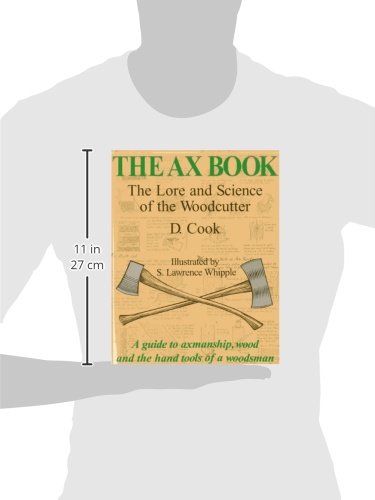
The Ax Book: The Lore and Science of the Woodcutter
G**H
a great guide to the ax
Years of experience and vast knowledge went into the writing of this book. The author goes into every aspect of selecting, using, and maintaining an ax with great care and detail. He also has a good section on saws.The book is so good that aside from recommending everyone who uses an ax or saw to read it, there's not much to say, so I will digress.Something I didn't understand was that the author emphasizes that a straight handle is superior to a curved handle. I agree. Then why does the picture of the curved handled ax crossed with the double head ax appear on every chapter?Of course the author is writing on his experience, which is far vaster, but different from my more limited experience. Here in northern Taiwan, we have different trees which provide different wood, so a lot of the information about American trees was interesting, but not practical for me. A big problem is that sometimes when you chop through a trunk, the tree stands and doesn't fall, because the crown is full of vines attached to the jungle canopy. Here is where bamboo is so handy. You can have a five meter bamboo pole chopped, cleaned, and ready to use in a few minutes, and it's a simple matter to attach a saw to that. Then good luck trying to saw through the vines. They're springy.Also, the very first thing you need to know about a woodpile here is that snakes love them. When I was reading his chapter on woodpiles, I kept expecting him to teach the first rule of woodpiles: You never! ever! stick your hand into a woodpile without looking carefully twice! Then check again.Something that amused me was comparing American, Japanese, and Chinese mindsets. How do you sharpen a saw? Cook provides ten pages of detailed information about the ins and outs of sharpening a saw. My Japanese carpentry book finishes the topic in one sentence: "Sharpening saws is a difficult task that should be left to a professional, so send your saw to a professional saw sharpener." I asked an expert about in northern Taipei about sharpening saws; he sold me a feather file, spent about two minutes explaining the basics, and cheerfully sent me on my way. The Chinese idea is, what works for me may not work for you, but put some effort into it, and eventually you will come up with something good.FYR: I am the proud owner of two hand-forged axes, one a 3kg splitting ax, the other a hatchet forged from an artillery shell left over from the bombardment of Jinmen/Quemoy in 1958. For most of my work in the mountains, though, I use a laraw, a Tayal aborigine mountain knife.
P**L
Fascinating and informative book
I found this book to be an excellent bit of story telling and also quite informative.I grew up feeding a fireplace and I've learned a lot of things from this book, especially that I was quite lucky not to injure myself in my youthful ignorance. The author grew up back when firewood was more than a pleasant hobby and an ax was an important tool. Other than a bit of inevitable nostalgia for 19th century steel the book does not descend into romanticizing the past. He makes clear that axes and their usage used to be taken very seriously before the invention of the chain saw and thus they were made and used with more skill than might be applied to them today. I wished I'd read this book fifty years ago.
R**.
Excellent, highly informative and entertaining
Author makes a subject that might otherwise be dull into entertaining and highly informative reading. Highly recommend.
A**R
Great Knowledge Transfer
I am not a lumberjack nor do I plan to become one, but I do fell an occasional tree and wanted to know how to do it better with a variety of tools. While the book focuses on doing so with an axe, the author also covers other methods and will indicate which is best under different circumstances. The author's knowledge and expertise obviously came from growing up and using an axe extensively in an era when the axe was the primary tool used for woodcutting, but he has not limited the text to only the use of an axe. I'm amazed that he appears to have left few details out, large or small. Only someone who had experienced getting a wedge "spit out" of a kerf would think of recommending methods to prevent it. This book is about performing difficult, dangerous timbering tasks more efficiently and safely. The prose is engaging and the illustrations well drawn and helpful. Yes it is from the past and about mostly by-gone methods. But given the global instability and cost of a chainsaw's most critical resource, fuel, the methods are certainly good to have in a man's toolkit, even today. Besides, few things feel better than bringing a good sized hardwood to the ground, just where you wanted it, with nothing but sharp steel, muscle and a little practical physics. Regardless of whether or not you do it frequently, having the confidence and skills to be able to, makes this book well worth its price.
T**E
Update of Keeping Warm With an Ax: A Woodcutter's Handbook
This is an revision of "Keeping Warm With an Ax: A Woodcutter's Handbook", from 1981.It claims to be a revision, but I don't see much difference between the two. Whatever may have been added or deleted seems to be minimal from a comparison of random pages. Just be aware that it is a update so you don't end up buying both it and Keeping Warm With an Ax: A Woodcutter's Handbook like I did.It is still one of the best books, if not the best, on selecting and using an axe that I have read among the limited number of books on the axe. Cook's emphasis on safety is well presented, with a concept of "frontal zone" as the area extending from one's feet forward at the width of the outsides of the feet, with objects to be cut to the left or right of this zone. Use of a frontal zone will mean that any swing that misses or ricochets will miss the user because it is already past the user. This is a concept that I had not seen before, yet makes much sense for safety.I strongly recommend this book. In the very limited genre on axes, it is a gem well worth reading and studying. In fact, I have bought several copies to give to my axe-using friends and relatives.
S**T
If an axe features in your work or leisure life, read this.
This is one of those books which is essentially a textbook, but reads as interestingly as a novel. All aspects of axe use is covered, helping the reader to remain both safer and more productive at his or her forestry projects.
M**K
A must.
Used axes for years, didn't know how much I didn't know, until I read this book. A must.
L**A
Five Stars
enjoyable
K**R
Worth the money
Good informitive read.
J**.
Wohl eines der besten Bücher über Äxte
Der Autor beschreibt die komplette Welt der Axt, die Anwendung beim Fällen und Aufarbeiten von Brennholz, die Instandhaltung, mögliche Gefahren bei der Anwendung. Dabei sind die Themen weit gefasst, es werden z.B. auch das Lagern von Brennholz, Fällen von Bäumen oder die Grundlagen des Heizens behandelt.Beim Lesen hat man nicht das Gefühl, ein Buch über Axte zu lesen, sondern dass jemand der sein Leben lang mit der Axt gearbeitet und sich dabei Gedanken gemacht hat, erzählt. Es ist die richtige Mischung aus Theorie und Praxis, wirklich ausführlich aber keinenfalls langatmig.Absolut empfehlenswert.
Trustpilot
1 week ago
1 month ago