
DOWNLOAD THE APP


Customer Services
Copyright © 2025 Desertcart Holdings Limited
DOWNLOAD THE APP
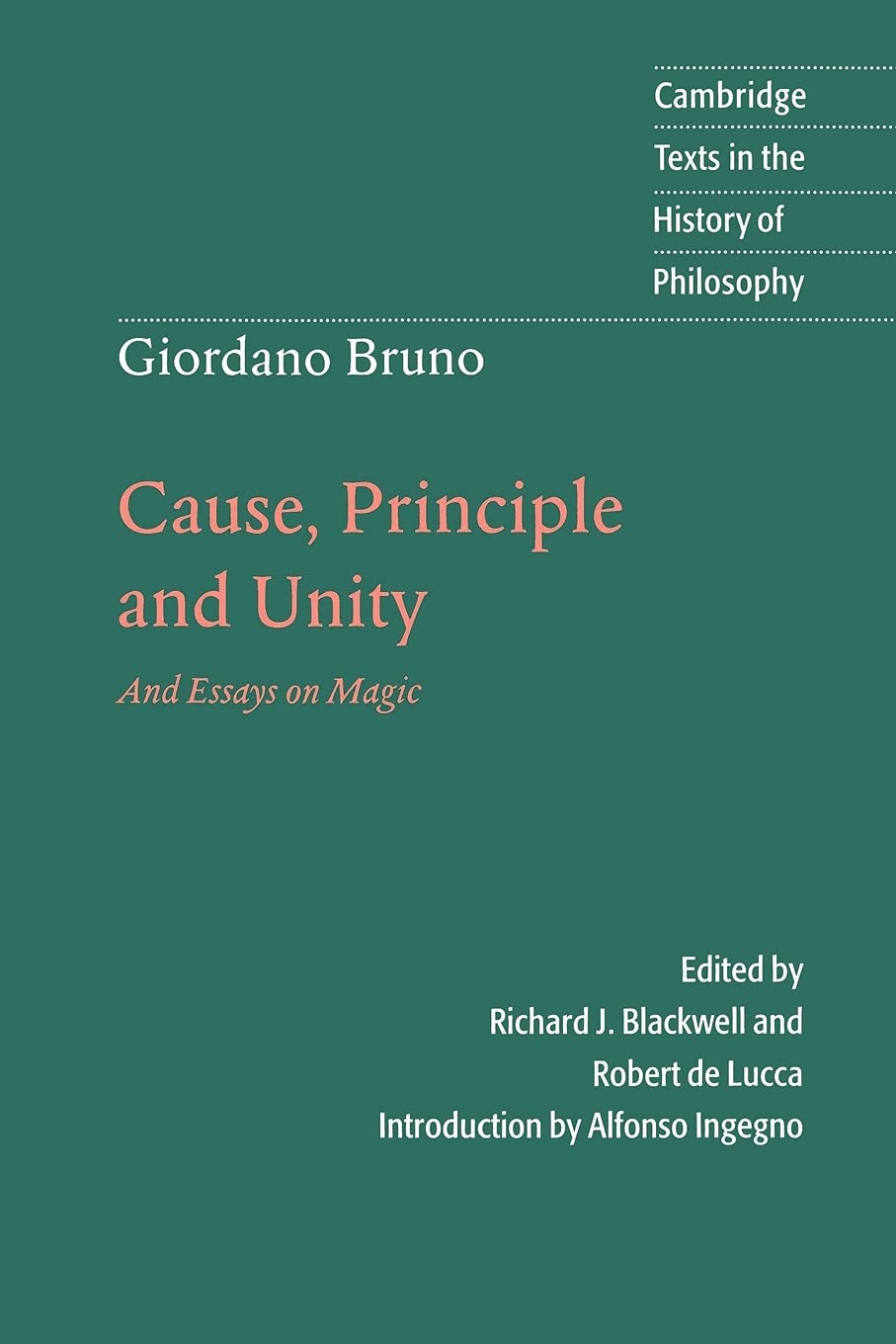
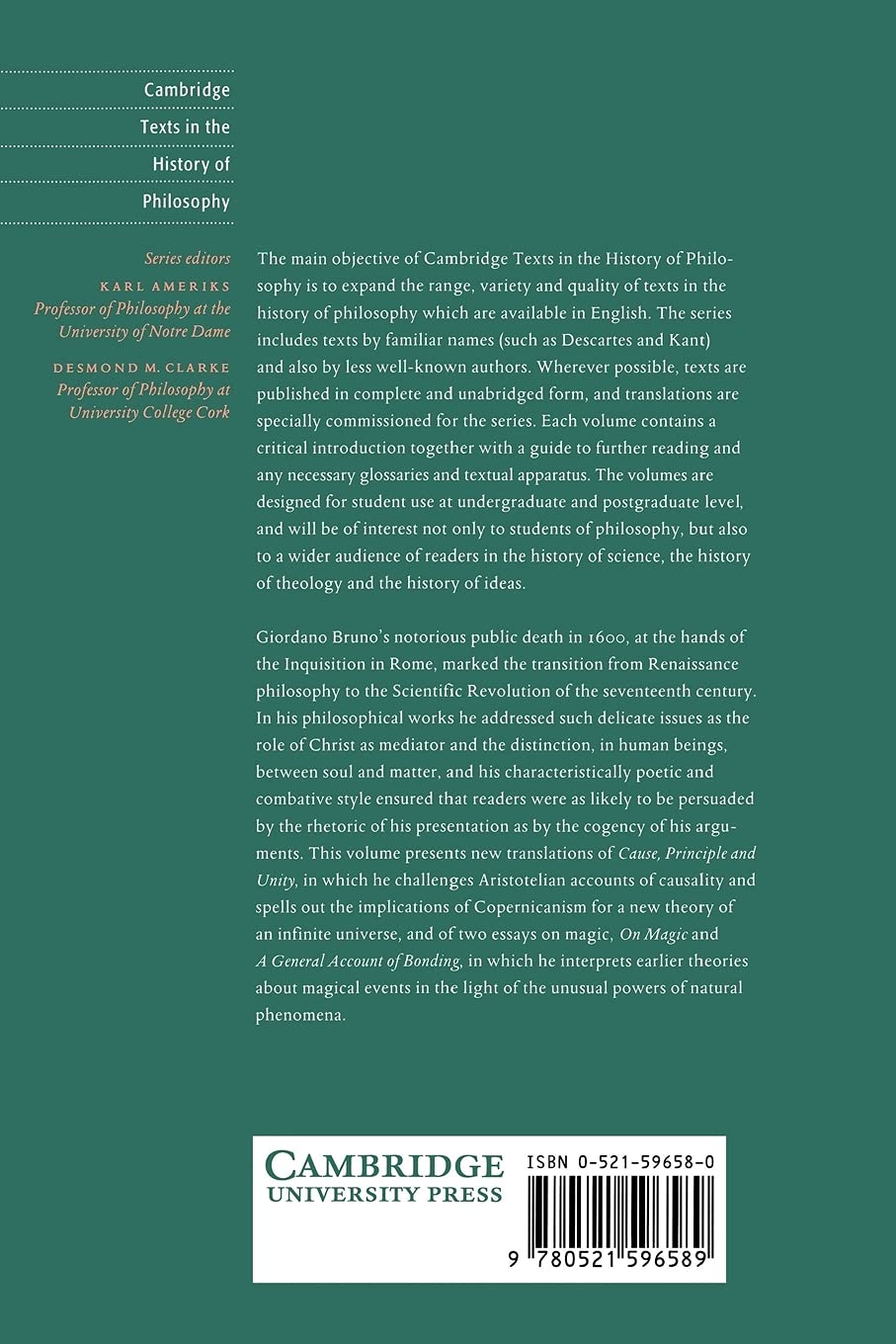
Giordano BrunoGiordano Bruno: Cause, Principle and Unity: And Essays on Magic (Cambridge Texts in the History of Philosophy)
F**R
Fascinating man.
I enjoyed this book very much.
V**Y
Crowley, Vivianne. “Review: 'Cause, Principle and Unity' by Giordano Bruno.” Heythrop Journal 41, no. 2 (April 2000): 252-253.
This is one of the series of Cambridge Texts in the History of Philosophy, published with the aim of expanding the range, variety and quality of texts available in English in the history of philosophy. This is a worthy aim and amply carried out by this elegant collaborative translation from Italian of one of Giordano Bruno’s principal works.Since Frances Yates’ groundbreaking work at the Warburg Institute in the 1960s (1), there has been an upsurge of interest in Bruno which increased as we entered the '90s and includes Morton Yanow’s novel 'The Nolan' (2) . As we enter the postmodernist 21st century, individualists like Bruno have a fascination and appeal. A renegade Dominican who was burned alive at the stake in Rome in the Campo dei Fiori, his prefatory epistle to Cause, Principle and Unity has a certain precognitive poignancy.O mount, though the Earth bounds you,holding you by the deep roots on which you repose,at the summit you can stretch to heaven.O mind, a sister mind from the high summit of the world calls you,to be the boundary between heaven and hell.Do not lose your rights here below,and do not touch the black waters of Acheron,falling to the bottom and becoming caught in it.Rather, investigate the sublime recesses of nature,since, if God moves you,you will become ardent fire.In 'Cause, Principle and Unity', Bruno expounds a world view with elements of Neoplatonism, monism and pantheism that were roundly condemned in his own day, but which would be unexceptional in our own—other than for some lack of intellectual coherence. Today, in an era where we talk of biospheres, Gaia, space travel and multiverses, Bruno’s views that all matter is composed of the same elements, that the universe is infinite, that there are a multitude of inhabited worlds other than our own, and that Earth is ensouled, can be seen as the ideas of someone struggling to make the transition to the scientific age.'Cause, Principle and Unity' is presented in the form of dialogues; On Magic as essays. They are not great treatises of philosophy, but they are of considerable interest from a historical perspective and also for those who have sympathy for the mercurial, impetuous, sincere and irascible Bruno—the man.References:1. See Frances A. Yates, 'Giordano Bruno and the Hermetic Tradition'. Chicago and London: Univ. of Chicago and Routledge KeganPaul.2. Morton Yanow, 'The Nolan: Prisoner of the Inquisition'. New York: Crossorads, 1998.
H**R
The ... Science
Giordano Bruno is not only a writer of marvelous wit and virtuosity, and the only one since Plato to breathe life into the philosophical dialogue, but also a thinker of great consequence, imagination and purity. While he is generally seen to stand at the threshold between the medieval and the modern, cabilistic magic and scientific rationality, it is wrong to regard him merely as an anticipation of Leibniz and Spinoza. In certain respects, indeed, he goes farther in freeing thought from the residues of Scholasticism, and if his understanding of the coincidence of absolute potentiality and absolute actuality as the ground of Being points the way to Schelling, the freer winds of his thinking, with its wondrous openness towards the possibilities of the body as the possibilities of life, make him a kindred spirit of Nietzsche.
Trustpilot
3 days ago
2 days ago