
DOWNLOAD THE APP



Desert Online General Trading LLC
Warehouse # 7, 4th Street, Umm Ramool, Dubai, 30183, Dubai
DOWNLOAD THE APP
Desert Online General Trading LLC
Warehouse # 7, 4th Street, Umm Ramool, Dubai, 30183, Dubai

Full description not available
R**O
Magical Mystery Tour
I never got past Econ 101 in college. In fact, I never had much interest in finance until reading a biography of Alexander Hamilton by Forrest McDonald in which the author explained how Hamilton’s financial policies actually worked, and converted the nation’s crushing Revolutionary War debt into liquid capital and jump-started American capitalism. McDonald also focused on the origin of Hamilton’s financial ideas—notably the writings of Scottish philosophers Adam Smith, David Hulme and James Steuart, and the financial wizardry of British chancellor of the exchequer Robert Walpole and French finance minister Jacques Necker. I was—and there is no other word for it—enchanted. I have since read a number of books on money and finance including two recent ones, “America’s Bank” by Roger Lowenstein, and “The Alchemists” by Neil Irwin. Which brings us to “Money Changes Everything” by financial historian William Goetzmann. I was disappointed that Hamilton and Smith are mentioned but once, and Hulme, Steuart, Walpole and Necker not at all, but this is a small quibble. The book is engagingly written and masterly in its presentation of 5000 years of financial history—a veritable magical mystery tour of how the use of money transformed both the ancient and modern world.It seems finance has ever been with us, from the time hunters and gatherers first pooled their resources and created the world’s first cities in the Mesopotamia Valley. With an annual harvest of crops and livestock entering the cities for sale and distribution, some form of accounting was needed, and this led to the invention of numbers and basic math which in turn led to the creation of writing. Finance, notes the author, enables people to transact with each other over time and places a value on time itself. He cites the invention of debt and the emergence of interest to incentivize lending in third millennium Mesopotamia as “the most significant of all innovations in the history of finance.” Indeed, much of what we associate with a modern economy—mortgages, promissory notes, lines of credit, partnership contracts, and international trade—were developed at this time. The world’s first investors were something akin to capitalists—using money to make money. How big a role did finance play in the first cities? Very big. Archeologists have unearthed the world’s first financial district in the ancient city of Ur—the fabled birthplace of Abraham.The classical civilizations of Greece and Rome developed sophisticated financial economies based on money and markets. Writes the author: “The Greeks invented banking, coinage, and commercial courts. The Romans built on these innovations and added business corporations, limited liability investments, and a form of central banking.” Unlike the cities of Mesopotamia, Athens and Rome both outgrew their local agricultural capacity and so became overseas traders to feed the people of their cities.Since that time, finance has made its greatest advances where the power of the state has been limited. In the Middle Ages, it was the self-governing Italian city-states that took finance to the next level. The Lombards dominated European banking. Venice created the first bond market. Genoa refined the corporation with distinctly modern features, including a separate legal identity, dividend payments, and transferable shares. The first money-markets appeared in the free cities of Antwerp and Bruges, and the first stock exchanges appeared in the free cities of Amsterdam and London. Says the author—the freedom to speculate in an open market equates to freedom and self-rule.What occurred in China is quite another story. The Chinese were the first to invent paper money, but they failed to develop a market for government credit or the equivalent of modern corporations. Private business in China, then as now, was vulnerable to expropriation by corrupt mandarines. “The intricate bureaucratic structure that made China the world’s longest-lived continuous civilization,” says Goetzmann, “survived by regularly seizing commercial opportunities from private entrepreneurs and crowding out private enterprise with state-supported monopolies.” At the expense of free enterprise, the Chinese state was always financially secure, therefore, never having to borrow money, such as governments in the West. Indeed, the Chinese government itself served as lender to business, rather than the other way around. As a result, economic development was minimal. The Middle Kingdom failed to originate its own industrial revolution. Ironically, the Chinese were richer, per capita, in the 12th century under the Song Dynasty than they were under Chairman Mao. When China modernized in the 19th century, it was funded by China’s then burgeoning private enterprise. China’s railway system was funded by the sale of bonds.In the West, where the rule of law, the existence of intellectual property rights, the ability of inventors and entrepreneurs to benefit from innovation, and the ready availability of profit-seeking capital stimulated economic growth and—oh-by-way— funded the Industrial Revolution and drove the Great Age of Discovery. At the heart of it was the freedom to choose. The English and Dutch East India companies that dominated world trade for 200 years and helped colonize North America were privately-funded enterprises. Which brings us back to Alexander Hamilton. He had only to study the development of Western Europe's financial tools to make provision for the war debt and restore public credit, and in doing so convert the nation’s economy from one of agriculture and land-based wealth to one of business and liquid capital.While finance has shaped civilization and made our world an infinitely better place to live, it has a dark side. Abuses have always been a part of the game. The anecdote is transparency. Finance is about trust. Investors need to know exactly how their money is being invested. It was a lack of transparency that led to the 2008 financial crisis: Wall Street practices had become overly complex—securitized bonds were issued with hundreds of pages of documentation, and credit was measured by employing highly contrived mathematical models that few could understand, and fewer still tried to understand. Banks in Europe and American invested billions in packaged loans without really knowing what they were buying. The result was very nearly catastrophic. Had it not been for the world’s lenders of last resort—the central banks in Great Britain, in Europe, and in the United States, the world economy would have suffered a financial meltdown the likes of which had not been seen since the Great Depression.There is a great deal more to Goetzmann's book, of course, including chapters on Karl Marx and Communism, John Maynard Keynes, Russia, the secret of successful investing (there is none), and three profound concluding chapters: “The New Financial World,” "Re-Engineering the Future,” and “Post-War Theory.” Five stars.
S**U
A masterpiece on world finance history!
This book helps understand finance and its importance to society at a much deep level. Very rich in historical details and insights.
A**N
Great overview how finance has had a role in forming history from the earliest civilzations to the modern day
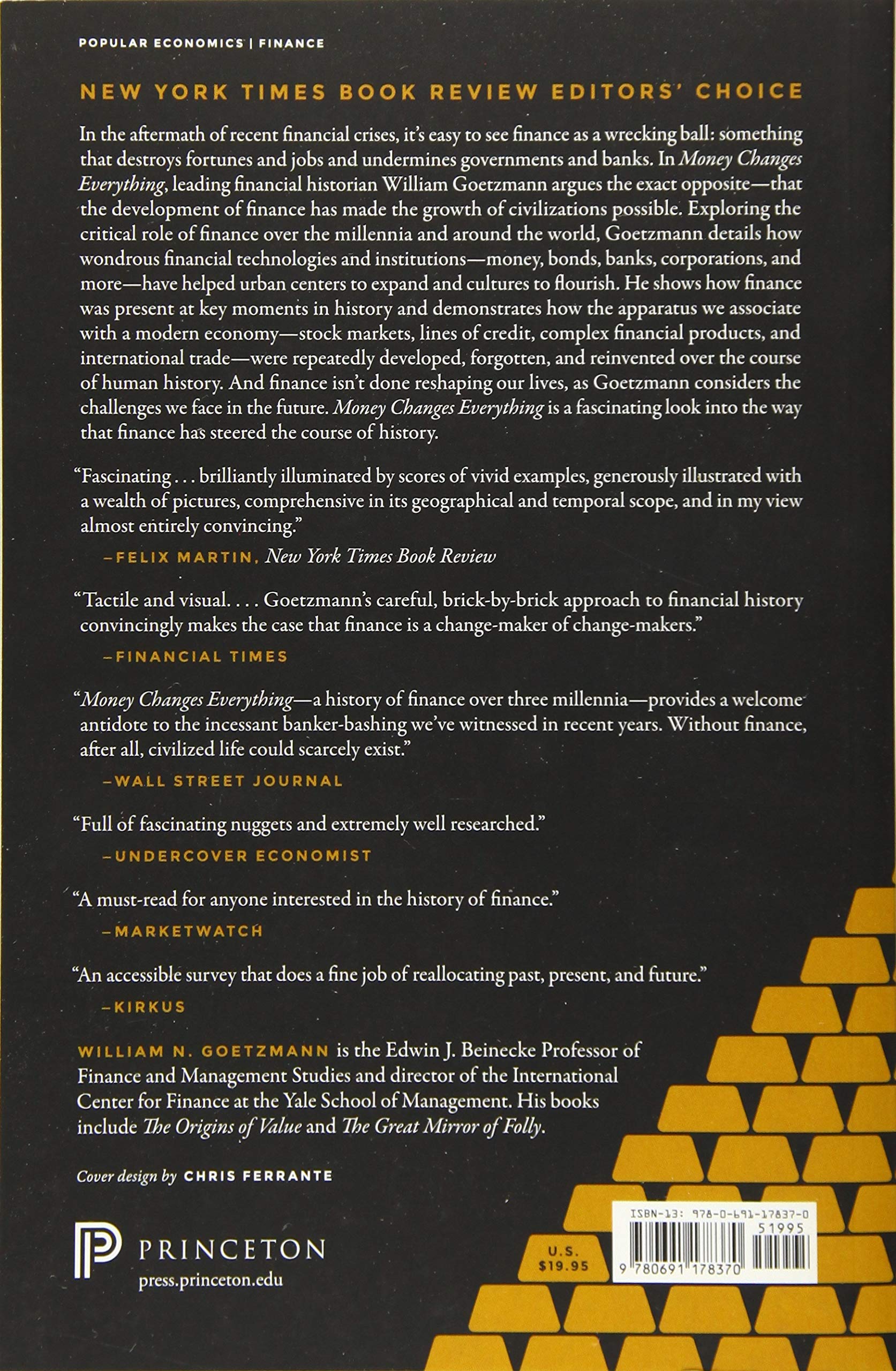
Money Changes Everything gives an overview of how finance has been intertwined with civilization from Sumer up to recent times. Its a unique book from what I have read as it explores in some detail the specific financial mechanisms used by early civilizations to facilitate growing complexity in the economy. The book looks at ancient civilizations as well as the modern world but I would say for new material the explorations of Mesopotamian, Greek, Roman and Chinese civilization particularly interesting.The book is split into four parts starting with the archaeological record. It is fairly well known that cuneiform was used to record trade and probably invented for that purpose but the author goes through old texts and discusses contracts drafted from the beginning of human history. We see how interest was developed (which interestingly seems to have been formed due to the idea that a flock borrowed would grow overtime). The author analyzes situations where there is contract dispute and how parties accrued interest in their calculations of liability. The author spends some time on Greece as well and discusses the mercantile nature of trade and use of silver in transactions. The author gives the refreshing background of the economic environment of Ancient Greece and its role in trading and mercantile exchange. The author discusses how insurance contracts were originated in this period to help diversify risk and discusses how disputes were dealt with. The author also discusses Roman finance which was very sophisticated due to the extent of the empire. You learn about the beginnings of principal-agent relationships in investing and limited liability vehicles and the beginnings of a capitalist class in the sense that senators had excess savings that were used for investments through LP structures. The author then moves to China which developed concurrently but had a system very distinct from Europe and the Middle East. The minting of a sovereign coin system is discussed as well as the fact that China was the first country to use a paper currency. The author discusses the economic system in China and how its centralized bureaucracy didn't allow for an entrepreneurial economic environment where inventions were rewarded with financial gains.The author moves on to the middle ages and refocuses on Europe up to the 18th century. One gets an understanding of the financial network that were constructed to facilitate transfer of savings on religious pilgrimages and in particular the formation of protobanks as finance filled a gap of how to send money over large distances. The author then goes to Italy to discuss merchant finance in Venice and as well the development of math to improve financial reasoning. This exercise was taken up by the famous Fibonacci and the author discusses his work on problem solving for financial accounting. The author discusses some interesting examples of early innovations of finance like perpetual bonds as well as various complex conditional forms of insurance. All these products who were developed before a mathematical theory for them was and so its interesting to read about how people took advantage of financial instrument mispricing. The author gets into topics that more has been written about recently and things like the manias that took over markets like the South Sea Bubble and John Law's financial alchemy in France. The accounts are very readable and definitely hold your attention.The author then moves into the modern realm really starting with Marx and going through Keynes, the Depression and the further codifying of mathematical finance. This is a history of how finance has been embedded in civilization form its beginnings and how finance is inescapable as the complexity of an economy grows. I enjoyed the book for its early history of finance in ancient civilization and the examples discussed about financial mechanisms developed by people to solve particular problems they were facing. The lesson of the use of finance to coordinate actions is a fairly trivial one so its really the history and examples chosen that gives life to the book. It is quite detailed and though parts can be a bit dull I enjoyed the book. The later parts are well written but there are other accounts out that I think are superior but the book achieves its purpose of discussing how finance is embedded in civilization and has been from the very beginning.
S**A
Mix of finance, history and archeology
Very good book, essentially a fascinating mix of finance, commerce, history and archeology.Unlike many books that give you a high level overview, this one goes in depth.
M**L
Excellent
un des meilleurs livres d'histoire que j'ai lu depuis longtemps; les angles de vue et les informations sont, tout le temps, profonds et novateurs; je pense que Braudel aurait aimé ce livre...
H**R
Super Produkt !
Alles ist in bester Ordnung,Artilkel wie beschrieben passt genau.
J**A
really fantastic book
thorough, engaging, well-written and very informative. its much better than the other "history of money" type books out there. even for someone who is not well-versed on the topic, its an enlightening look at the link between the evolution of finance, and the evolution of culture it helped to propel forward. highly recommend.
P**T
El dinero y el tiempo
Es un libro básico para estudiantes, profesores e interesados por cómo funciona una de las bases esenciales de la economía: el dinero y el tipo de interés. Muy recomendable y fácil de entender si se tiene una base de inglés.
Trustpilot
5 days ago
3 days ago