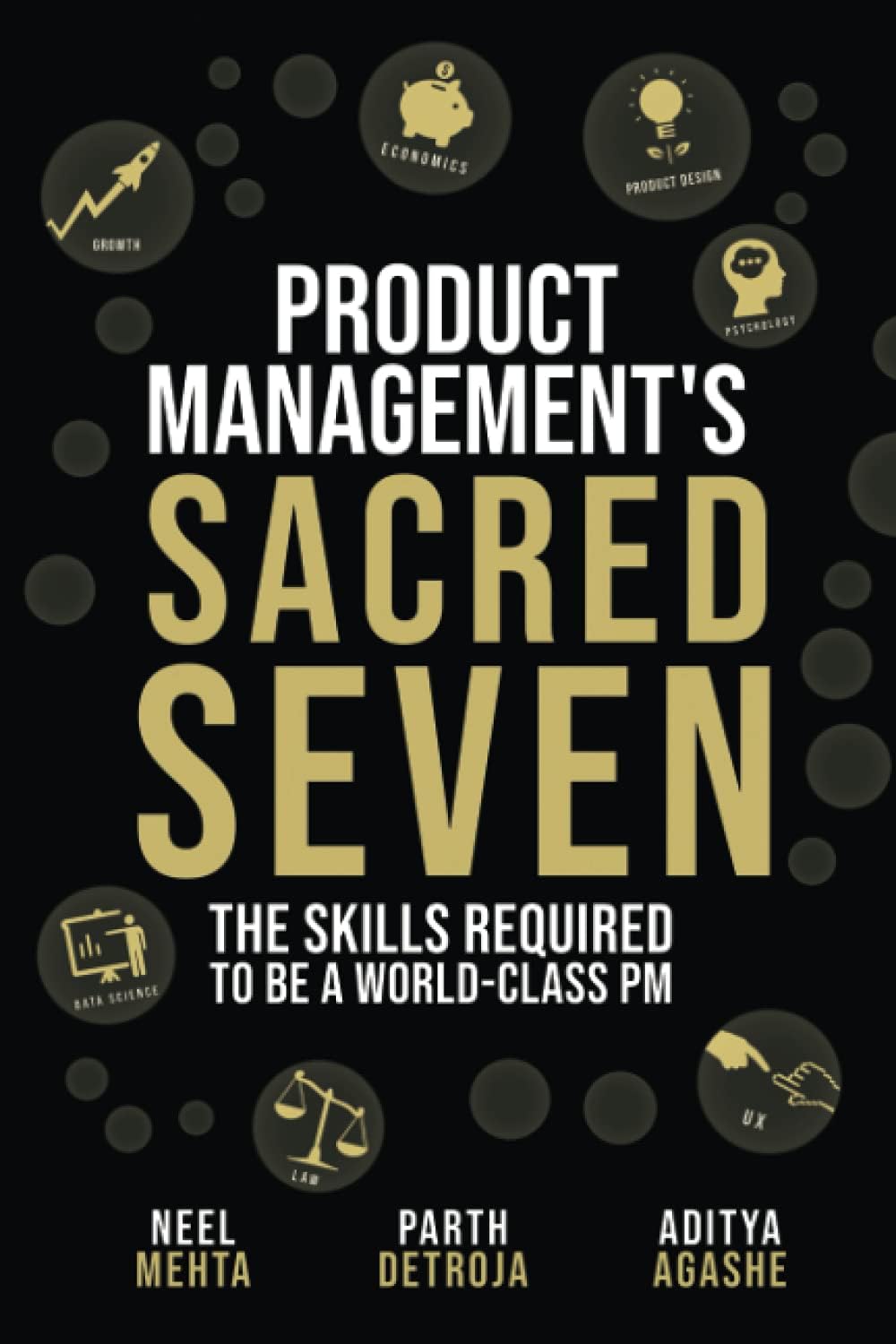
Product Management's Sacred Seven: The Skills Required to Crush Product Manager Interviews and be a World-Class PM (Fast Forward Your Product Career: The Two Books Required to Land Any PM Job)
Product ID: 234380021
Buy anything from 5,000+ international stores. One checkout price. No surprise fees. Join 2M+ shoppers on Desertcart.
Desertcart purchases this item on your behalf and handles shipping, customs, and support to Vanuatu.
Authored by 3 Product Managers at Facebook, Google, and Microsoft, Product Management’s Sacred Seven is a comprehensive resource that will teach you the must-know knowledge and applied skills necessary to become a world-class PM that can get hired anywhere. COUNTERFEIT PHYSICAL BOOK WARNING: There are several sellers selling counterfeit new and used copies of our book. The counterfeit copies are missing 83 pages of new content updates made in 2026 and have horrible print quality. To ensure you get a legitimate version of our book with the latest updates, please only buy NEW copies that say "Ships From & Sold By desertcart." In writing this book, we interviewed 67 product leads and hiring managers from 52 top companies around the world. They ranged from all the usual FAANG suspects to darling unicorns such as Coinbase, TikTok, and Grab. We asked everyone two simple questions: What knowledge separates interview candidates you hire from those you don't? What hard skills help PMs advance their careers the fastest? Given that we talked to product leaders across the world who worked in various different countries and industries, we expected to see no clear pattern in our responses. We were shocked to find a common theme across all of our interviews. The knowledge and skills which separated exceptional PMs from the rest all boiled down to seven subjects: product design, economics, psychology, user experience, data science, law & policy, and marketing & growth. The average PM excels at 2 or 3 of these disciplines. A truly world-class product manager, however, thrives in all 7. Authored by the #1 bestselling authors of Swipe to Unlock, this book blends case studies, theory, and mental models to help you master these seven subjects and fast forward your product career! Inside Product Management’s Sacred Seven , you’ll find real-world examples from over four dozen companies, battle-tested interview tips, and free access to a library of bonus video content online. Topics Covered: Product Development, Hypothesis Testing, Market Selection, Prototyping, Product Strategy, Business Models, Market Entry Strategies, Unit Economics, Customer Economics, Product Segmentation, Pricing Psychology, User Motivation, Creating Product Stickiness & Habit, Gamification, Cognition & Mental Models, UX Principles, Product Usability, Light & Dark Patterns, Data Analysis, Experimentation Frameworks, Product Metrics, Storytelling with Data, Antitrust Policy, Intellectual Property, Platform Liability, Privacy, Employment Law, Accessibility, Brand Building, Advertising, Growth Hacking and much more! Featured Companies: Google, Facebook, Microsoft, desertcart, TikTok, Snapchat, Apple, Spotify, Uber, WeChat, Yelp, Tinder, Twitter, Tesla, ByteDance, OnePlus, PayPal, LinkedIn, Airbnb, Pinterest, Zillow, Visa, Salesforce, Asana, Robinhood, Adobe, Alibaba, Netflix, Bloomberg, Shopify, Trello, Workday, Notion, Nintendo, Glossier, Lyft, Telegram, Disney, and many more! Read Sacred Seven today to ace your PM interviews and become a better product leader! Review: Helpful Resource for Building Product Management Foundations - Sacred Seven provides a solid foundation in core product management concepts, covering a wide range of topics like product strategy, execution, metrics, and structured decision-making. I especially appreciated the use of real examples and case studies, which helped make abstract frameworks more practical and easier to understand. The interview tips embedded throughout the book, along with links to relevant videos, added helpful context and made the material more engaging. Overall, it’s a well-rounded resource for building PM fundamentals and understanding how experienced PMs think through common product challenges. Review: A Masterpiece Unveiled: "Product Management's Sacred Seven" Redefines Excellence in the Field - "Product Management's Sacred Seven" is a groundbreaking masterpiece penned by the brilliant trio of Neel Mehta, Parth Detroja, and Aditya Agashe. This exceptional book is a revelation for product managers, both novices and seasoned professionals alike, as it unravels the intricacies of the field with unprecedented clarity and insight. The authors embark on an ambitious journey, dissecting the multifaceted world of product management through a lens that encompasses seven pivotal domains: Product Design, Economics, Psychology, User Experience, Data Science, Law & Policy, and Marketing & Growth. This holistic approach sets the book apart from others in the genre, providing readers with a comprehensive toolkit that extends beyond the traditional boundaries of product management. The first standout feature is the authors' ability to distill complex concepts into digestible, actionable insights. Whether you're grappling with the nuances of user experience or navigating the legal landscape, "Product Management's Sacred Seven" serves as a beacon of clarity. The writing is not only engaging but also remarkably accessible, ensuring that readers of all levels can absorb and apply the wealth of knowledge within. The integration of diverse disciplines is a stroke of genius. By seamlessly weaving together elements of design, economics, psychology, data science, law, and marketing, the authors create a holistic framework that mirrors the dynamic reality of modern product management. This interdisciplinarity is a testament to the authors' deep understanding of the multifaceted challenges that product managers encounter daily. One of the book's greatest strengths lies in its applicability. It doesn't merely present theories; it equips readers with practical tools and strategies to excel in each domain. The real-world examples and case studies peppered throughout the book serve as invaluable guides, illustrating how these principles can be implemented to overcome real challenges in product management. "Product Management's Sacred Seven" doesn't cater exclusively to a particular skill level. Whether you're a budding product manager eager to kickstart your career or a seasoned professional looking to refine your skills, the book provides a roadmap for success. The balanced blend of foundational principles and advanced strategies ensures that every reader, regardless of experience, finds immense value within its pages. In conclusion, "Product Management's Sacred Seven" is a 5 out of 5 stars spectacular book that transcends the boundaries of conventional literature in the field. Neel Mehta, Parth Detroja, and Aditya Agashe have not only delivered a comprehensive guide to product management but have redefined the standard for excellence in the discipline. For anyone serious about excelling in the world of product management, this book is not just recommended—it's essential.
| Best Sellers Rank | #105,698 in Books ( See Top 100 in Books ) #7 in Project Management Software Books #35 in Job Interviewing (Books) #141 in Job Hunting & Career Guides |
| Customer Reviews | 4.7 out of 5 stars 864 Reviews |
N**A
Helpful Resource for Building Product Management Foundations
Sacred Seven provides a solid foundation in core product management concepts, covering a wide range of topics like product strategy, execution, metrics, and structured decision-making. I especially appreciated the use of real examples and case studies, which helped make abstract frameworks more practical and easier to understand. The interview tips embedded throughout the book, along with links to relevant videos, added helpful context and made the material more engaging. Overall, it’s a well-rounded resource for building PM fundamentals and understanding how experienced PMs think through common product challenges.
R**R
A Masterpiece Unveiled: "Product Management's Sacred Seven" Redefines Excellence in the Field
"Product Management's Sacred Seven" is a groundbreaking masterpiece penned by the brilliant trio of Neel Mehta, Parth Detroja, and Aditya Agashe. This exceptional book is a revelation for product managers, both novices and seasoned professionals alike, as it unravels the intricacies of the field with unprecedented clarity and insight. The authors embark on an ambitious journey, dissecting the multifaceted world of product management through a lens that encompasses seven pivotal domains: Product Design, Economics, Psychology, User Experience, Data Science, Law & Policy, and Marketing & Growth. This holistic approach sets the book apart from others in the genre, providing readers with a comprehensive toolkit that extends beyond the traditional boundaries of product management. The first standout feature is the authors' ability to distill complex concepts into digestible, actionable insights. Whether you're grappling with the nuances of user experience or navigating the legal landscape, "Product Management's Sacred Seven" serves as a beacon of clarity. The writing is not only engaging but also remarkably accessible, ensuring that readers of all levels can absorb and apply the wealth of knowledge within. The integration of diverse disciplines is a stroke of genius. By seamlessly weaving together elements of design, economics, psychology, data science, law, and marketing, the authors create a holistic framework that mirrors the dynamic reality of modern product management. This interdisciplinarity is a testament to the authors' deep understanding of the multifaceted challenges that product managers encounter daily. One of the book's greatest strengths lies in its applicability. It doesn't merely present theories; it equips readers with practical tools and strategies to excel in each domain. The real-world examples and case studies peppered throughout the book serve as invaluable guides, illustrating how these principles can be implemented to overcome real challenges in product management. "Product Management's Sacred Seven" doesn't cater exclusively to a particular skill level. Whether you're a budding product manager eager to kickstart your career or a seasoned professional looking to refine your skills, the book provides a roadmap for success. The balanced blend of foundational principles and advanced strategies ensures that every reader, regardless of experience, finds immense value within its pages. In conclusion, "Product Management's Sacred Seven" is a 5 out of 5 stars spectacular book that transcends the boundaries of conventional literature in the field. Neel Mehta, Parth Detroja, and Aditya Agashe have not only delivered a comprehensive guide to product management but have redefined the standard for excellence in the discipline. For anyone serious about excelling in the world of product management, this book is not just recommended—it's essential.
A**R
Must Read for Product Managers and those who aspire to be
Summary: Great book. Must be an addition to any ProdMgr's library (next to Swipe to Unlock). Well written and keeps a reader's interest throughout. It should be read in its entirety first and then as a reference guide for interviews and keeping fresh. Through interviews with PMs and their own experience, the three authors break down product management into 7 Disciplines. Product Design Highlights * Fundamentally breaks down design into building a new product (0 --> 1) and scaling an existing one (1 --> n) * Mentions the Kronos effect - Companies protect their cash cows through a variety of tactics (acquisition, etc). One of the more dangerous implementations of protection is companies ignoring research or building out disruptive technologies to their own cash cow. The authors cite a great example in Eastman Kodak which actually invented the digital camera in 1975. Investment in the idea was squashed by leadership. * Assumptions in Chapter 3 - The books rightfully points out that "If you’re going to be going successful, your assumptions have to be valid - so your first step has to be finding and validating your assumption.” They go on to mention "Assumptions are hard to dig from the back of your mind, so it helps to have a systematic way to catalog them”. While the authors rightfully acknowledge this as critical they provide a quick write-up of a potential way of systemically eliciting the assumptions and organizing them. I would have liked to see some more depth here. The link doesn’t seem to work well for the footnote (PD.CH.FN1). Many people including myself don’t even realize they are making assumptions. I would like to have seen more depth in the book or via footnote on this important topic. * MVP vs RAT vs MLP - The authors correctly mention that MVP is a flawed term and oft-debated terms. They propose the Riskiest Assumption Test (RAT). Great concept! Which Assumption is Riskiest and how can it be most simply tested? They go on to expound on another very useful concept, Minimum Likable Product (MLP). An MLP "is the simplest thing that will impress your users and make them stick around." The key with an MLP is to identify the "surface area" for the feature set. * User Personas - The authors provide some strong arguments against the overuse of user personas which I found both interesting and compelling. * User research - ask open-ended questions to ascertain a fuller picture. They give a great example and funny at the same time example from a Pink Panther movie. While Y/N or multiple choice questions are standard, advancement is possible when an investigator breaks away from dominant methods with the courage to opt for labor intensive ones. * Experience over products - consumers are not just purchasing a set of features or a product. They value a complete experience. * Randon Note - the authors provide some interesting examples of how American Airlines and Ford complimented their products. AA with Sabre and Ford with their financing arm. Provides food for thought.
S**E
A great resource in 2026!
I bought this book years back and even years later it’s still just as impactful and resonate to the current state of tech. Yes, AI is shifting the landscape but the core 7 skills that they advocate for in this book are more needed than ever.
J**H
A useful primer on Product Management with a major caveat
Comprehensive and thoughtful, this is a worthwhile read, especially for folks new to Product Management. For experienced or well-read PMs, this book would more likely be a convenient way to refresh on key concepts. In other words, it may offer a few new insights but it likely won’t transform the way you think about Product Management. (Off the top of my head, some books that were gamechangers for me are Competing Against Luck, Don’t Make Me Think, Sprint, and Monetizing Innovation.) I’m rating the book 4 stars instead of 5 for two reasons. First, I wish a Kindle version of the book were available. According to one of the authors, Amazon’s incentive structure made it infeasible to offer a Kindle version at a fair price. So, while I don’t fault the authors for this gap, it still resulted in a slightly less convenient experience than getting a Kindle book on-demand. Second, it’s not clear to me how trustworthy the reviews are. In the conclusion of the book, the authors mention they’ve created a $79 interview-strategy ebook. They offer to give it for free, conditional upon writing an Amazon review. Specifically, they state: “If you share what you liked about Product Management’s Sacred Seven in an Amazon review, we’ll send you a free copy of this normally-$79 interview strategy ebook.” I spoke with one of the authors, and they plan to update the language of this offer in the next version of the book to minimize bias in reviews. I appreciate their responsiveness to my call out. At the same time, when I first purchased the book, I wish I had known that some of the reviews may have been biased. All in all, the book is useful and informative, and I would recommend it, especially for anyone considering a career in Product Management. For what it’s worth, I’ve been sufficiently impressed by the book that part of my motivation in writing this review is to receive a copy of the authors’ interview e-book.
D**Z
Phenomenal Read!!! 10/10 Would Recommend 🙌
I thoroughly enjoyed every page of this book 🙂. The authors are excellent at keeping a consistent voice & flow, so it doesn't feel like any part of it drags on (which is quite frankly incredible for a nearly 700-page book). For each "Sacred" topic, the authors clearly & concisely explain the most-impactful frameworks & also reference case studies that are relevant & fascinating (with funny footnotes sprinkled throughout). I was actually surprised that I enjoyed this format. I normally feel that case studies are overused & often employ poor logic (correlation, rather than causation) to argue why an author's theories are applicable. When other authors do this, it makes it difficult to pinpoint the true underlying explanatory principles, which makes those case studies fun stories... but not exactly replicable for your own work challenges. However, these case studies were truly insightful, with logical explanations!! (I assume this was uniquely possible in this book since the authors had to critically assess which of their many topics ACTUALLY explained what happened... and it helps that they've validated their perspectives through practice in the messy workplace). I highly recommend this book to anyone interested in any of the 7 "Sacred" topics... Honestly, any one of these chapters could easily be a fully sellable book in its own right: 1. Product Design 2. Economics 3. Psychology 4. User Experience (UX) 5. Data Science 6. Law & Policy 7. Marketing & Growth
R**S
The best Product Management book, invest in yourself with this awesome publication
As many have stated, I believe given the breadth of knowledge and awareness a Product Manager needs to bring to the table, is very hard to find a book that covers all of the most important angles with a fresh perspective, besides giving key insights on each area and business cases, it also provides interview tips on each chapter, coupled with free videos to watch, makes the best investment you can make on yourself if you want to become a better Product Manager or break formally into it, as is my case, has helped me to skill up. Notes: In Statistical Significance section in the Data Science chapter, one needs to investigate more to get a better understanding on what the authors are mentioning, for example, it pays to review Central Limit Theorem, Confidence Intervals, Student's two-tailed t-test, t-table, also, get a better understanding what p-value is, which is very very complicated to have a definitive and understandable answer in simple terms, it is a struggle to define it coherently. Remember to read the footnotes, they are super valuable! All in all, this book covers all the areas fantastically and authors went the extra mile to make it easy to read plus the interview tips, I got hooked since the first pages and could not put it down. It is the Product Manager Bible hands down!
S**M
A MUST-READ!!!
I was such a big fan of Swipe to Unlock that I immediately went to purchase the Sacred Seven. I really appreciate how the authors debunk and articulate different concepts so comprehensively yet succinctly. I already started applying the lessons and tips that I learned from the book in my day-to-day job as a PM, which is not something that I was able to come by from other books I’ve read about product.
M**Y
Foundational information for aspiring product managers
I really enjoyed this book. Some concrete examples across the core skills required for top performing product managers.
E**A
Very Insightful book
I have been looking to transition to Product Management from my Finance field and I have had to get some materials that could help me through this phase. Of all these materials I got, I must acknowledge this was my best hands down. I believe the uniqueness with which they portrayed their case studies, the real-life examples, and how the concepts were applied made the difference. In my opinion, I think lots of work was put into writing this book. Kudos to the writers.
Z**Z
The most complete PM book
I’ve read many books (50+) about product management, UX, and psychology, but none was nearly as comprehensive as this book. I wish this book had been available when I started as a PM 10 years ago. Reading it will feel like reading the most important parts of the best PM books. With lots of examples, tips and practices written clearly, this book best reflects the mindset of a PM. If you've been a PM for a while, it won't be completely new, but as a beginner, it's a must. Now, if someone asks me how to be a PM, I just have to show them this book. The seven areas are: Product design (scaling, finding advantages, MVP, hypothesis testing, etc.), Economics (business models, GTM, customer economics, segmentation, etc.), Psychology (pricing, motivation, stickiness, gamification, etc.), UX (mental models, principles, usability, etc.), Data science (principles, metrics, metric models, Law (intellectual property, privacy, accessibility, etc.), Marketing&Growth(branding, market types, advertising, growth hacking, etc.).
L**Y
Fantastic resource for aspiring PM’s
I read the swipe to unlock by the same authors and really enjoyed it. Having been in tech for 6 years I still learned a lot. Was no Suprise to pick this book up as one of my reads as I prepare for interviews and eventually a job as a PM. The book is great, and has fantastic resources and insights on what I believe every PM requires and more so every aspiring PM. It will remain my go to ….
H**N
If you are looking for an end to end Product Management guide , this is for you
Provide detailed overview, guideline and case study of important aspect of being a Product Manager. Really help to know what are important framework in both start up and big tech world! Highly recommend!
Trustpilot
1 month ago
1 week ago