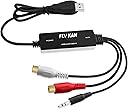
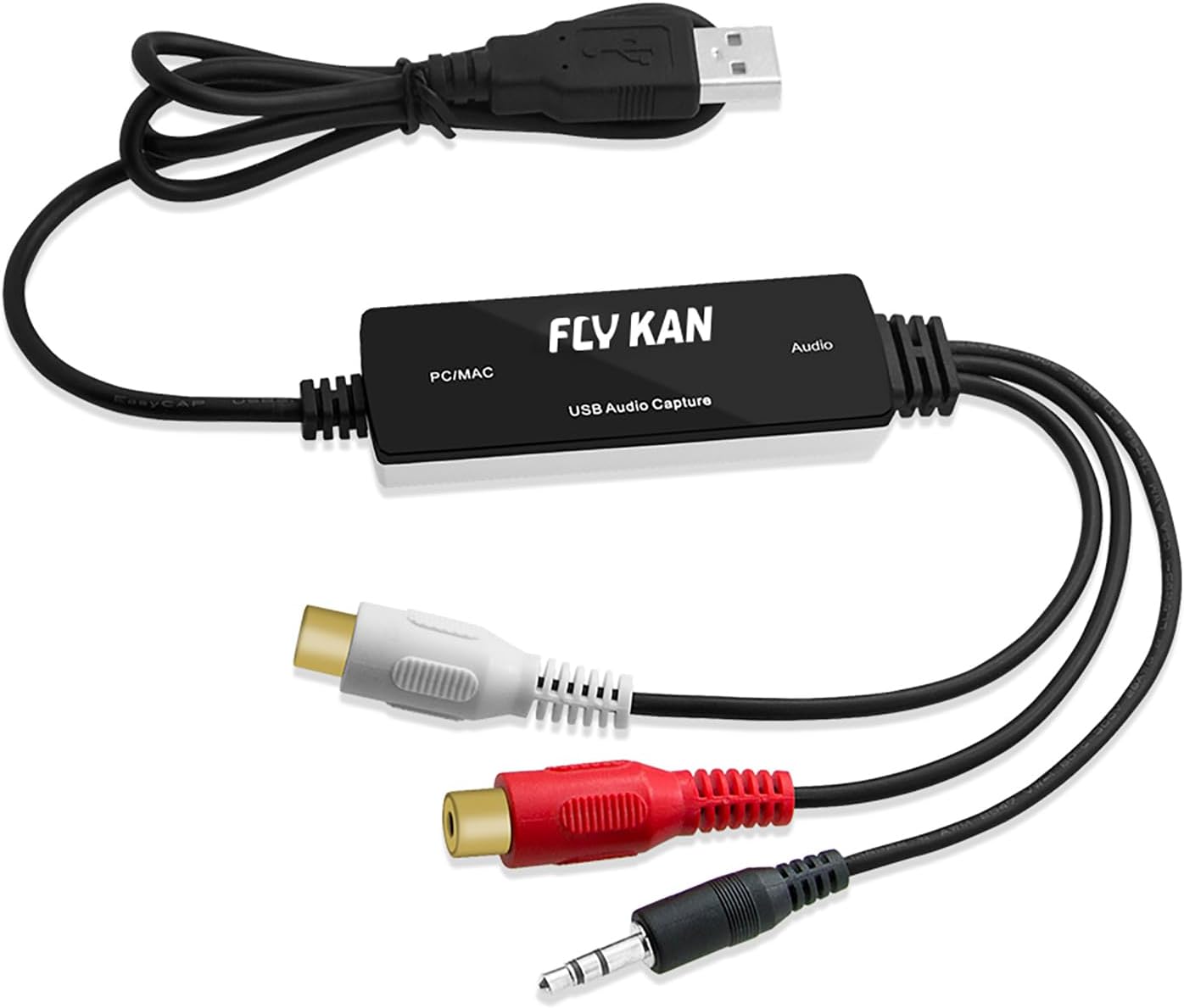
🎧 Digitize your nostalgia—turn timeless tunes into modern masterpieces!
The FLY KAN USB 2.0 Audio Capture Card is a compact, plug-and-play device designed to convert analog audio from vinyl records and cassette tapes into high-quality digital MP3 or WAV files. Compatible with Windows 7 to 10 and Mac OS 10.7 to 10.14, it includes professional Audacity software for seamless recording and editing. Perfect for preserving your classic audio collection with crystal-clear sound, all without needing extra power or complex setup.


| ASIN | B019T9KS04 |
| Antenna Location | Audio Conversion, Audio Recording |
| Best Sellers Rank | #419 in Video Converters |
| Brand | Fly Kan |
| Built-In Media | 1x capture card 1x manual |
| Compatible Devices | Laptop, Personal Computer |
| Customer Reviews | 4.2 out of 5 stars 845 Reviews |
| Hardware Interface | USB 2.0 |
| Item Dimensions | 3.54 x 0.59 x 1.18 inches |
| Item Weight | 0.07 Kilograms |
| Manufacturer | FLY KAN |
| Minimum System Requirements | Compatible with Windows 10, 8.1, 8, 7, Vista, and XP, as well as Mac OS 10.7-10.14 |
| Model Name | FLY KAN USB 2.0 Audio Capture Card |
| Model Number | 8541594591 |
| Operating System | Vista,Mac Os,8 . 1,Mac,Windows 10 |
| Other Special Features of the Product | Professional Audio Capture/Converting Software (Audacity) |
| Platform | Windows, Windows 10 |
| Recommended Uses For Product | Audio Conversion, Audio Recording |
| Special Feature | Professional Audio Capture/Converting Software (Audacity) |
| Unit Count | 1 Count |
S**8
Works Well, Just Need to Adjust Software
Needed this to rip copies of my rare records (and maybe cassettes soon) so I can listen to them wherever I go and not be stuck in my bedroom with the record player. The device itself is fine and very easy to setup and use. The instructions for the hardware process didn't quite match the system screens I saw, which confused me for a minute, but it was okay. The trick is the Audacity software, which I already had installed on my laptop anyway, so I didn't need the included disc. But you really need to take the time to check Audacity settings and fix the volume and everything, or you're going to wind up blaming the device for your issues. The device is great, just be patient and learn to work Audacity a little bit and you should be fine. If you run into some minor issues with recording glitches like I did, check the latency settings and bit rate and all of that stuff. Your issue is the software, not the device. Once I fixed the software to eliminate the one glitch, everything was fine and honestly the rip from vinyl sounds like it is a CD recording, it was that clear and without any surface noise or hardware issues, etc.
D**.
Niche Product but WORKS!!! macOS 10.14 compatible, macOS 10.15 partially compatible
It truly is plug-n-play, even on the latest macOS, 10.15 Catalina (Preference pane shows live signal meter). BUT... Audacity (the digital recording software most people use with it) is slightly incompatible with OS X 10.15. For privacy reasons, macOS 10.15 is now requiring user permission to use any microphone devices, but the current version of Audacity was released pre-10.15 and does not request permission, meaning while OS X 10.15 can see the input levels (System Preferences -> Sound -> Input -> USB PnP device), Audacity 2.3.2 is unable to see/record the audio signal. When I initially used it, even Garage Band didn't request microphone access and couldn't see the audio. Thankfully, QuickTime Player in OS X 10.15 does request permission to access the microphone and allowed me to adjust input levels and record audio, and I brought it into Audacity to process it. Apple's Garage Band does work now (as of November 9 2019). I'm a happy camper, especially now that I can import using either Quicktime Player or Garage Band. I imagine soon Audacity might add the microphone permission function. I reached out to tech support for the product and I heard back a few days later stating they don't recommend macOS 10.15, but that it works fine in macOS 10.14. Luckily it is may not be a problem at all if you can just import straight into Garage Band if it meets all your needs.
B**.
Just Works and Right Solution For Me
I have some old lower-quality cassette tapes, both full-sized and micro, that I used to record some conversations about 20 years ago. I needed to reference some of those tapes again. The sound only plays through the left channel on my headphones. To get the audio to play through both channels, I thought digitizing the tapes was the best solution. I also figured the digital files could be loaded onto my phone so I could listen to them anywhere at any time when I needed to. It was easy to get working. I just plugged the USB A end of the adapter into my iMac and the 3.5 mm plug on the other end of the adapter into the headphone jack on the tape player. I then started up Garage Band on the Mac, selected "monitor" in the software, pressed play on the tape player, and started to hear sound. I didn't need any additional software or drivers. It just worked out of the box. The sound is not perfect. I'm getting a soft electrical hum that shouldn't be there, so this probably isn't the right solution if your final output needs to be high quality audio. Then again, I'm not an electrical or sound engineer so maybe there's a way to filter that sound out, or I've got a bad jack somewhere. Those with more knowledge may be able to weigh in. For my project, the tape audio quality is so low that the additional hum isn't a problem. I was also pleased to discover that GarageBand automatically outputs the single channel mono audio to both channels, so I didn't need to configure anything to get the result I was looking for. I just pressed "record" and it began capturing the sound from the tapes into a digital file. This was exactly what I needed.
G**G
It works fine.
Yes, By coincidence, I already had the Audacity app on my computer, and when I plugged in the Audio Grabber capture device to my computer's USB port, the required drivers also loaded automatically. I have a HP laptop with Windows 10 with all the latest updates. Then I was able to start capturing nearly immediately. I was able to capture and record two 40 year old cassette tapes to mp3 without incident. Frankly, the instructions for the Audacity app are not easy to understand, but I was able to fiddle with the "record" settings on the front panel and it worked. Perhaps eventually I will be able to do more with it. The instructions for the Audacity app are very technical and hard to understand. I already owned a patch cord with 3.5 inch male connectors at each end. I used the included female to female 3.5 inch adapter. I plugged the patch cord into my Sony boombox with cassette deck, and into the Audio Grabber capture device using the included female to female 3.5 inch adapter. I was afraid the signal level from the boombox would be too high, but it was not too high. In fact, I had to set the volume control on the boombox nearly all the way up to get the required record levels. There is probably an attenuator in the included female to female 3.5 inch adapter. With the patch cord plugged into the headphone jack, there was no way to listen during the recordings, however, that I could figure out. So I had to record silently, and then play back in order to test the setup. It worked very well!!! Perhaps in the future I will figure out how to monitor the recording in real time. The device works well. Thank you, Bill
D**F
Need to know how to use it.
Ok it is plug and play with my win 10 computer. I put cassette tapes in my cassette deck and connect line out to the red and white RCA phono Jack's on the device. The usb a plug goes into my desktop usb port. Then I load audacity software. Had to learn the basics of audacity software. All the levels worked correctly. Saved file as was because it sounds better. Downloaded file to a spare smartphone I have and now it is a music player. This device makes it all happen easy once you know how it all works together. My cassette deck is a 500 unit with good frequency response so the end result was file is real good. Mp3 files are also good but wav files sounds better.
A**A
Works at well 44.1kHz, does not work well at 48kHz
Product works as expected when capturing audio at 44.1kHz, but does not work well at 48kHz which is the default for a growing number of audio applications. at 44.1kHz the capture is high quality and perfectly acceptable. at 48Khz the audio is pitch shifted and choppy, as if the device is still capturing at 44.1kHz and thus is producing gaps in the recording where the extra 3900 samples per second should be found. if you need 48kHz capture, avoid. if you only need 44.1kHz capture buy away.
Z**Z
Did not work
1st, it came with no CD. The listed PDF manuals name a different brand and links in them don't work FLY KAN website shows for this device only the Audacity software install download. Just plugging in my tape player to this device, plugging in the USB connection and turning on the tape player's PLAY wasn't enough for my system to recognize something was there. (Tape player works fine with earphones plugged in.) I have Audacity 4.4.2 running on Windows 10 22H2 (current on updates) and Audacity works okay with other inputs. Device manager shows nothing new when this device is plugged in and turned on. Perhaps there is software or a driver that must be installed first? Maybe this is a malfunction unit? I've wasted enough time on this -- it does not work for me and I'm returning it.
D**N
V.TOP is a Quality analog-to-digital Conversion Tool
I have dozens of ancient Cassette Tapes (early 1970s) needed to be digitied. I had bought a used Yamaha KX-R430 Cassette Deck & digitized to play them into the V.TOP USB device, available on Amazon here: [link deleted]. The "Line-Out" RCA pin jacks on the KX-R430 tape deck produced only thin, echo-y output to the V.TOP, which in turn produced a thin, echo-y digital file to Audacity, the free Windows analog-audio-capture and digitizing softare. This is because "line out" from the deck was in need of a pre-amp to contour the output into its full fidelity potential. Luckily, the HeadPhone output jack of the KX-R430 produced rich, full stereo sound. The V.TOP device worked well when connected to the preamped HeadPhone Jack of the Yamaha KX-R430. NOTE: A male 1/4" (KX-R430 HP output) male to a "small" (1/8" V.TOP male input) audio adaptor jack was needed to make the Cassette music flow from the deck to the V.TOP and thence into the USB port of the computer. Such an adaptor is available on Amazon here: [link deleted]. USB output of V.TOP USB device captured, recorded, and copied out as a digital file, which in turn was captured and saved to the laptop hard drive by Audacity. The V.TOP package provides a mini-CD which contains the excellent, and free, Audacity recording app. NOTE: Audacity FAQ says: "You will probably want to both hear the monitored audio and see it on screen while recording. To do this, enable "Software Playthrough" in the Transport > Transport Options menu." This worked perfectly. Now headphones are hooked up to DELL Inspiron 15 laptop speaker output and V.TOP USB device is connected to HeadPhone Jack (front panel) of Yamaha KX-R430. V.TOP draws its power from the USB port of the laptop to which it is connected (see picture). This allows realtime, monitoring & recording by Audacity. The process is 100% manual during Start/Record/Stop of all Tape Deck and Audacity "Transport" controls. If you have a 60 minute cassette tape, it will take 75 minutes to digitize it track by track. Audacity's File --> Export command allows direct saving of stereo tracks as .mp3 or .wav (and other) audio formats to the local hard drive. Track Names are up to the archivist. Once these files are on the local HD they can then be used to burn to a data CD or a thumb drive. If you only want to make .mp3 files of your old time "Mickey Mouse" kids cassettes, then any of the cheap "MP3 Converter" Walkman-style Cassette Players sold on Amazon will probably do. But Beware: These devices are toys, not tools. I bought one and sent it back. The V.TOP is a credible tool for making high fidelity digital stereo files [.mp3 or .wav] to preserve important cassette recordings, PROVIDED you use a quality, stereo cassette tape deck to play them into the V.TOP. V.TOP is Highly Recommended by me. Audacity settings are: Audio Host: MME Recording Device: Microsoft Sound Manager Recording Channels: 2 (Stereo) Recording Playback Device: Speakers/Headphones
Trustpilot
3 weeks ago
2 weeks ago