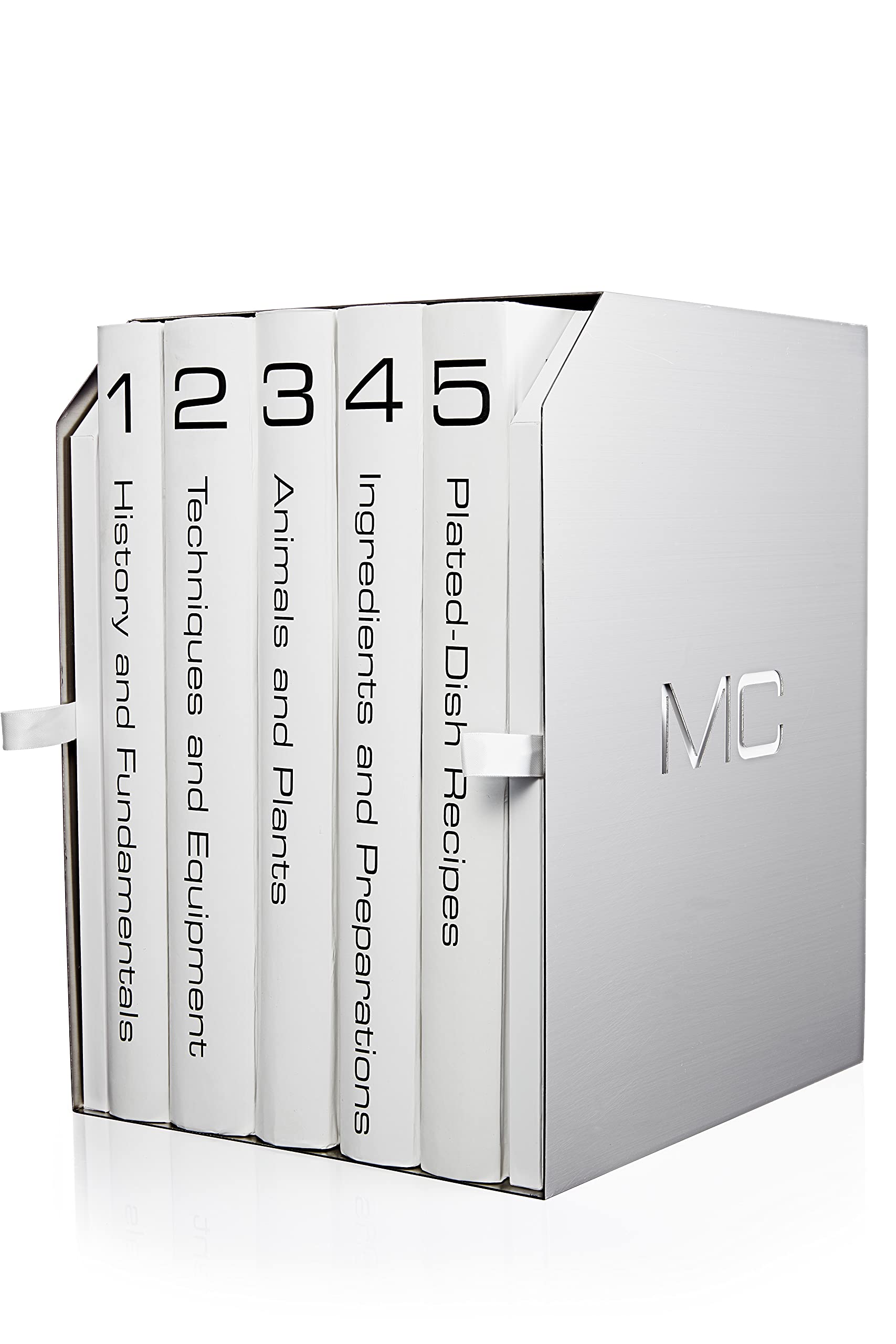
Modernist Cuisine: The Art & Science of Cooking [Myhrvold, Nathan, Young, Chris, Bilet, Maxime] on desertcart.com. *FREE* shipping on qualifying offers. Modernist Cuisine: The Art & Science of Cooking Review: Well worth it! - Love these books. So much valuable information. A great starter set that covers so many aspects of cooking. Love the illustrations too. Review: What is in it for a home cook? - It’s expensive, but the real cost is the time it takes to read the books, plural. That’s right. It’s not one book; it’s five huge books. It took me three months of reading 1 to 2 hours every day to go through the almost 2000 pages in the first four volumes. There are about another 300 pages of recipes in volume 5. It’s not worth it if you are just looking for a cookbook. Calling Modernist Cuisine a cookbook is as wrong as calling Cruyff a footballer. They don’t just redefine the role; they redefine the game. Whether you will enjoy these books comes down to why you cook. Think of every meal as a project over which you can have total artistic, technical, and operational control. And the wife approves. Now, how often can a middle age man say that? To be in control, you need to know what you are doing. Here is a small subset of the science I learned from the book about how cows become steaks (I have a longer review on medium. Search for "book review: modernist cuisine" there): It all starts on the ranch. The animals’ diet affects the quality of the meat. Feeding an animal a high-calorie diet accelerates the typically slow replacement of mature, stiff collagen with new, weak collagen. Making such a change to the animal’s diet just before slaughter thus produces more tender meat. That’s why so many cooks swear by corn-fed beef. Even if you have a perfect specimen, a lot can still go wrong with the slaughtering. Dead muscle goes through a complicated biochemical process to become meat. After death, no oxygen is delivered to the muscle tissue because there is no blood flow. The cells burn through their energy reserve like anaerobic exercise burns energy. In turn, the pH of the muscle tissue drops, the same way you feel sore after intense exercise. If the cows are left in cold rain right before slaughter, the animals use up their energy reserve in the muscle. After slaughtering, not enough lactic acid is produced to drop the pH value. This causes too much water to be retained, and the meat appears darker. It’s a quality defect known as Dark Firm Dry (DFD). On the other hand, if the animal experiences acute stress before slaughter, a different kind of defect ensues. The surge of adrenaline accelerates the consumption of energy reserve in the muscle. The pH value drops rapidly before the temperature of the muscle has the opportunity to drop. The low pH and high temperature combination causes the muscle protein to denature and exude water. This is known as Pale soft exudative (PSE). Quality beef can be easily ruined if not stored and cooked correctly. To freeze it properly, you need to understand the science of water. To cook a steak right, you should know the science of heat transfer. It’s all in the books. Can you cook a nice meal without taking science classes? Yes, with a few rules and a lot of practice. But why would you trade knowledge and enlightenment for repetitive, menial labor? One last thing: Modernist Cuisine at Home is not a good low-cost alternative. More than half of the single volume is recipes, so it necessarily has to cut a lot of the scientific content. The recipes are still hard to make at home. Two much better alternatives are Harold McGee’s On Food and Cooking, and Science and Cooking: Physics meets food, from home made to haute cuisine, based on the popular Harvard lectures.


| Best Sellers Rank | #158,371 in Books ( See Top 100 in Books ) #183 in Cooking Encyclopedias #229 in Cooking, Food & Wine Reference (Books) |
| Customer Reviews | 4.8 4.8 out of 5 stars (96) |
| Dimensions | 10.31 x 14.5 x 17.5 inches |
| Edition | 7th |
| ISBN-10 | 1734386142 |
| ISBN-13 | 978-1734386141 |
| Item Weight | 48.2 pounds |
| Language | English |
| Print length | 2400 pages |
| Publication date | September 21, 2021 |
| Publisher | The Cooking Lab |
L**Y
Well worth it!
Love these books. So much valuable information. A great starter set that covers so many aspects of cooking. Love the illustrations too.
C**M
What is in it for a home cook?
It’s expensive, but the real cost is the time it takes to read the books, plural. That’s right. It’s not one book; it’s five huge books. It took me three months of reading 1 to 2 hours every day to go through the almost 2000 pages in the first four volumes. There are about another 300 pages of recipes in volume 5. It’s not worth it if you are just looking for a cookbook. Calling Modernist Cuisine a cookbook is as wrong as calling Cruyff a footballer. They don’t just redefine the role; they redefine the game. Whether you will enjoy these books comes down to why you cook. Think of every meal as a project over which you can have total artistic, technical, and operational control. And the wife approves. Now, how often can a middle age man say that? To be in control, you need to know what you are doing. Here is a small subset of the science I learned from the book about how cows become steaks (I have a longer review on medium. Search for "book review: modernist cuisine" there): It all starts on the ranch. The animals’ diet affects the quality of the meat. Feeding an animal a high-calorie diet accelerates the typically slow replacement of mature, stiff collagen with new, weak collagen. Making such a change to the animal’s diet just before slaughter thus produces more tender meat. That’s why so many cooks swear by corn-fed beef. Even if you have a perfect specimen, a lot can still go wrong with the slaughtering. Dead muscle goes through a complicated biochemical process to become meat. After death, no oxygen is delivered to the muscle tissue because there is no blood flow. The cells burn through their energy reserve like anaerobic exercise burns energy. In turn, the pH of the muscle tissue drops, the same way you feel sore after intense exercise. If the cows are left in cold rain right before slaughter, the animals use up their energy reserve in the muscle. After slaughtering, not enough lactic acid is produced to drop the pH value. This causes too much water to be retained, and the meat appears darker. It’s a quality defect known as Dark Firm Dry (DFD). On the other hand, if the animal experiences acute stress before slaughter, a different kind of defect ensues. The surge of adrenaline accelerates the consumption of energy reserve in the muscle. The pH value drops rapidly before the temperature of the muscle has the opportunity to drop. The low pH and high temperature combination causes the muscle protein to denature and exude water. This is known as Pale soft exudative (PSE). Quality beef can be easily ruined if not stored and cooked correctly. To freeze it properly, you need to understand the science of water. To cook a steak right, you should know the science of heat transfer. It’s all in the books. Can you cook a nice meal without taking science classes? Yes, with a few rules and a lot of practice. But why would you trade knowledge and enlightenment for repetitive, menial labor? One last thing: Modernist Cuisine at Home is not a good low-cost alternative. More than half of the single volume is recipes, so it necessarily has to cut a lot of the scientific content. The recipes are still hard to make at home. Two much better alternatives are Harold McGee’s On Food and Cooking, and Science and Cooking: Physics meets food, from home made to haute cuisine, based on the popular Harvard lectures.
M**.
Amazing books
I am so satisfied. After so long I have it and it's worth every penny.
K**V
Luxurious book
An outstanding read that every Chef should have.
F**E
Insanely Comprehensive
Covering just about every topic in modern cooking, in heinous detail, with exquisite photography, spread across 5 volumes and an additional spiral-bound cookbook - Modernist Cuisine is just amazing. The entire set just reeks of quality, from the physical production of the substantial books to the actual knowledge & content that received a James Beard award. You will herniate yourself trying to lift these 50lbs of books into your bookshelf, but it's worth it. Buy a sous vide kit while you're at it and don't look back.
D**S
This is a BIG set!
We just received this set. My wife has wanted it for years and I finally broke down and got it for her for Christmas. We haven't had time to do more than a cursory reading, but it is gorgeous. It is also HUGE! Make sure your shelf can hold it. It is almost fifty pounds and 10.31 x 14.5 x 17.5 inches. It's the size of two good-sized truck batteries and half the weight. There is a lot of information in these and I guess you need somewhere to put it.
A**R
If you're on the fence just buy it
Very large books, easy to read with many pictures. Clearly a premium product. Came packaged very well, triple boxed, no problems. I waited a while to make this purchase but I am very glad I did.
C**K
Expansive but expensive
Great material, photos, etc. Very bulky and extremely expensive. Not sure if it was worth the cost.
N**K
The books are excellent, but one of them arrived damaged, presumably during placement into the case. Additionally, the metal case has sharp edges, so if you plan to use it with the books, be prepared for the hardcovers to potentially wear down quickly.
M**S
Mejores libros del mundo, información súper precisa y util. Esta obra no tiene precedentes. Si eres estudiante de gastronomía es súper recomendable .
G**T
Sehr schwere und hochwertige Ausstattung. Toll, dass das zusätzliche Heft abwaschbar ist. Schnelle und zuverlässige Lieferung. Sicher verpackt.
D**A
Produto de excelente qualidade! Muito bonito! Entregue no prazo!
Trustpilot
1 month ago
3 weeks ago