Desert Online General Trading LLC
Dubai, United Arab Emirates
Desert Online General Trading LLC
Dubai, United Arab Emirates

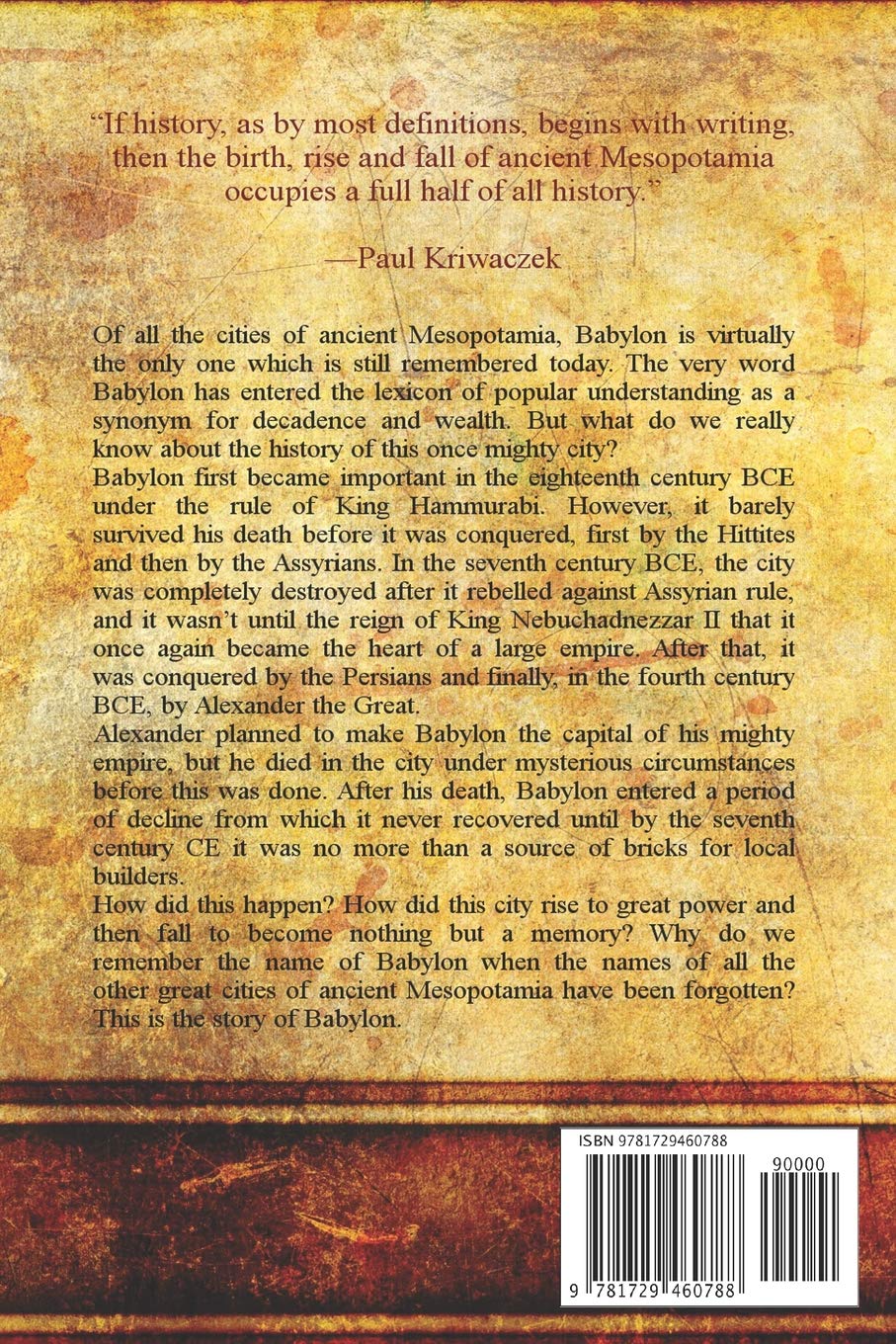
Babylon: A History From Beginning to End (Mesopotamia History)
I**N
One of the great deals on Amazon
There are free short books written in easy to read English that contain significant history that can be obtained from “Hourly History” every Friday. The books can be read in their entirety in an hour. This past Friday, on November 2, 2018, for example, the free books were: Babylon, Anne Frank, Spartacus and the Slave Wars, Byzantine Empire, Hittites, and Alexander the Great. Information about Hourly History can be found on the internet at [email protected] Babylon book is a good example. Babylonia had a significant effect upon the life, philosophy, and theology of early Judaism and, hence, also on later Christianity and Islam. Although not discussed in this volume, it is likely that when the Judeans were exiled to Babylon, they accepted the Babylonian calendar, begining the day in the evening rather than the morning, making the year start in the fall rather than the spring as required by Exodus 12. Also, it was in Babylonia that the Babylonian Talmud was composed.The Hourly History book is only 41 pages. It tells readers much about Babylon, that Babylon was a city in Mesopotamia and that there were many different Babylons in the same area in different times, ruled by different people with different beliefs and activities. Sumerians settled in the area around 3,000 BCE. The city of Babylon was around 60 miles from modern day Baghdad. The meaning of Babylon is obscure, but it may mean “God’s Gate.” One of its famed kings was Hammurabi who expanded the area and named his kingdom Babylonia. Around 1792, he developed a code of 282 laws for his kingdom. Many of the laws are quite harsh as, for example, “an eye for an eye” did not mean monetary compensation as the rabbis interpreted the biblical version, but the removal of a person’s eye if he cut out the eye of another.We read how Babylonia lost its power several times and then regained it. How in 722 BCE, Sargon of Assyria, who had conquered and ruled over Babylonia for a time, destroyed the northern kingdom of Israel, and exiled the inhabitants who became lost to history, the Lost Ten Tribes. But, in 612 BCE, Babylonia regained power and destroyed the Assyrian capital Nineveh, which is mentioned in the biblical book Jonah, and ended the Assyrian empire.Nebuchadnezzar II became one of the kings of Babylonia, ruled for over forty-years, conquered Judea in 586 BCE and forced many Judeans to live in Babylonia. In 539, Babylonia was attacked and soon defeated by Cyrus who allowed the Judeans to return to Judea, but most Judeans chose to remain in Babylonia as many American Jews chose America as their homeland today.Alexander the Great came to the area of Judea in 332 BCE on his way to conquer Egypt and the Greeks who came with him brought many philosophical and theological concepts that many Jews accepted. He conquered Babylon and thought to make it his capital but died at age 32 before he could do so.The book concludes by telling us that “One of the reasons that Babylon became such surpassing interest to European historians and archeologists is its association with [what is stated in] the Bible.” And this final chapter sites biblical references to Babylon. These include the tower of Babel, mentioned in Genesis, which may refer to the very tall religious structures in Babylon called ziggurats, and to the description in the biblical book Daniel how the Babylonians had festive meals using articles stolen from the Jewish temple.
N**E
Now I understand
This book provides a succinct review of the history of Babylon. Quick read & lots of interesting information. Definitely recommend if you are curious about Babylonian history.
P**Y
Fascinating and sad
All I knew of Babylon was what I had read in the Bible, mainly the story of the tower of Babel. The author did an excellent job of telling the long history of this, usually, magnificent city which rose and fell through the centuries as it's rulers, brilliant or incompetent, led it to dominance or demise. I especially.Enjoyed Learning of Alexander the Great And his brief Tenure as The ruler of Babylon. He had plans that would have restored the city as a center of culture and beauty.
K**R
Babylon
This book was a fascinating read although it primarily dealt with its political and military conflicts and rightfully soit gave very little of its culture an ok read of a fascinating history
P**N
Very basic information
Interesting however very basic overview
H**T
Great overview
Great overview. Easy to read and has a nice flow. It didn't take long to read. Helped clarify a pretty complex history.
K**G
short concise history of Babylon
The book was great in that it gave a condensed history of Babylon. It gave the rise and fall of Babylon that was short but well written.
T**6
Good
Nice history summary of a fascinating culture. Incredibly advanced for their time .
Trustpilot
2 weeks ago
3 weeks ago