
DOWNLOAD THE APP


Customer Services
Copyright © 2025 Desertcart Holdings Limited
DOWNLOAD THE APP
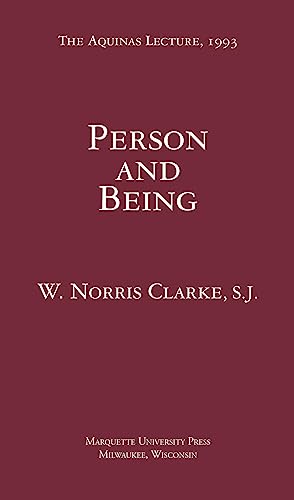
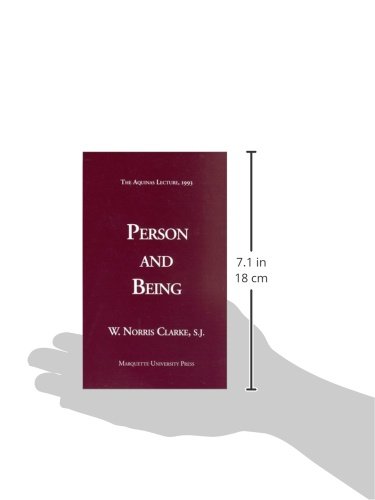

Person and Being (Aquinas Lecture) [Clarke, W. Norris] on desertcart.com. *FREE* shipping on qualifying offers. Person and Being (Aquinas Lecture) Review: The Wisdom of a Lifetime - Norris Clarke, in this remarkable little book, sums up many years of intense philosophical exploration into the meaning of personhood. He writes of deep things without a trace of affectation, never burying the light of his message beneath a bushel-basket of jargon and cant. With gentle but insistent urgency, he challenges readers to appropriate their personhood--with all the infinite longing and immeasurable richness that implies. How many contemporary philosophical books have the power to change lives? This one does. Read it and find out for yourself. Review: Great book! - This book is very clearly written and lays a good foundation for understanding at least one expression of Thomistic personalism. In fact, I recommend reading it before reading other books on personalism as a very fine orientation to this branch of philosophy.
| Best Sellers Rank | #327,788 in Books ( See Top 100 in Books ) #1,156 in Philosophy of Ethics & Morality |
| Customer Reviews | 4.7 4.7 out of 5 stars (25) |
| Dimensions | 4.5 x 0.5 x 7.25 inches |
| Edition | 5/28/02 |
| ISBN-10 | 0874621607 |
| ISBN-13 | 978-0874621600 |
| Item Weight | 4.8 ounces |
| Language | English |
| Print length | 136 pages |
| Publication date | February 28, 1993 |
| Publisher | Marquette Univ Pr |
R**I
The Wisdom of a Lifetime
Norris Clarke, in this remarkable little book, sums up many years of intense philosophical exploration into the meaning of personhood. He writes of deep things without a trace of affectation, never burying the light of his message beneath a bushel-basket of jargon and cant. With gentle but insistent urgency, he challenges readers to appropriate their personhood--with all the infinite longing and immeasurable richness that implies. How many contemporary philosophical books have the power to change lives? This one does. Read it and find out for yourself.
M**L
Great book!
This book is very clearly written and lays a good foundation for understanding at least one expression of Thomistic personalism. In fact, I recommend reading it before reading other books on personalism as a very fine orientation to this branch of philosophy.
G**W
One of the best short philosophy books I've ever seen
One of the best short philosophy books I've ever seen... using it as a supplement for teaching my Phil 102 class!
D**L
Unforgetable
I was a graduate student in philosophy at Marquette University when Fr. Clarke came to Marquette to deliver the annual "Aquinas Lecture." The book here is the written text of the lecture presented on a sunny but cool Sunday in March of 1993. I attended many lectures as a graduate student and remember only a few, this being one. Fr. Clarke spoke rather softly and you could hear a pin drop in the hall in which the talk was delivered. He was short, and smiled alot. The day after this lecture he came and spoke to the required course on St. Thomas Aquinas which I was in. I remember that talk very well also. He came in and said "I could talk about three topics today, I'll tell you the three topics and then as a class you decide what you want me to talk on." He then gave a unscripted hour and a half long talk on how Aquinas viewed human beings as the highest of material entities, and the lowest of spiritual creatures. I still remember that talk as well. This book is an excellent contemporary discussion of the Thomistic notion of what a human is, presented by one of the best living Thomists. I highly recommend it to Thomists and non-Thomists alike; it is a powerful presentation.
M**Y
I recommend Maurice de Wulf's "The System of Thomas Aquinas
I purchased this and "The One and the Many" because of the glowing reviews. I write this as someone who might have gotten the same titled book and same author's name but the wrong author and book. The author has fundamental misconceptions of Thomistic philosophy. He gives the impression of not being sure that the Triune Relations in the one God of a single existence, which is His essence, are personally distinct relations. each Person of the Three being the one Divine Essence/Existence. The three Persons ARE the three relations, since "Deus est ens simplicissimum." As for creatures, every relation is an accident subsequent upon substance receiving existence, which the author seems to think is some existential disability that needs the accident of relation to amount to anything, particularly as an actional existent, a dynamic and communicative entity. He seems to elevate relationship above existence and particularly above essence, which in us humans means the individual substances that make us able to exist as individual human beings within the same philosophical species. I think he does not distinguish the metaphysically different kinds of relation, which is not at all a univocal term. If one wants to have a sound, basic grasp of Thomistic philosophy in an accurate, clear and succinct exposition, I recommend Maurice de Wulf's "The System of Thomas Aquinas," Dover Publications, 1922. Any other edition would do as well, of course. It was formerly titled, according to the title page, as "Medieval Philosophy Illustrated from the System of Thomas Aquinas." Wulf has the enlightening and sober addition of reminding us along the way of the limits of philosophy, and particularly of metaphysics, due to our being the lowest ranking beings with intelligence, and that our limits do not negate what we can know and understand of all realities, especially and delightfully of the Being most beyond all created intelligences, God. Wulf plants the seeds of assurance of that true and beautiful knowledge of the Divine that our most extremely limited intelligence can bless us with. He tops off this lovely gift with reminder of Revelation's gifts of truths, truths exceeding our native intelligence but not lacking in assurance, a gift that has most generously added to the marvels created nature holds for us. Marcel Matley San Francisco, CA
D**O
After all these years
Father Clarke was my teacher for in several courses at Fordham in the 1950's; I obtained a minor in Philosophy. He also was a spiritual advisor to me in a time of personal difficulty over matters of faith and belief. Finally, he was the most intelligent, modest and gentle man I can remember. If I had listened to him in 1958/9, I would have saved myself much grief, lapsing from the Church for 35 years ..and, who knows what else? Yet, even as we wrestled with my faith/belief, he reduced it all to a simple issue...as he was always able to get to the core of philosophical issues in his classes...and, he left me with hope and the offer to come to him whenever...even though I rejected his advice. He was a great teacher. I never knew he was the giant in American philosophy that he was; sadly, after graduation from Fordham, I was commissioned in USAF, never returned to NYC, and my grad school career took other paths. Upon idly putting his name in Google, I saw all he had written and obtained 3 of his books, to include the above. It was wonderous to read him; I almost could hear and see him. As ever, he gave insights, makes you wrestle with concepts and shows how St. Thomas is relevant today. His writings, sadly too few are in print,must be experienced...and, I mean must be experienced/read. This one should lead to 2 of his books...they will also be well-worth your time.
B**N
A compelling interpretation of personhood, from a Thomistic perspective.
I was fortunate to have been able to take courses from Fr.W. Norris Clarke, an inspiring and sensitive teacher and philosopher/ scholar who I think interpreted and expanded on the thought of St. Thomas Aquinas in relation to God, being, and personhood, in a way that makes it compelling today. This book should be of interest to many people who are sympathetic to religion and of a philosophical bent, but not necessarily 'Thomists" themselves.
A**N
A revoluntionary book, showing how the focus on self-communicative action and relationality that is to be found in many modern existentialist philosophers is hinted at in the writings of St Thomas Aquinas. A great introduction to personalist Thomism.
Trustpilot
1 month ago
1 day ago