




⚡ Power up your savings with precision and style!
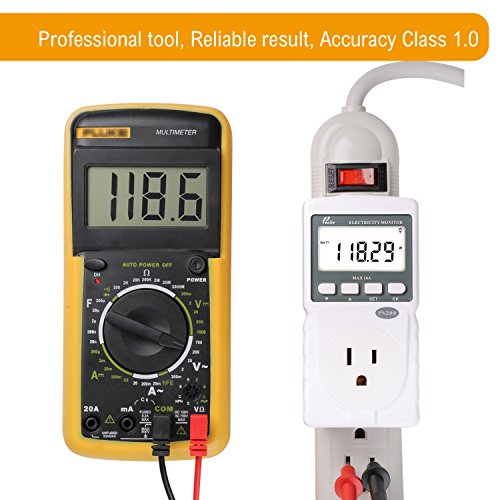
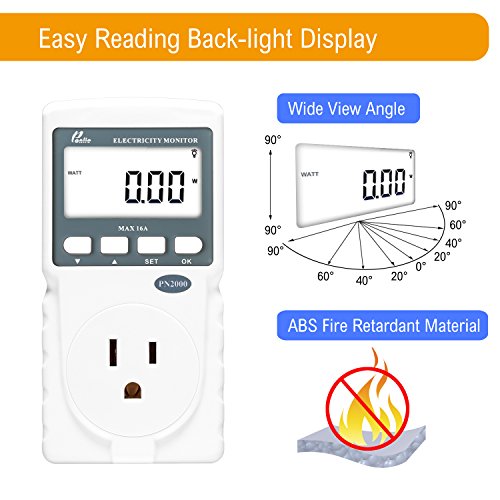
The Poniie PN2000 is a professional-grade plug-in electricity usage monitor featuring Class 1.0 accuracy and a 16A max load capacity. It tracks real-time power consumption in watts, volts, amps, frequency, and power factor, with a clear backlit LCD and memory for cumulative kWh readings. Designed with fire-retardant ABS housing and a heavy-duty extension cord, it’s perfect for savvy users aiming to optimize energy use and cut costs.


| ASIN | B0777H8MS8 |
| Amperage Capacity | 16 Amps |
| Batteries Required? | No |
| Batteries included? | No |
| Certification | Ce, Class 1.0 |
| Colour | White |
| Customer Reviews | 4.5 4.5 out of 5 stars (2,820) |
| Date First Available | 7 Nov. 2017 |
| Display style | Backlight LCD |
| Extension Length | 1 Feet |
| Included Components | 14 AWG Extension Cord |
| Item Package Quantity | 1 |
| Item Weight | 168 g |
| Item model number | PN2000 |
| Manufacturer | Poniie |
| Material | Fireproof ABS |
| Maximum power | 1760 Watts |
| Measurement Accuracy | Meter Class 1.0 |
| Measurement System | English/Standard |
| Number of Pieces | 1 |
| Part Number | PN2000 |
| Plug format | B - US style with ground plug. |
| Power Source | Ac |
| Product Dimensions | 5.84 x 5.59 x 11.94 cm; 168 g |
| Shape | Rectangular |
| Size | 25.5 cubic inches |
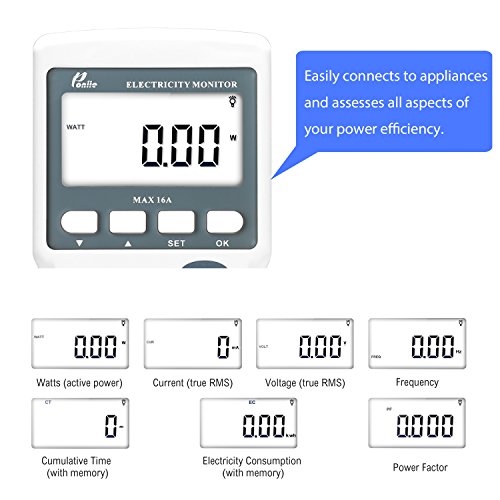
| Special Features | Monitoring Watts (active power), Current (true RMS), Voltage (true RMS), Frequency (Hz), Power Factor, Cumulative Time(with Memory) & Electricity Consumption (with Memory) |
| Style | Voltage |
| Viewing area | Wide View Angle Backlight Display |
| Voltage | 110 Volts |
A**R
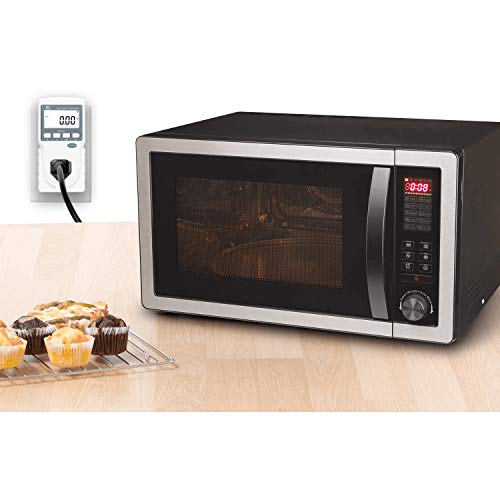
Plug an electrical device into the Poniie watt meter to measure the wattage, current, or voltage flowing through. You can also set the Poniie to measure the amount of kWh used over a period of time, good for determining how much an electrical device costs you during usage. The display on the Poniie is of high quality and brightness, making it easy to read. Product also comes with an extension cable of about a foot long, so that you don't block multiple outlets in a wall or power strip. It additionally comes with an operation manual. Ultimately, the Poniie watt meter does precisely what you'd expect, and perhaps a little beyond that, at a high level.
S**O
I like that this meter doesn't need batteries. I used it to check the running power of a freezer and fridge not just the starting draw, because I wanted to know what I could all run off my generator when the power is out. I also discovered that a spare tv in the basement was drawing 40 watts when off. So it's now unplugged. The meter is very easy to use and read. The price is reasonable as well.
A**N
This replaces my previous Kill-a-Watt meter ( terrible calibration, save your money for this one). The calibration seems very good, I will compare to a DVM later. Resolution is as good as practical, considering V, I and f fluctuations. The backlighting is useful. If I had to criticize, minor, it would be Elapsed Time (how long the load is on, cumulative) because the threshold for "on" is low and not adjustable. The instructions are bit short. Be creative in how to Set things. Zon is asking me to rate Thickness. By existing in space, I must rate this meter's thickness as five stars, I can confirm that it has thickness and does it well.
J**I
I got this initially to monitor voltage at various times of day. Over the space of a few days, I found it varied from 122 volts all the way to 126. Also learned that I wasn't getting 60Hz, which wouldn't be a concern for most folks because not many people have a turntable with a motor whose speed is dependent on line voltage and frequency, but I do. The variations this product revealed caused me to purchase a dedicated power regenerator designed specifically for the turntable. And yes, the turntable speed is rock solid now. Anyway, the meter is very easy to use, since you can just plug it into the wall or power strip and if you are intending to measure power consumption of a product, just plug it in to the meter. If there's anything about it I don't like, it's that the backlight has a timed auto shutoff I can't disable. I was taking photos of the readings and often had to hit a button just to bring up the backlight.
I**O
The Poniie PN2000 is an easy to use and simple device after you read the instructions and various customer reviews in order to figure out the menu settings. The device is well made, the digital read out is easy to read, and it works just as described. From the owners manual: The device can measure Watts (active power), Current (true RMS), Voltage (true RMS), Frequency, Cumulative Time (with hold over circuit memory), Electricity Consumption (with hold over circuit memory) and Power Factor (as Watts/Vrms*Arms). The important numbers to figure power being used by an electrical device are the "cumulative time" and the "energy consumption". You plug the meter in line with the device you want to monitor and then simply divide the cumulative time (this being the "stopwatch" time that the device is pulling power - if the electrical device is turned off for a while the timer does not keep adding minutes to the clock and picks up again when the device is turned back on, by the electrical consumption. The time is given in minutes so we find it easiest to figure out how many kilowatts were used by "the minute" and then multiply times 60 to get the power used in a kWh (kilowatt hour). For an item like a refrigerator that cycles on and off constantly you might want to leave the device connected for a lengthy period (perhaps 24 hours or longer) in order to get a more accurate power use profile as it cycles on, then off, then through a defrost cycle, and so on. Simple "on or off" devices might only need to be monitored for a half-hour or even less to find out the energy consumption. Unfortunately, like many of Amazon's sellers these days, the Poniie PN2000 seller sends the buyer e-mail asking them to write a review of their product if they like using it. E-mail from sellers requesting the purchaser write a review is what has ruined Amazon's best feature, and those reviews are always suspicious as not only no. Too bad that the seller doesn't have enough faith in their product and has to prompt buyers to write a review. To make it simple we divide the monthly electric bill total by the number of kilowatt hours used found on the monthly bill to get a per hour kW price, and then multiply that number times the kWh for the device we were monitoring (we're currently paying 0.12 cents per kWh).
Trustpilot
2 weeks ago
5 days ago