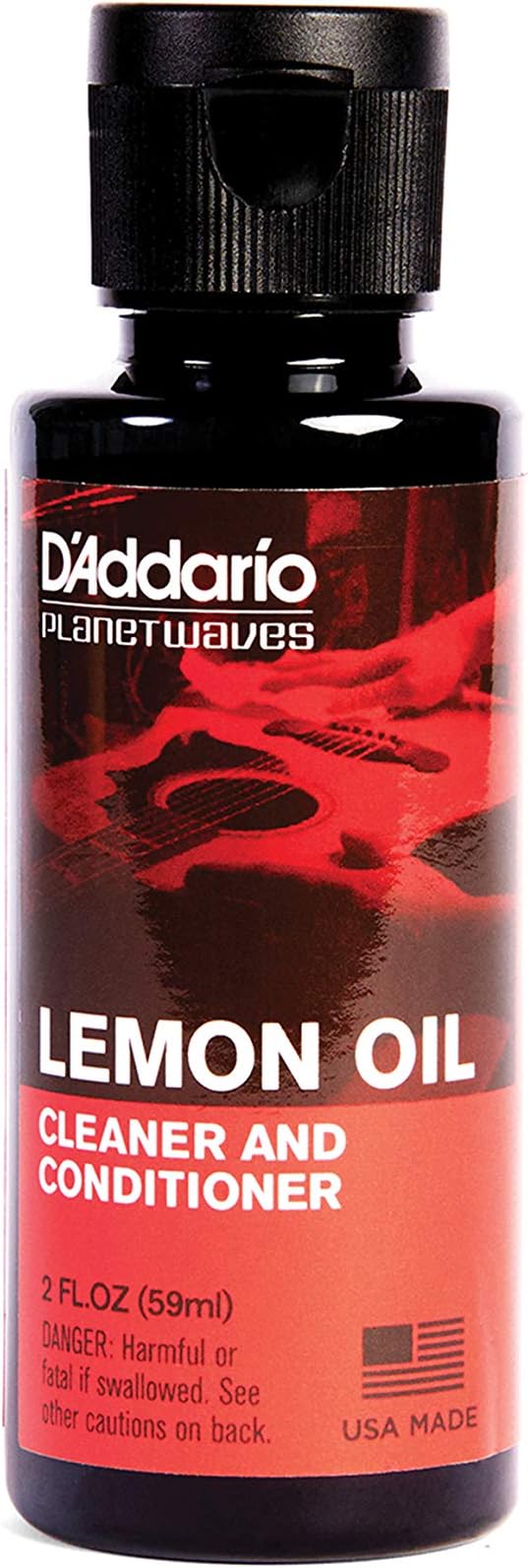
🍋 Keep your fretboard fresh, smooth, and stage-ready — because your guitar deserves the VIP treatment.
D'Addario Lemon Oil is a premium natural cleaner and conditioner designed specifically for unfinished wood fretboards. It removes grime and build-up while restoring moisture to prevent drying and cracking, ensuring your guitar stays in top playing condition with a smooth, residue-free finish. Highly rated and trusted by musicians worldwide.

| ASIN | B000BNSYHW |
| Back Material | Rosewood |
| Best Sellers Rank | 422 in Musical Instruments & DJ ( See Top 100 in Musical Instruments & DJ ) 5 in Guitar Cleaning & Care 70 in General Music-Making Accessories |
| Body Material | Wood |
| Colour | Wood |
| Country Produced In | USA |
| Customer Reviews | 4.7 4.7 out of 5 stars (15,520) |
| Date First Available | 4 July 2008 |
| Fretboard Material | Rosewood |
| Guitar Bridge System | Fixed |
| Guitar Pickup Configuration | H |
| Item Weight | 56.7 g |
| Item model number | PW-LMN |
| Material Type | Plastic |
| Neck Material Type | Wood |
| Product Dimensions | 3.17 x 3.17 x 9.52 cm; 56.69 g |
| Size | Small |
| String Material | Natural |
| Top Material | Wood |
R**D
Good stuff, easy to handle.
This was terrible on my fish & chips the other night, although my palate felt pretty fresh and zesty afterwards. After that disappointment I thought I'd try it on my new Ibanez Talman guitar that still smells of fish (it came out of the box that way, as the bishop said...). It did a lot to improve the odour of the guitar even though my playing still stinks. I don't think I'll try it on my hands though. More importantly it helped a lot when cleaning the rather well-used neck of my 1980 Stratocaster, which came up a treat and looks pretty nice now, just how I remembered it, but with a zesty lemon freshness that makes it feel like playing in an Italian orchard. I shouldn't have to tell anybody how to use it but, for those guitarists unused to basic household chores (99%?) I will. Put a bit on the neck, preferably with the strings off, covering about 5 frets at a time, and rub it to cover the fretboard in that area, thoroughly, with a non-abrasive cloth (especially on finished necks!), as though you're trying to grind it into the wood. Then leave it for just a few minutes (maybe five) to do its magic before wiping as much of it off as you're able. Really try hard not to leave any residue anywhere, especially along the frets. It's a finishing layer on the wood, not a deep wood treatment, and the frets go deep into the neck, so clean it off really well before moving on, use an old toothbrush if you must. As you move up the neck you might be tempted to do more frets since they're closer together. I tend to avoid this since I'm concerned about keeping the oil around the frets for as short a time as I feel I can get away with, so I do smaller areas with the same number of frets as I go on, using less oil each time and working hard to keep the fret-fingerboard area as clear as can be. Don't work so hard that you remove everything, just bring the fretboard back to a clean state, easily eyeballed. You can cut down on the times if you use this more regularly. If you have the discipline to do this as a weekly job, you can be very quick and sparing on the oil, I would guess, because it is more maintenance than restoration! For really grubby fretboards this oil should work pretty well, although I read some advice online about using Windex or other cleaning compounds in moderation, and leaving them on the neck for minimal time before coming in with the lemon oil and finishing the job. Lemon oil is better for the wood than solvents and other compounds would be.
L**N
Great stuff at a good price
Absolutely fantastic stuff, used on my vintera Jag and Les Paul tribute, it worked absolute wonders on the Les Paul
L**N
Works.
Works well and soaks into fret board well. Could use a better applicator as its either nothing coming out or dripping off of the neck. Once applied it does the job and the guitars feel good again.
C**S
Good product.
I am not overly fussy when it comes to lemon oil, i just put on my guitars fretboards and it makes them look nice, as far as i can see this oil is fine and it does exactly the same thing as other well known brands of lemon oil.
A**R
Well-sealed, spreads easily, refreshes fretboards, prevents drying, and has a mild scent.
🎸 The lemon oil comes in a well-sealed bottle, with a foil cap underneath the lid to stop any evaporation during transit. This means it arrives intact and fresh. The flip-up cap is secure and makes it easy to dispense just the right amount without spills. I found that only a small amount is needed, as it spreads easily and absorbs well into the wood. It does a good job of lubricating and freshening the fretboard, restoring moisture and helping to prevent drying or cracks over time. 🎸 As a cleaner, it works reasonably well for general build-up, though heavier grime needs a bit of extra effort. I used cotton buds to get into the edges and around the frets where dirt tends to collect. Any excess wipes away cleanly, leaving a smooth, non-greasy finish. The lemon scent is noticeable but not too strong, which makes it pleasant to use without being overpowering. ✔️
S**S
Comparison between fast fret
. I use it every few months, and it's amazing how it cleans out all the gunk while keeping the wood from drying out. The lemon scent is a nice touch, making maintenance enjoyable. It's on the pricier side, but for the deep conditioning it provides, especially in colder months, it's worth every penny. GHS Fast Fret: For quick touch-ups before gigs or practice, Fast Fret is my go-to. It makes my strings glide and quiets down any squeaks. I apply it in a flash, and my guitar feels brand new. The scent's not my favorite, but it gets the job done. Only downside is managing the residue, but otherwise, it's perfect for daily care. The Verdict: Both have carved out essential roles in my routine. Lemon Oil for those deep clean and condition sessions, Fast Fret for the quick, daily love. They complement each other perfectly for keeping my guitar in top shape. If you're serious about your guitar's health, grab both.
M**A
Perfect
Good quality and value
C**S
Wood looks good
Easy to use
A**R
El mejor producto para cuidar el mástil de la guitarra, o más concretamente el diapasón, que habitualmente está acabado con maderas nobles sin barnizar. El mejor momento para utilizarlo es durante un cambio de cuerdas. Basta con impregnar un paño de lienzo (algodón que no suelte pelusa) con unas gotitas de este aceite, extenderlo y frotar bien como si fuera un producto de limpieza. Limpia toda la suciedad del diapasón, y una vez que retiramos el sobrante con otro paño seco, queda con un aspecto muy bueno y con la madera nutrida y protegida de la humedad que podría quedarse por el contacto de nuestros dedos. No sé si en maderas más claras alterará el color, pero en mi caso, con diapasones de ébano, muy negros de por sí, lo único que se nota es que su coloración queda más homogénea tras la aplicación, y con un ligero brillo satinado, la guitarra rejuvenece de aspecto. Cunde muchísimo, tengo tres guitarras y creo que me durará décadas. Lo único que no entiendo es el nombre, que en todas las marcas es "aceite de limón", pero se indica que proviene de destilados del petróleo, y a limón tampoco huele... Supongo que antiguamente sí se utilizaba algún producto derivado del limón o de la madera del limonero y que la denominación ha persistido en el tiempo.
F**L
Angenehmer Geruch und pflegt das Griffbrett perfekt.
A**L
Best lemon oil. Very good shine and good sound enhancement.
A**R
I love this stuff... its very subtle, and works great to hydrate your fretboard without any harsh chemicals or nasty smell.
I**N
Ett måste om du vill förlänga livslängden och kvalitén på din gitarr. Citronolja används av en rad seriösa gitarrister som månar om sitt instrument.
Trustpilot
1 week ago
2 days ago