Mind-Lines: Lines for Changing Minds
Product ID: 62831476
Buy anything from 5,000+ international stores. One checkout price. No surprise fees. Join 2M+ shoppers on Desertcart.
Desertcart purchases this item on your behalf and handles shipping, customs, and support to Vanuatu.
Buy Mind-Lines: Lines for Changing Minds 5 by Hall, Michael L., Bodenhomer, Bob G. (ISBN: 9781890001155) from desertcart's Book Store. Everyday low prices and free delivery on eligible orders. Review: Abstracting is what flesh does...(Korzybski) - In A Theory of Cognitive Dissonance (1957), “Leon Festinger proposed that a person who experiences internal inconsistency is motivated to reduce the cognitive dissonance, by making changes to justify the stressful behaviour. adding new parts to their cognition.” (Wiki). Harnessing this neural propensity for change-making is to a certain extent what conversational neurosemantics is all about, and follows on from an all-embracing philosophy of “counteracting the black magic of the primary sensory cinema - the associated movie-mind.” According to Denis Bridoux (once a student of Dr Hall) who has his own contribution to make in discovering a number of “overarching symmetries” to Hall’s model. There are two ways for a client to learn the linguistic structure of a problem and resource a better map - based on whether a slant is placed on the pacing or leading aspect of the ‘in-syncing’ harmonisation between the client and practitioner: ‘communication’ (pacing) exquisitely matches the client to elicit the structure of the existing cognitive dissonance with a meta-model interrogative question, e.g. the universal quantifier challenge of “always?”; or ‘rapport’ (leading) exquisitely mismatches the client to install the cognitive dissonance to generate the shift, e.g. the ‘allness frame’ challenge of “You always think everyone (even your mum) - who shows up late does not care about you!?” To the casual observer the differences between these two approaches can seem quite minimal with a lot of room for cross-over, for example where does Groveian Clean Language and Rogerian paraphrasing fit into the either/or schema? However, what the dissimilarities amount to are distinctions between the application of ‘meta-model’ questioning derived from therapeutic contexts (courtesy of Satir) and the application of ‘mind-line’ utterances in coaching scenarios. I mention a demarcator between ‘neurolinguistics’ and ‘neurosemantics’ [The two terms were originally referred to by Korzybski who introduced both phrases in his 1936 papers] because it is one the authors propagate; and they do not hold back in critiquing the classic model which sometimes comes across as abstrusely pedantic and somewhat theoretically cosmetic IMHO. For example, at one point the proposed alternative for the finer modal distinction termed in NLP a sub-modality is better thought of a meta-modality. Seriously, why? The material contained within Mind-Lines is if nothing else tenacious in driving home the power of conversational framing, and promoting a set of pedagogical props to assist the learner. These consist of a magic cube, eight mind-line movements and a set of fairly intelligible mind-maps (with contributions by Bridoux). First and foremost it is important to understand the two implicit structures or levels of meaning: involving primary associations or linkages - how content is made inside the box - i.e. ‘this external behaviour leads to or equals that internal state’; and, secondly, the embedment of frame upon frame (up framing) - how contexts are formed outside the box - i.e. ‘idea x is embedded inside of idea y’. The secret sauce to the whole shebang is that for each of the two levels - building upon Korzybski’s theory of Structural Differential, (i.e. event-object-description-inferences) - there are a number of customary ways to tackle belief systems. Inside the box - corresponding to the deductive reasoning of sensory based descriptions (the movie mind) - mind-lines redefine the ‘content’ from one frame of reference to another using chunking down, strategies, reframes of external behaviour, reframes of internal state, (self) reflexive reframing and counter-exampling (with cartesian quadrants). Outside and above the box - corresponding to the inductive reasoning of evaluative symbolic systems (inferences) - out-framing refers to shifting the ‘context’ by artfully challenging the client into considering different frames of reference. These mind-lines are ‘directionalised’ through what Hall calls “the three spells of languaging” in explaining the effects on consciousness: ‘vertical shifting down’ patterns break the spell of universality by deframing via precision and clarity; ‘horizontal shifting across’ breaks the spell of evaluation by constructing new realities and reframing old realities. The ‘vertical shifting up’ pattern of out-framing creates the spell of embedded framing or multi-layering frames upon frames, in simple meta-projections, eg “I will never amount to anything”; then the vertical shifts further upwards to a meta-meta level (state about a state) and self-fulfilling prophecies, eg. “this is the way life is going to be”; and then upwards further still to the highest ‘up-frame’ (enhancing frame of reference) that out frames all lower frames into “mis-beliefs and erroneous conclusions of self-blame”, eg. “those are the ideas you built as a little child!” In summary, Mind-Lines (2002) is a considerable evolution on Bandler and Grinder’s ‘Reframing: NLP and the Transformation of Meaning’ (1982), and owes much of its debtitude to Dilt’s ‘Sleight of Mouth: The Magic of Conversational Belief Change’ (1999). It is not an easy read by any reframing of the imagination, not because the material is difficult, but in having so many options in changing beliefs to explore! Also the scalable simplicity of the magic cube as a mnemonic device means you only ever need to go as deep as you really want to and still not loose sight of the eight belief-busting mind directions - and lest not forget there is analogous reframing too which hovers somewhere off plan in Hall’s and Bodenhamer’s model of the world. What a world to discover! Review: Excellent reference work - This book is 5 stars as a reference work. However you would be better off starting off with something easier to get you up and running. I would recommend Doug O'briens audio (sleight of mouth Its called), you can find it via google The book itself can feel like hard work as its very dense. But it is very comprehensive and makes for a good reference book once you have a basic understanding of the patterns. Also I would recommend Dilts Sleight of Mouth book. One of the best things about the book is it teaches you the importance of deframing the belief first, that makes reframing much easier, as the logical flaws become more obvious. I recommend that you start by writing down your own limiting beliefs in a word document. Create a template with all the patterns listed and a space to write out the reframe. After you have done several you will start to become skilled with the patterns and over time you can go back and edit the document as you become better. You will start to notice results both in terms of improvement in your own thinking patterns and your reframing skills. Its a really wonderful experience when you feel a paradigm shift on a negative thinking pattern that has troubled you for years. This stuff really brings NLP to life and makes it practical
| Best Sellers Rank | 1,086,802 in Books ( See Top 100 in Books ) 23,449 in Higher Education of Biological Sciences 45,647 in Psychology & Psychiatry 210,123 in Society, Politics & Philosophy |
| Customer reviews | 4.4 4.4 out of 5 stars (60) |
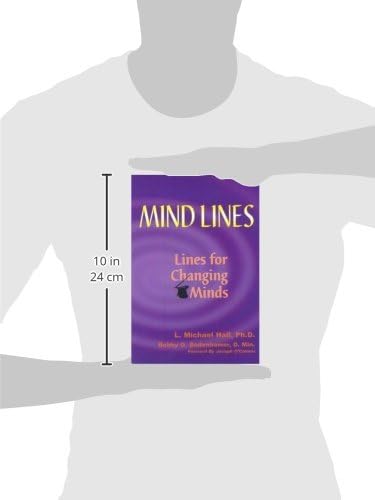
| Dimensions | 17.15 x 1.91 x 24.77 cm |
| Edition | 5th |
| ISBN-10 | 1890001155 |
| ISBN-13 | 978-1890001155 |
| Item weight | 612 g |
| Language | English |
| Print length | 208 pages |
| Publication date | 1 July 2002 |
| Publisher | International Society of Neuro-Semantics |
J**E
Abstracting is what flesh does...(Korzybski)
In A Theory of Cognitive Dissonance (1957), “Leon Festinger proposed that a person who experiences internal inconsistency is motivated to reduce the cognitive dissonance, by making changes to justify the stressful behaviour. adding new parts to their cognition.” (Wiki). Harnessing this neural propensity for change-making is to a certain extent what conversational neurosemantics is all about, and follows on from an all-embracing philosophy of “counteracting the black magic of the primary sensory cinema - the associated movie-mind.” According to Denis Bridoux (once a student of Dr Hall) who has his own contribution to make in discovering a number of “overarching symmetries” to Hall’s model. There are two ways for a client to learn the linguistic structure of a problem and resource a better map - based on whether a slant is placed on the pacing or leading aspect of the ‘in-syncing’ harmonisation between the client and practitioner: ‘communication’ (pacing) exquisitely matches the client to elicit the structure of the existing cognitive dissonance with a meta-model interrogative question, e.g. the universal quantifier challenge of “always?”; or ‘rapport’ (leading) exquisitely mismatches the client to install the cognitive dissonance to generate the shift, e.g. the ‘allness frame’ challenge of “You always think everyone (even your mum) - who shows up late does not care about you!?” To the casual observer the differences between these two approaches can seem quite minimal with a lot of room for cross-over, for example where does Groveian Clean Language and Rogerian paraphrasing fit into the either/or schema? However, what the dissimilarities amount to are distinctions between the application of ‘meta-model’ questioning derived from therapeutic contexts (courtesy of Satir) and the application of ‘mind-line’ utterances in coaching scenarios. I mention a demarcator between ‘neurolinguistics’ and ‘neurosemantics’ [The two terms were originally referred to by Korzybski who introduced both phrases in his 1936 papers] because it is one the authors propagate; and they do not hold back in critiquing the classic model which sometimes comes across as abstrusely pedantic and somewhat theoretically cosmetic IMHO. For example, at one point the proposed alternative for the finer modal distinction termed in NLP a sub-modality is better thought of a meta-modality. Seriously, why? The material contained within Mind-Lines is if nothing else tenacious in driving home the power of conversational framing, and promoting a set of pedagogical props to assist the learner. These consist of a magic cube, eight mind-line movements and a set of fairly intelligible mind-maps (with contributions by Bridoux). First and foremost it is important to understand the two implicit structures or levels of meaning: involving primary associations or linkages - how content is made inside the box - i.e. ‘this external behaviour leads to or equals that internal state’; and, secondly, the embedment of frame upon frame (up framing) - how contexts are formed outside the box - i.e. ‘idea x is embedded inside of idea y’. The secret sauce to the whole shebang is that for each of the two levels - building upon Korzybski’s theory of Structural Differential, (i.e. event-object-description-inferences) - there are a number of customary ways to tackle belief systems. Inside the box - corresponding to the deductive reasoning of sensory based descriptions (the movie mind) - mind-lines redefine the ‘content’ from one frame of reference to another using chunking down, strategies, reframes of external behaviour, reframes of internal state, (self) reflexive reframing and counter-exampling (with cartesian quadrants). Outside and above the box - corresponding to the inductive reasoning of evaluative symbolic systems (inferences) - out-framing refers to shifting the ‘context’ by artfully challenging the client into considering different frames of reference. These mind-lines are ‘directionalised’ through what Hall calls “the three spells of languaging” in explaining the effects on consciousness: ‘vertical shifting down’ patterns break the spell of universality by deframing via precision and clarity; ‘horizontal shifting across’ breaks the spell of evaluation by constructing new realities and reframing old realities. The ‘vertical shifting up’ pattern of out-framing creates the spell of embedded framing or multi-layering frames upon frames, in simple meta-projections, eg “I will never amount to anything”; then the vertical shifts further upwards to a meta-meta level (state about a state) and self-fulfilling prophecies, eg. “this is the way life is going to be”; and then upwards further still to the highest ‘up-frame’ (enhancing frame of reference) that out frames all lower frames into “mis-beliefs and erroneous conclusions of self-blame”, eg. “those are the ideas you built as a little child!” In summary, Mind-Lines (2002) is a considerable evolution on Bandler and Grinder’s ‘Reframing: NLP and the Transformation of Meaning’ (1982), and owes much of its debtitude to Dilt’s ‘Sleight of Mouth: The Magic of Conversational Belief Change’ (1999). It is not an easy read by any reframing of the imagination, not because the material is difficult, but in having so many options in changing beliefs to explore! Also the scalable simplicity of the magic cube as a mnemonic device means you only ever need to go as deep as you really want to and still not loose sight of the eight belief-busting mind directions - and lest not forget there is analogous reframing too which hovers somewhere off plan in Hall’s and Bodenhamer’s model of the world. What a world to discover!
S**N
Excellent reference work
This book is 5 stars as a reference work. However you would be better off starting off with something easier to get you up and running. I would recommend Doug O'briens audio (sleight of mouth Its called), you can find it via google The book itself can feel like hard work as its very dense. But it is very comprehensive and makes for a good reference book once you have a basic understanding of the patterns. Also I would recommend Dilts Sleight of Mouth book. One of the best things about the book is it teaches you the importance of deframing the belief first, that makes reframing much easier, as the logical flaws become more obvious. I recommend that you start by writing down your own limiting beliefs in a word document. Create a template with all the patterns listed and a space to write out the reframe. After you have done several you will start to become skilled with the patterns and over time you can go back and edit the document as you become better. You will start to notice results both in terms of improvement in your own thinking patterns and your reframing skills. Its a really wonderful experience when you feel a paradigm shift on a negative thinking pattern that has troubled you for years. This stuff really brings NLP to life and makes it practical
P**7
Wish I'd read this sooner
Terrific, thought provoking in the extreme, a useful, practical guide to getting the best out of change work - if you're NLP trained and haven't read it - read it now. Dive deep.
P**L
Really takes sleight of mouth to another level
An excellent companion to the work of Roberts Dilts and Sleight of Mouth. It takes it on by looking at external actions and the internal states that it creates. Takes a bit of time to read and is more of a manual of reframing however some excellent gems in here. Magic if you are prepared to put in the time. I loved the frame they put around things that are "complex". Its true that your mind opens when the frame changes. Wish we could make this easy to learn for everyone and the world and your world would change, wouldn't it? That has to be is the bigger ambition for NLP. Mind lines is a skill to master over time and worth it.
G**N
Clear and great examples in the book to change minds, how you think about anything. Though I find it a bit too long and that is the only reason why it's not a 5 but 4 rating for me.
P**R
This book is great. I highly recommend it if you have limiting beliefs you want to overcome. You know the idea of "glass half empty half full." You can put a spin on things to make something resourceful/positive rather than negative. Well, this book explains 26 different patterns to do just that. Do the exercises, which require a lot of deep thinking, and you'll see negative beliefs transform to something resourceful and thus empowering. As I did the exercises, I felt a shift on how I viewed some limiting beliefs; it was as if weight was lifted from my shoulders. I've heard others describe Mindlines as a tough read. There were parts where I had to read a second time around to get a full understanding. But other than that, I don't consider it tough at all. The book assumes readers are familiar with NLP. If you are unfamiliar with NLP, there will be parts in the book where you'll be like, "What the hell's he talking about?!" But you will still reap the benefits if you do the exercises. Great book! (As mentioned in another review, there are a ton of typos! Out of all the books I've read, this tops the list for the most) UPDATE, two years later January 2009 *** stars rather than *****: I do not recommend this book for deep-rooted issues. Reframing a deep-rooted issue may alleviate pain and suffering initially. But the pain/suffering will come back just like a splinter that's bound to come to the surface. I do feel, however, that reframes work well for minor issues. Another cool thing about reframes is that it shows you the numerous viewpoints and angles to look at things from. It'll train you to see things from an overall picture as opposed to a narrow view. But the thing you have to realize is that no viewpoint is right or wrong, ultimately. Reframes consists of A LOT of thought and analysis. I spent numerous hours reframing limiting beliefs. It worked for the minor issues, but never for the deep-rooted issues in my life. The thing I failed to see initially was the fact that it was thought that caused the pain and suffering in the first place. Eckhart Tolle wrote a book entitled "The Power of Now." In the book he gives the following analogy: It's like trying to catch an arsonist on the loose and the arsonist is the Chief of the fire department (paraphrased). Thought can never solve an issue fully because it is thought that is the root of the problem in the first place. Here's another quote from Krishnamurti's The First and Last Freedom: "Can thought resolve our problems? By thinking over the problem, have you resolved it? Any kind of problem-economic,social, religious-has it ever been really solved by thinking? In your daily life, the more you think about a problem, the more complex, the more irresolute, the more uncertain it becomes." If you want to overcome deep-rooted issues, you have to "see" thought for what it truly is. The "seeing" is not conceptual. It's not something you understand mentally; that's just another thought looping around and around in the head. Check out the following books if you're interested: Eckhart Tolle's The Power of Now, A New Earth, Michael Singer's The Untethered Soul, I Am That by Sri Nisargadatta Maharaj.
S**U
have you ever thought a self help book was fantastic, only to apply its work over time.. learning that the effect is not lasting? ..a person's mind works this way: the cognitive mind accepts an idea, but if the emotional brain's danger switch gets tripped, we end up with aggressive rejection of the affirming thoughts- the limbic brain punches out some limiting belief - wiring for our survival (positive intent) changing minds of others is tricky business; changing one's own mind is also tricky. this is a book that has tremendous power and potential. it can be used for sales objections, arguing (i assume lawyers would benefit tremendously from this book), debating (politicians), and also self-soothing and therapy. before i could use it for self-soothing and therapeutic uses, i had to learn a bit more about psychology- having read 'emotion regulation' books and the like. .. our brains push the panic button on certain situations. often, we learned this growing up... either modeled behaviour (caregivers were panicked people, or lacked emotional resolve), lack of soothing or compassion directed at us (lack of forgivness for mistakes, lack of soothing support or tolerance for emotions). the mindlines book can slow things down, allow us to reflect on our 'rules', and create new rules for ourselves. it does require intensive study and work. also, you have to have the 'frame' that you are doing it to be inquisitive, not to blame yourself for getting it wrong. this is done through inquisitiveness and curiosity... instead of blame or attack. if you do that, if everybody did that, the pharma industry would go bankrupt (they would have to take their own antidepressive medications :-)). this book is that effective, but i believe it took me a lot of background understanding to get there. Its the compassion for one's beliefs, that soothes the emotional brain (the part of the mind that creates the negative beliefs, it is trying to protect us). Thereafter, it is the soothing inquiry frame using this book, that creates tremendous change and resolve. Best Book on the Subject of Cognitive Reappraisal.. and it came from NLP, not psychology (amazing stuff).
A**R
Acquistato come usato da worldofbooksit è il libro è arrivato in ottime condizioni, nuovissimo. Thanks to worldofbooksit, provides its customers with a serious and reliable service
D**A
I have come away from this book with a profoundly different perspective on life. We are all meaning making machines. Most of us are not aware of all the meanings that we are creating and this book gets into the nitty-gritty of it with great detail. I found the author's formula of a Meaning; "External Behavior = Internal State" or "External Behavior causes Internal State" to be utterly mind blowing. For those reading who have no idea what this is, here is an example. We see or hear something (this is the External Behavior) and we make that external behavior equal or lead to some idea or feeling (the Internal State). "Your being late makes me sick" is a meaning where "Your being late" is External Behavior and " makes me sick" is Internal State. The premise of this book is that when we create meanings for ourselves, they create the frame of reference for how we see the world. Those who experience a lot of pain growing up create meanings (or frames) that have them see the world as a scary place even if there is no danger in the moment, while those who experience mostly joy growing up create meanings (or frames) that have them see the world as a safe place. How we frame the external events creates our experience of those events. This book is about examining the meanings you have created (your frames) and re-working the ones that do not serve you. This can be a lot of work as I found myself often having to re-read pages over and over to see where it applies in my life and how I can use this. But doing the work provides a BIG payoff of feeling lighter and more in control of your experience and the experience of others.
Trustpilot
2 weeks ago
1 month ago