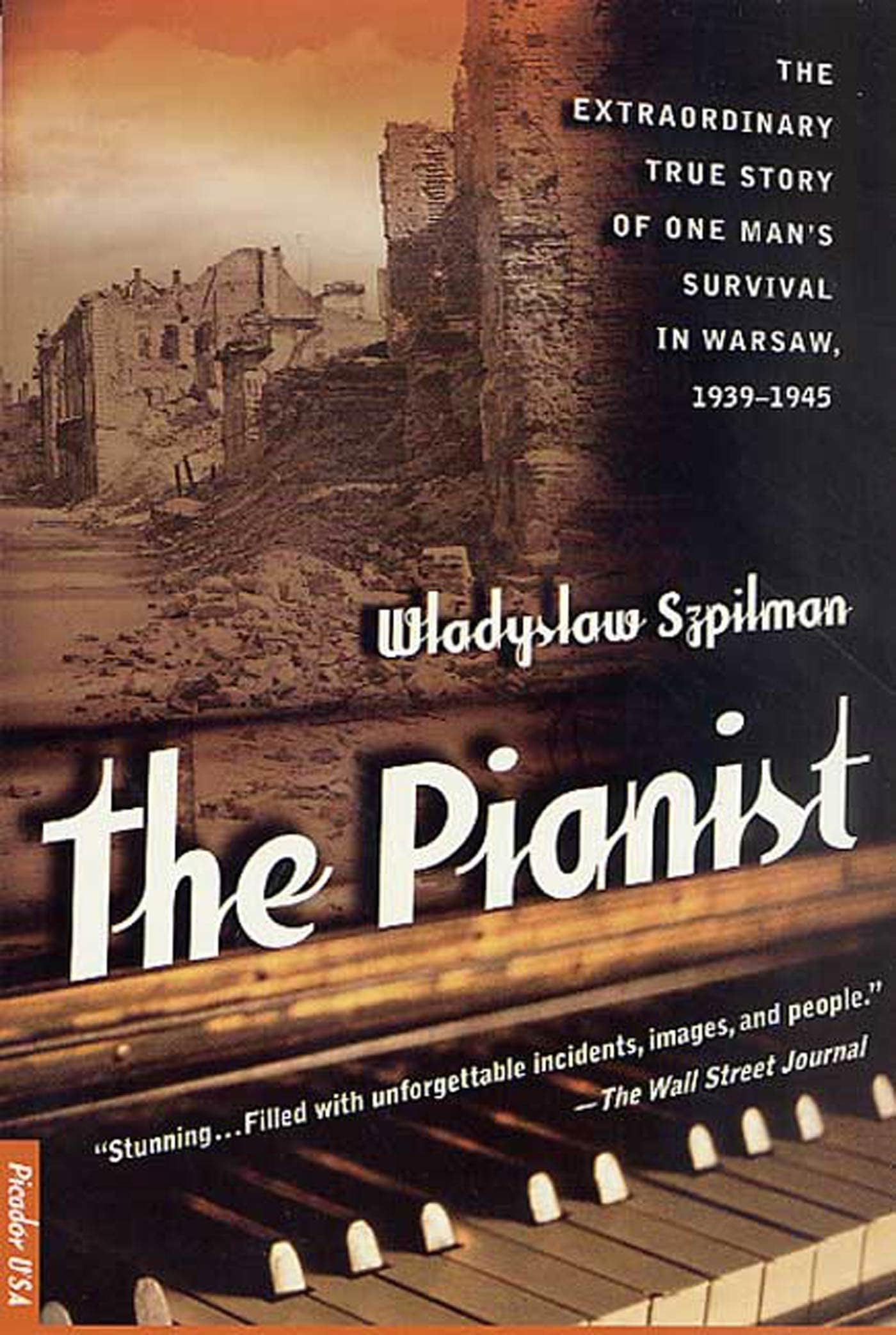

The Pianist: The Extraordinary True Story of One Man's Survival in Warsaw, 1939-1945
Product ID: 8640068
Buy anything from 5,000+ international stores. One checkout price. No surprise fees. Join 2M+ shoppers on Desertcart.
Desertcart purchases this item on your behalf and handles shipping, customs, and support to Vanuatu.
The Pianist: The Extraordinary True Story of One Man's Survival in Warsaw, 1939-1945 [Szpilman, Wladyslaw] on desertcart.com. *FREE* shipping on qualifying offers. The Pianist: The Extraordinary True Story of One Man's Survival in Warsaw, 1939-1945 Review: A true story that reads like a great novel - The Pianist: The Extraordinary True Story of One Man’s Survival in Warsaw 1939-1945 “Until The Pianist, I have never read a piece so moving that I had to bring it to the screen,” declared the award-winning movie director Roman Polanski, himself a survivor of the Krakow Jewish Ghetto, from which he escaped as a child after his mother’s death. The story Polanski would make into an unforgettable film in 2002 is the war journal of the world-class pianist Wladyslaw Szpilman and his incredible tale of survival (The Pianist, Wladyslaw Szpilman, New York: Picador Press, 1999). Szpilman lived through the Nazi occupation of Poland between 1939-1945. His life was constantly in peril, and doubly so: both as a Jew and as a Pole. His family was rounded up in the Warsaw Ghetto and was liquidated along with its nearly half a million Jewish inhabitants, who were shot, died of disease or starvation, or were sent to concentration camps. (For more on this subject, see my earlier article on the Warsaw Ghetto, “Heroism in Hell”): http://literaturadeazi.ro/content/heroism-hell-resistance-warsaw-ghetto-uprising-israel-gutman) Time after time Wladyslaw’s intuition, luck, connections and resilience save him from a near-certain death. Although his brother, sisters and parents perished in the Treblinka death camp, the young man manages to survive thanks to the last-minute intervention from a friend who works for the Jewish Ghetto Police, who helps him right as he’s about to board the cattle train to the concentration camp. To evade death yet again, Wladyslaw gets a work permit and becomes a slave laborer, along with the 50,000 working Jews (and their families) left in the Warsaw Ghetto, who, for a few more weeks or months, were still deemed “useful” by the Nazis. Later the young man becomes involved in the Jewish resistance movement in the ghetto, made up mostly of very courageous young men, who would rather die fighting than let the Nazis “slaughter them like sheep”. Right before the Nazis stomp out the rebellion, killing almost every last Jew and burning the ghetto to the ground, Wladyslaw yet again manages to miraculously escape by hiding with two Polish friends, the married couple Andrez and Janina Bogucki. Once their neighbor discovers him there, however, he is obliged to flee into an empty room with a piano, where he tries to recover from jaundice and malnutrition. When in the midst of the Polish resistance his apartment hit by bombs, he escapes from place to place in the stark and empty shell left of what was once the beautiful and prosperous city of Warsaw. Just as he believes he has cheated death and found a safer building that hadn’t yet been destroyed, Wladyslaw runs into an elegant German officer. Had this man been a typical SS officer this would have meant certain death for the Jewish Pole. But in a twist of fate that seems to be the stuff fiction is made of, it so happens that this particular German officer, Wilm Hosenfeld, is a rare breed: a refined, humane man who hates the Nazi totalitarian regime and what it has done to Germany, to the Jewish people, and to the rest of the world. Wilm also adores classical music. Once he finds out that Wladyslaw is a musician, he asks him to play something on the grand piano. Szpilman chooses Chopin’s Ballade in G Minor. When he hears this beautiful music, the German officer is not only convinced of Wladyslaw’s talent, he’s also deeply moved by it. He returns several times to give the starving young man much-needed food provisions, without which he no doubt would have died. Germans have almost lost the war by the time of this fortuitous meeting between the German officer and the Polish Jew. In gratitude, Wladyslaw tells him his name, in case he’s ever taken prisoner by the Poles or Russians and will need his help someday. In a twist of fate--and strange role reversal—when captured by the Red Army Wilm Hosenfeld mentions Szpilman’s name to save his own life. Unfortunately, by the time the Wladyslaw learns of this fact, it’s too late. The Soviet prisoner of war camp had already been abandoned. The most memorable aspects of The Pianist, for me, are its beautiful writing—this journal reads like a great novel—and its nuanced descriptions of life in the Warsaw Ghetto: the overcrowded and increasingly desperate, deplorable conditions, where “Half a million people had to find somewhere to lay their heads in an already over-populated part of the city, which scarcely had room for more than a hundred thousand” (59). Class hierarchies may have saved the richer inmates from the worst conditions for a while, but eventually almost everyone meets their death. Even the children of the orphanage are doomed. They go to their deaths with dignity, sheltered by their beloved leader, Janusz Korczak, from knowledge of their tragic fate: “The evacuation of the Jewish orphanage run by Janusz Korczak had been ordered that morning. The children were to have been taken away alone. He had the chance to save himself, and it was only with difficulty that he persuaded the Germans to take him too. He had spent long years of his life with children, and now, on this last journey, he would not leave them alone. He wanted to ease things for them. He told the orphans they were going out into the country, so they ought to be cheerful. At last they would be able to exchange the horrible, suffocating city walls for meadows of flowers, streams where they could bathe, woods full of berries and mushrooms. He told them to wear their best clothes, and so they came out into the yard, two by two nicely dressed and in a happy mood. The little column was led by an SS man who loved children, as Germans do, even those he was about to see on their way into the next world” (95-96). Claudia Moscovici, Literature Salon Review: A book EVERYONE should read - This book is fascinating. Not always an easy read, due to graphic and disturbing WWII Holocaust content, but one that everyone should read. To be a Polish Jew in Warsaw during WWII was an automatic death sentence. Szpilman's story is relentless and powerful, penned just after the war, before anything could completely settle and emotions were still running rampant. His story centers around the Warsaw Ghetto, where his family lived during the War. Szpilman is a professional musician--a pianist, which winds up saving his life, though he must replay the madness of watching his entire family be hauled away to their fates in the gas chambers. The entire book turns into a remarkable paradox, when Szpilman is rscued by his enemy. A Wermacht officer risks all to provide for him in the last days of the War. Truly a remarkable read. I highly recommend it. So far, the finest book I've read this year.
| Best Sellers Rank | #935,205 in Books ( See Top 100 in Books ) #81 in Jewish Biographies #94 in Jewish Holocaust History |
| Customer Reviews | 4.7 4.7 out of 5 stars (2,947) |
| Dimensions | 5.65 x 0.67 x 8.26 inches |
| Edition | First Edition |
| ISBN-10 | 0312263767 |
| ISBN-13 | 978-0312263768 |
| Item Weight | 6.9 ounces |
| Language | English |
| Print length | 224 pages |
| Publication date | September 2, 2000 |
| Publisher | Picador |
C**I
A true story that reads like a great novel
The Pianist: The Extraordinary True Story of One Man’s Survival in Warsaw 1939-1945 “Until The Pianist, I have never read a piece so moving that I had to bring it to the screen,” declared the award-winning movie director Roman Polanski, himself a survivor of the Krakow Jewish Ghetto, from which he escaped as a child after his mother’s death. The story Polanski would make into an unforgettable film in 2002 is the war journal of the world-class pianist Wladyslaw Szpilman and his incredible tale of survival (The Pianist, Wladyslaw Szpilman, New York: Picador Press, 1999). Szpilman lived through the Nazi occupation of Poland between 1939-1945. His life was constantly in peril, and doubly so: both as a Jew and as a Pole. His family was rounded up in the Warsaw Ghetto and was liquidated along with its nearly half a million Jewish inhabitants, who were shot, died of disease or starvation, or were sent to concentration camps. (For more on this subject, see my earlier article on the Warsaw Ghetto, “Heroism in Hell”): http://literaturadeazi.ro/content/heroism-hell-resistance-warsaw-ghetto-uprising-israel-gutman) Time after time Wladyslaw’s intuition, luck, connections and resilience save him from a near-certain death. Although his brother, sisters and parents perished in the Treblinka death camp, the young man manages to survive thanks to the last-minute intervention from a friend who works for the Jewish Ghetto Police, who helps him right as he’s about to board the cattle train to the concentration camp. To evade death yet again, Wladyslaw gets a work permit and becomes a slave laborer, along with the 50,000 working Jews (and their families) left in the Warsaw Ghetto, who, for a few more weeks or months, were still deemed “useful” by the Nazis. Later the young man becomes involved in the Jewish resistance movement in the ghetto, made up mostly of very courageous young men, who would rather die fighting than let the Nazis “slaughter them like sheep”. Right before the Nazis stomp out the rebellion, killing almost every last Jew and burning the ghetto to the ground, Wladyslaw yet again manages to miraculously escape by hiding with two Polish friends, the married couple Andrez and Janina Bogucki. Once their neighbor discovers him there, however, he is obliged to flee into an empty room with a piano, where he tries to recover from jaundice and malnutrition. When in the midst of the Polish resistance his apartment hit by bombs, he escapes from place to place in the stark and empty shell left of what was once the beautiful and prosperous city of Warsaw. Just as he believes he has cheated death and found a safer building that hadn’t yet been destroyed, Wladyslaw runs into an elegant German officer. Had this man been a typical SS officer this would have meant certain death for the Jewish Pole. But in a twist of fate that seems to be the stuff fiction is made of, it so happens that this particular German officer, Wilm Hosenfeld, is a rare breed: a refined, humane man who hates the Nazi totalitarian regime and what it has done to Germany, to the Jewish people, and to the rest of the world. Wilm also adores classical music. Once he finds out that Wladyslaw is a musician, he asks him to play something on the grand piano. Szpilman chooses Chopin’s Ballade in G Minor. When he hears this beautiful music, the German officer is not only convinced of Wladyslaw’s talent, he’s also deeply moved by it. He returns several times to give the starving young man much-needed food provisions, without which he no doubt would have died. Germans have almost lost the war by the time of this fortuitous meeting between the German officer and the Polish Jew. In gratitude, Wladyslaw tells him his name, in case he’s ever taken prisoner by the Poles or Russians and will need his help someday. In a twist of fate--and strange role reversal—when captured by the Red Army Wilm Hosenfeld mentions Szpilman’s name to save his own life. Unfortunately, by the time the Wladyslaw learns of this fact, it’s too late. The Soviet prisoner of war camp had already been abandoned. The most memorable aspects of The Pianist, for me, are its beautiful writing—this journal reads like a great novel—and its nuanced descriptions of life in the Warsaw Ghetto: the overcrowded and increasingly desperate, deplorable conditions, where “Half a million people had to find somewhere to lay their heads in an already over-populated part of the city, which scarcely had room for more than a hundred thousand” (59). Class hierarchies may have saved the richer inmates from the worst conditions for a while, but eventually almost everyone meets their death. Even the children of the orphanage are doomed. They go to their deaths with dignity, sheltered by their beloved leader, Janusz Korczak, from knowledge of their tragic fate: “The evacuation of the Jewish orphanage run by Janusz Korczak had been ordered that morning. The children were to have been taken away alone. He had the chance to save himself, and it was only with difficulty that he persuaded the Germans to take him too. He had spent long years of his life with children, and now, on this last journey, he would not leave them alone. He wanted to ease things for them. He told the orphans they were going out into the country, so they ought to be cheerful. At last they would be able to exchange the horrible, suffocating city walls for meadows of flowers, streams where they could bathe, woods full of berries and mushrooms. He told them to wear their best clothes, and so they came out into the yard, two by two nicely dressed and in a happy mood. The little column was led by an SS man who loved children, as Germans do, even those he was about to see on their way into the next world” (95-96). Claudia Moscovici, Literature Salon
T**T
A book EVERYONE should read
This book is fascinating. Not always an easy read, due to graphic and disturbing WWII Holocaust content, but one that everyone should read. To be a Polish Jew in Warsaw during WWII was an automatic death sentence. Szpilman's story is relentless and powerful, penned just after the war, before anything could completely settle and emotions were still running rampant. His story centers around the Warsaw Ghetto, where his family lived during the War. Szpilman is a professional musician--a pianist, which winds up saving his life, though he must replay the madness of watching his entire family be hauled away to their fates in the gas chambers. The entire book turns into a remarkable paradox, when Szpilman is rscued by his enemy. A Wermacht officer risks all to provide for him in the last days of the War. Truly a remarkable read. I highly recommend it. So far, the finest book I've read this year.
R**Y
Required Holocaust reading
I became interested in reading "The Pianist" after seeing the excellent movie, directed by Roman Polanski, that was based on the book. After thoroughly enjoying the movie, I had very high hopes for this tome, and I was not disappointed. This book is a stunner, bringing to life the horrific conditions and brutality that Wladyslaw Szpilman endured to survive six years of Nazi brutality in Warsaw, Poland. What's truly amazing about this book is how Szpilman tells the story with a sense of detachment - the barbaric killing that he sees up close; his final moments with his family, when he realizes shortly after they are gone that will never see them again; his bearing witness to the piles and piles of corpses; and mindless executions for some minor infraction, etc. Szpilman writes it all in stunning, unforgettable prose. It baffles the mind how he was able to keep his wits about him and survive after suffering and witnessing such unspeakable horrors at the hands of such barbarians, and in the end his survival may well have hinged on the kindness of a Nazi Captain, Wilm Hosenfeld. The fact that a Nazi helped him live is too unbelievable to be fiction after all that Szpilman had witnessed and endured - it must be true, and this story is. The Pianist is a remarkable story that will be every bit as powerful hundreds of years from now. The Washington Post calls this book "historically indispensable," and that is right on the mark. The book sits along side Anne Frank's tome as required Holocaust reading. Adding excerpts of Hosenfeld's diary at the end of the book makes this read all the more powerful. Hosenfeld's story is an amazing one, which reminded me of Oskar Schindler, since he, like Schindler, did much to save many Jews. Hosenfeld's diary entries in the back of the book add much to the story and torpedoes the assumption that every single Nazi had no heart and enjoyed the killings (although an overwhelming majority did, in this reviewer's opinion). This book is invaluable to Holocaust scholars and World War II students alike. And since I watched the movie before I read the book, I can attest that the movie was right on the mark in terms of accuracy. Very highly recommended reading.
A**O
Buen libro
C**S
As probably one of the few who has never seen the movie, I was a little embarassed to be so late to the party to read The Pianist. It's a remarkable book on its own - the tale is so profound, the characters so lifelike (which may seem foolish to say given that it is non- fiction, but that they are so relatable is key to the impact this book has on us). I really felt as though I lived the entire terrible adventure. On a secondary note, this remarkable story is one of millions lost, and could have easily been lost to us. It's an incredible example of the need to remember and learn from our history, and to be as horrifically frank as possible in our recounting.
M**K
A breathtaking book narrating the story of a common man in the midst of a war. It's even better than the film. Buy it, it's worth it.
A**H
I like the pictures in the middle, I didn’t read it cause it’s present but it looked good and in good condition
S**A
I was drawn towards the book after seeing the movie based on it. It has always been beyond my comprehension as to how Nazis could be so cruel with jews. My heart cries for those sent to gas chambers. This book is an astounding account of how Szpilman struggled and survived only due to his love for music and of course,trmendous willpower. Manik Kher
Trustpilot
2 months ago
3 weeks ago